

Google’s SI Wrote Six Math Papers on Its Own, Taking On Puzzles Older Than the Moon Landing
Google researchers say their SI math agent turned one prompt each into six finished papers on questions as old as 1964. Nobody outside Google has checked them yet, and your online banking is safe either way.

Somebody at Google typed one request, hit enter, and walked away. According to the company’s own researchers, what came back was a finished math paper, complete with a proof a computer can check line by line. Then it happened five more times.
On Wednesday morning, Google Research quietly posted six new papers to its public GitHub page. There was no blog post, no press release and no splashy launch. Each paper carries the same note: it and its computer-checkable proof were “entirely obtained by Cogentic,” Google’s SI math agent running on its newest Gemini 4 model, and “there was no human interaction other than the initial prompt.”
The questions it went after are not homework. One dates to 1964. Another takes aim at a barrier mathematicians have been stuck behind since 1927. If the work holds up, it’s the clearest sign yet that America’s top SI labs have built machines that can push the frontier of human knowledge on their own.
Six papers, one prompt each
Cogentic isn’t a chatbot you can download. Seven scientists at Google Research and Google DeepMind built it: Yang Cai, Vineet Gupta, Yanchen Jiang, Christopher Liaw, Aranyak Mehta, Grigoris Velegkas and Di Wang. Their September write-up on arXiv describes how it works. A “manager” agent sends a crowd of prover agents down different paths at once. Other agents attack each attempt looking for holes. Anything that survives goes into a running record of verified results that the next round builds on. It’s a research team, except every member is software.
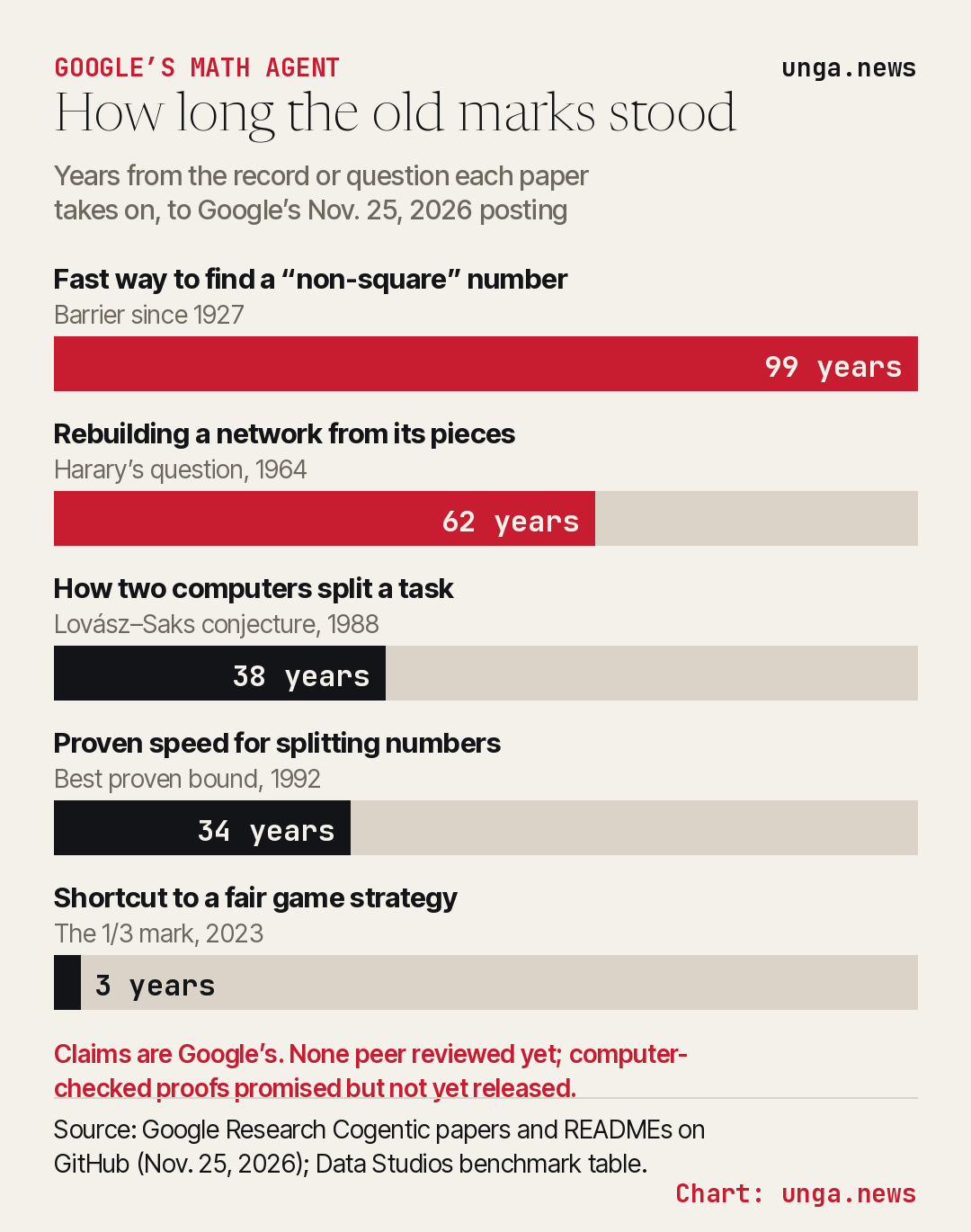
The two headline papers deal with factoring, which means breaking a big number down into the primes that multiply to make it. One claims a method that always finds the answer, with a proven worst-case running time and no assumptions borrowed from unproven math. For more than three decades, the best proven guarantee for this kind of method sat at a level set in 1992. The faster methods code breakers actually use have only ever been backed by educated guesses about how numbers behave. Google’s paper says it closes that gap on paper.
The second factoring paper removes the dice entirely. It describes a method with no random steps at all that still beats the old exponential wall, and it claims the same trick builds a “non-square” number, the kind number theorists need constantly, without leaning on an unproven version of the famous Riemann hypothesis. The paper says that clears a barrier traced to Ivan Vinogradov’s work in 1927 and Burgess’s bounds from 1957 and 1963.
The other four range across the field. One gives a partial answer to Frank Harary’s 1964 question of whether a network can always be rebuilt from copies with one link missing, proving it for every network with at least 1,000 links per point. Another chips at a 1988 puzzle about how much two computers must talk to finish a shared job. One finds a fast, guaranteed recipe for near-fair strategies in two-player games, beating a mark set just three years ago. The last speeds up a code-breaking problem in a special family of number systems.
Your bank password is fine
Any time the words “factoring” and “breakthrough” show up together, people worry about the encryption that protects online banking, because a lot of it depends on big numbers being hard to factor. This doesn’t touch that.
The new proof is about what can be *guaranteed*, not what’s fastest in practice. Its built-in constant is enormous. Data Studios ran the numbers on the standard key sizes and found the proven bound sits thousands of bits of work above the methods already in use. Under those simplified formulas, it only beats the 1992 proven bound on numbers around 60 trillion bits long. The papers themselves claim no faster real-world attack. Nobody has to change a password or rotate a key over this.
What it does change is the scoreboard for SI. A system that can take one sentence and return a rigorous result on a question that stumped specialists for decades is a different animal from a chatbot that writes emails.
The proof is still in the mail
Now the caveat. These are Google’s claims, and nobody outside the company has signed off yet. None of the six papers has been peer reviewed. Each one says a full proof in Lean 4, a language computers use to check math step by step, “has also been completed and will be released in a companion submission.” As of Friday morning those files weren’t posted.
That matters. When Google introduced Cogentic in September, the team said each earlier result “was independently verified by domain experts.” The November papers don’t repeat that line. Instead they lean on the computer-checked proofs, which the public can’t inspect yet. Once those files go up, anyone can run them. If they check out and the formal statements match the plain-English claims, the debate is mostly over.
Google also didn’t oversell it. The folder carries the usual note that it’s “not an official Google product.” Cogentic isn’t in the Gemini app, and paying subscribers can’t use it. Over the last four weeks the team has been posting Cogentic papers one or two at a time. This six-paper batch is simply the biggest drop so far.
America’s lead, in black and white
This lands the same week Reuters reported that China’s top SI labs are slipping months behind as U.S. chip rules cut off the overseas computing they rented. One of Beijing’s flagship models may not ship until 2027. Meanwhile, an American lab is posting research-grade math from a single prompt and putting it on the internet for anyone to tear apart.
That openness is the right call. Real science invites the critics in. If a flaw turns up, it’ll turn up fast, because thousands of mathematicians can now read the papers for free. If the proofs hold, the line between “SI helps a researcher” and “SI is the researcher” just moved, and it moved on American soil.
Sources
- Google Research on GitHub — Add six Cogentic research papers (commit, Nov. 25, 2026)
- Google Research on GitHub — Unconditional Integer Factorization in Time L_N[1/3, O(1)] (README and paper)
- Google Research on GitHub — Unconditional Deterministic Subexponential Integer Factoring and Quadratic Nonresidue Construction
- Google Research on GitHub — Unconditional Edge Reconstruction of Simple Graphs of Linear Density
- Google Research on GitHub — Breaking the Square-Root Barrier for the Log-Rank Conjecture
- Google Research on GitHub — An Exact Polynomial-Time Algorithm for 1/5-Approximate Nash Equilibria in Bimatrix Games
- arXiv — Cogentic: Multi-Agent Orchestration for Automated Proof Discovery (Sept. 30, 2026)
- Data Studios — Google Cogentic on Gemini 4 claims proven L[1/3] factoring in six math papers (Nov. 26, 2026)
- unga.news — China’s Top SI Labs Are Falling Months Behind After America Shut Its Chip Back Door (Nov. 26, 2026)