

China’s Top SI Labs Are Falling Months Behind After America Shut Its Chip Back Door
Two of Beijing’s best-known SI labs are running late on their next big models, Reuters reports, after a new U.S. rule cut off rented chips abroad and American companies blocked copycat training.
For two years China’s SI labs had a cheap trick for keeping pace with America. They rented time on Nvidia’s best chips in data centers outside China, and they fed their own models millions of answers scraped from American chatbots. Both doors are now closing, and it’s starting to show.
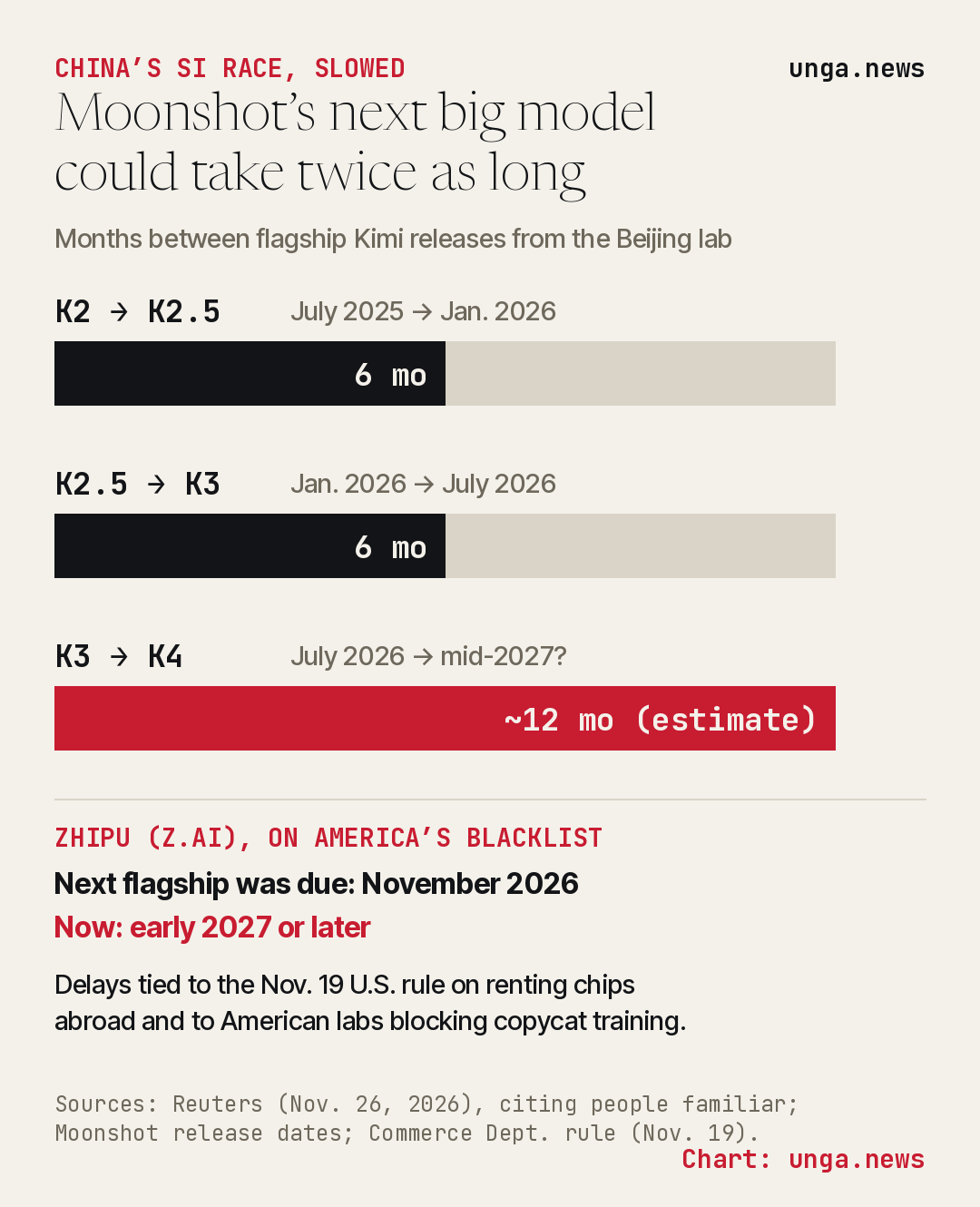
Two of Beijing’s best-known SI labs are falling behind schedule, according to a Reuters exclusive published Thursday. Zhipu, which sells its models under the name Z.AI, planned to release its next flagship model this month. It hasn’t. Moonshot, the lab behind the Kimi chatbot, now expects the time between its major releases could double, from six months to a year or longer, if it loses access to computing power overseas.
Reuters pinned the slowdown on two things: a new Commerce Department rule that took effect Nov. 19, and better defenses at American labs against copycat training. That’s a rare clean result for a policy fight usually argued in hypotheticals. Washington wanted China’s labs to stop building on American technology on the cheap, and the labs themselves are now telling people it’s working.
The rule that closed the rental loophole
For years, America’s chip rules mostly policed shipping. A Chinese company couldn’t legally import Nvidia’s top processors, but it could rent them by the hour from a data center in Malaysia, Singapore or Indonesia and train its models from Beijing. The chips never had to cross a border.
The new rule, published in the Federal Register, goes after that arrangement directly. Any data center anywhere in the world now needs an American license to supply large amounts of computing power to companies headquartered in China or Macau. The cutoff is roughly equal to 750 of Nvidia’s H100 chips, according to Reuters. Data centers already serving those customers got 90 days to get a license or face future export restrictions. Shipping advanced chips to Malaysia, Singapore, Indonesia, Thailand and Brazil now takes a license too, with exceptions for qualifying American companies.
The rule also puts the burden on the data centers to know their customers, including any company quietly owned or controlled from China. It leaves out the recommendation systems online stores and social media apps use, which the department said “do not pose the same national security threat.”
The Commerce Department’s Bureau of Industry and Security said the rule was written at the direction of the Treasury Department and the National Security Council. Its goal, the bureau said, is “to ensure that existing restrictions on access to sensitive American technology cannot be circumvented through remote computing arrangements involving data centers in third countries.”
The ripples showed up fast. Nvidia has told manufacturing partners such as Dell and Supermicro to stop shipping servers with its chips to Malaysia, Singapore, Thailand and Indonesia, the Financial Times reported Thursday, citing three people familiar with the matter. It isn’t clear whether the pause is temporary while companies work out how to comply. One cloud executive in the region told the paper, “It’s causing sheer chaos in the region.” Bankers backing a Singapore cloud project meant to rent computing power to ByteDance, TikTok’s Chinese owner, stopped issuing about $500 million in credit, the FT reported.
Moonshot feels it first
Moonshot is the most exposed, Reuters reported, because it rents the computing power it uses to train its models and prefers overseas providers. A person familiar with its operations said the computing capacity available inside China couldn’t make up the shortfall.
Moonshot released Kimi K2 in July 2025, K2.5 in January and K3 in July, a steady six-month rhythm. The next one, Kimi K4, could slip to around the middle of 2027, the person estimated. The Information reported last week that Moonshot scrapped a $150 million deal to use Nvidia’s newest Blackwell chips through an Indonesian data center.
The lab is now hunting for workarounds. It has stepped up efforts to rent computing power in Europe and plans to approach Chinese chipmakers about training on their processors, Reuters reported.
Zhipu is in a similar spot. Its next flagship, GLM-5.5, was designed at roughly 3 trillion parameters, a rough measure of a model’s size. One person told Reuters it was held up partly by stronger defenses against copycat training, and the new computing limits could push its launch into the first quarter of 2027 or later. On Monday Zhipu put out a stopgap, GLM-5.4, built on an older 750-billion-parameter model that the company claims rivals models up to four times bigger. Washington already has Zhipu on its trade blacklist over ties to China’s military.
Copying American chatbots got harder
The second door is what the industry calls distillation. A lab asks a smarter model millions of questions, saves the answers and uses them to train its own model. It’s far cheaper than building the smarts from scratch, and it has been a big part of how Chinese labs matched American models at a fraction of the cost.
Anthropic, the company behind Claude, laid out the scale in a September threat report. It tied nearly 200 million exchanges with Claude to five campaigns it attributed to Chinese labs. One it pinned on Alibaba ran to 151 million exchanges between May and July, spread across 3,500 accounts. In a campaign attributed to Moonshot, nearly 300,000 requests came in over 10 days through a network of about 5,000 accounts, and one asked Claude to judge whether a person on surveillance camera footage was “behaving abnormally.”
“Over the last several months, unauthorized labs have developed increasingly sophisticated methods to circumvent our defenses and harvest the capabilities of US frontier models,” Anthropic wrote, according to TechCrunch. OpenAI has made similar accusations against people tied to Moonshot and has described its own efforts to shut that copying down.
Moonshot has denied it. In July it told China’s National Business Daily that its Kimi K3 gains came from original changes to the model’s design. But Reuters’ source said that as answers from Anthropic and OpenAI became harder to get, Moonshot started distilling from Google’s and Meta’s models instead. Zhipu and Moonshot didn’t immediately respond to Reuters, and Google and Meta didn’t either.
That last detail tells you the job isn’t finished. Close one American well and the copying moves to the next. Still, for an administration that bet on cutting off China’s shortcuts instead of selling Beijing the tools to catch up, a six-month cycle turning into a year is exactly what winning the SI race looks like. Every month China’s top labs spend waiting on chips is another month America’s companies spend building.
Sources
- Reuters — Exclusive: US chip curbs, distillation crackdown threaten Chinese AI model development, sources say (Nov. 26, 2026)
- Federal Register — Addressing Remote Access to Advanced Semiconductors, interim final rule (Nov. 19, 2026)
- Bureau of Industry and Security — BIS Issues Rule Addressing Remote Access to American Super Intelligence Technology (Nov. 16, 2026)
- Financial Times (via CNA) — Nvidia halts chip shipments to Southeast Asia (Nov. 26, 2026)
- TechCrunch — Anthropic details distillation campaigns from Alibaba, Moonshot AI, and DeepSeek (Sept. 10, 2026)
- unga.news — Trump’s Chip Crackdown Just Forced the World’s Two Biggest Chipmakers to Cut Off China (Nov. 19, 2026)