

Trump’s Chip Crackdown Just Forced the World’s Two Biggest Chipmakers to Cut Off China
TSMC and Samsung paused some Chinese orders after a new Commerce rule closed the loophole that let Beijing’s designers get cutting-edge chips made without U.S. approval.

Taiwan’s TSMC and South Korea’s Samsung, the two companies that make most of the world’s most advanced chips, have started telling Chinese customers no. The reason is a Commerce Department rule that took effect Thursday, and it may be the most effective blow the Trump administration has landed yet on Beijing’s push to build its own super intelligence hardware.
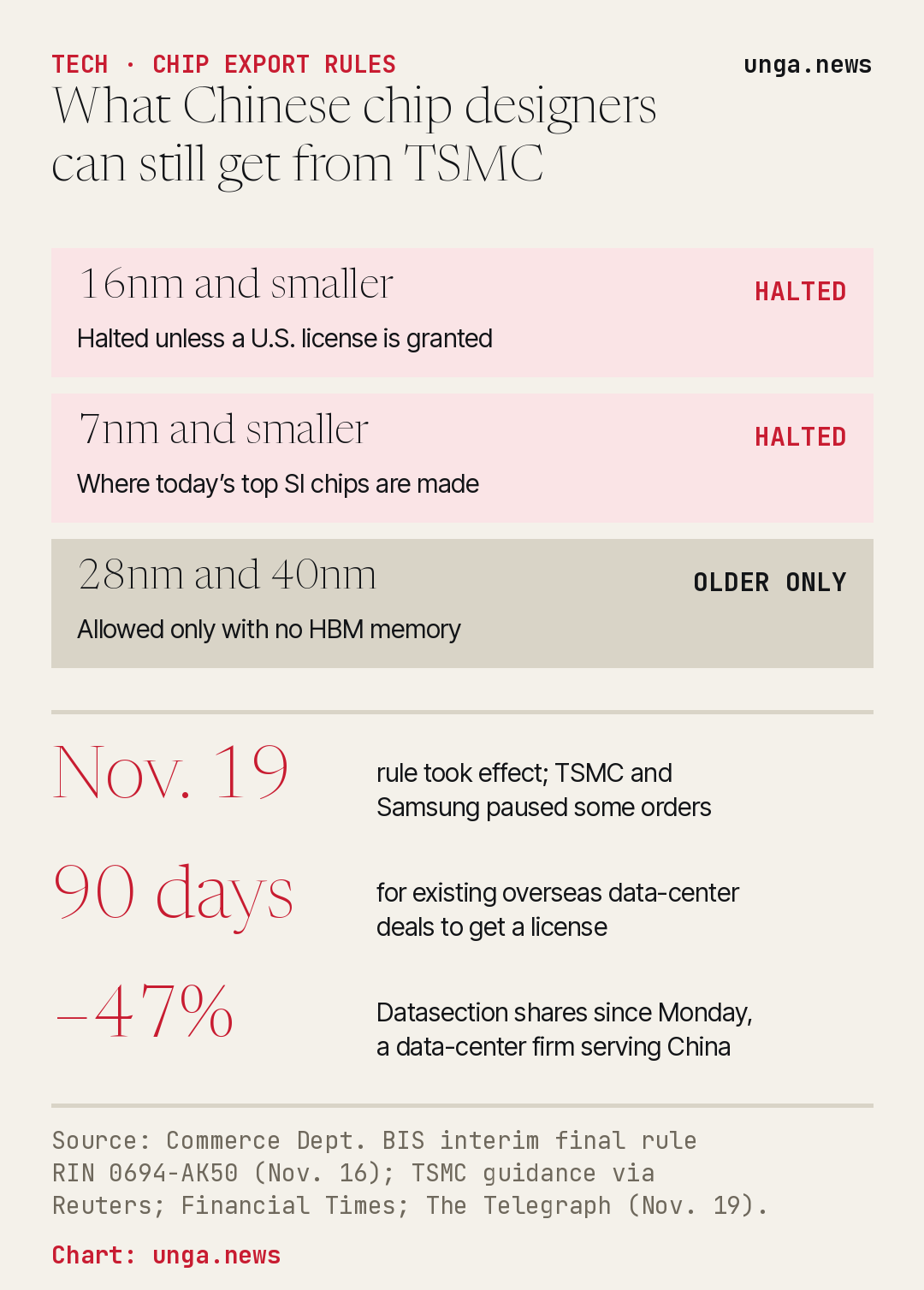
TSMC has ordered a halt to affected Chinese orders made on its 16-nanometer process and anything smaller unless the customer gets a U.S. export license, Reuters reported Thursday, citing two people who saw the company’s guidance. Chinese designers are being pushed back to older 28- and 40-nanometer lines, and only if their chips skip high-bandwidth memory and advanced packaging. The Financial Times first reported that both TSMC and Samsung had notified Chinese customers they were pausing some shipments while licenses are sought.
That is a big deal for one simple reason. Most leading SI chips are built on 7-nanometer processes or smaller. A Chinese designer stuck at 28 nanometers is a Chinese designer stuck a generation or more behind.
The rule that did it
On Nov. 16, the Commerce Department’s Bureau of Industry and Security put out an interim final rule titled “Addressing Remote Access to Advanced Semiconductors.” The BIS announcement says it was “written by and at the direction of the Department of Treasury and the National Security Council” and is meant to make sure existing limits on sensitive American technology “cannot be circumvented through remote computing arrangements involving data centers in third countries.”
unga.news covered that rule the day it landed, when the headline was Chinese companies renting U.S. chips through data centers overseas. What is new now is the second shoe. The same rule reaches the factories. According to the text published in the Federal Register, data centers, foreign foundries and chip exporters must now run real due diligence on their customers, including any direct or indirect ownership or control by companies in China or other countries of concern.
The rule also adds a license requirement for advanced chips headed to Indonesia, Malaysia, Singapore, Thailand and Brazil, which the government calls higher-than-normal risks for diversion. Overseas data centers that hand out large amounts of computing power to Chinese-headquartered companies need a license too, and existing deals get 90 days to come into line. Ordinary recommendation engines, like the ones online stores and social media apps use, are carved out.
The loophole that just closed
Here is how the old system worked. TSMC was allowed to look at the computing power and other specs of a Chinese chip design and decide for itself whether the chip fell outside U.S. controls. If it did, the order went through without Washington ever signing off.
Under the new rule, TSMC can no longer use that check for affected Chinese customers, Reuters reported. Their advanced chips are now presumed to be covered, which means a license unless an exception applies. The company’s guidance also calls for closer scrutiny of customers’ locations, parent companies, major shareholders, packaging providers and shipping routes, including orders that come in through subsidiaries in Taiwan, the United States, Europe, Japan and Southeast Asia.
The Asia Business Daily, citing the FT, reported that the fix also kills an old excuse. Chinese firms could previously argue a chip was meant for a phone or some other non-SI use. That exemption is gone, which is why even some consumer electronics shipments are on hold. TSMC makes phone chips for Xiaomi, Oppo and Vivo. Samsung’s Chinese customers include Baidu’s chip unit Kunlun and ByteDance, the company behind TikTok.
A U.S. government list of approved chip designers includes Nvidia, AMD, Apple, MediaTek and Realtek, Reuters reported. It includes no mainland Chinese companies.
Who is feeling it
The pain showed up fast. Shares in Japan’s Datasection, a data-center operator with business tied to China, have fallen 47% since Monday, and the company has warned its annual revenue could come in 89% below forecast, The Telegraph reported. Tencent president Martin Lau put it bluntly: “It sets everyone back in China.”
That quote is the whole story. For years, American export controls looked tough on paper while Chinese companies found side doors. They rented chips in Malaysia. They routed orders through middlemen. They told foundries their chips were for phones. Each workaround kept China closer to the front of the race than Washington intended.
The timing also matters. The rule came out days before President Trump arrived in China to meet Xi Jinping, and it came after the Nvidia scandal that pushed out Jensen Huang and put a Singapore data-center firm under a Justice Department criminal investigation. The administration could have softened the rules to smooth the summit. It did the opposite.
What to watch
Licenses are not bans. Some Chinese orders could still go through if Commerce approves them, and the agency now holds that decision instead of a factory compliance desk in Taiwan. Expect Beijing to lean harder on its own foundries and to complain loudly about American overreach.
For U.S. chip designers, the near-term picture looks better. Customers who want leading-edge manufacturing without a license fight have an obvious place to go, and it is the list that starts with Nvidia, AMD and Apple. The chips that run the future are still being designed here. As of Thursday, the factories that make them have to act like it.
Sources
- Bureau of Industry and Security — BIS Issues Rule Addressing Remote Access to American Super Intelligence Technology
- Federal Register — Addressing Remote Access to Advanced Semiconductors (interim final rule, RIN 0694-AK50)
- BIS — Interim final rule text (PDF)
- Reuters — TSMC tightens China AI chip curbs as new US rules close manufacturing loophole, sources say
- The Telegraph — Chip giants suspend shipments to China in threat to Xi’s AI ambitions
- The Asia Business Daily — U.S. Tightens AI Chip Export Controls... Samsung Electronics, TSMC Halt Chip Shipments to Chinese Customers