

Hackers Got Inside the Treasury Office That Collects Banks’ Reports on Your Money
The federal office that stores millions of bank reports on Americans’ cash deals and odd transfers says intruders reached some of its systems. Its own order shows filing trouble began six days before anyone was told.
Every year, American banks send the federal government tens of millions of reports about their customers’ money. Big cash deposits. Wire transfers that look odd. Accounts a teller flagged as suspicious. All of it lands in one place: a little-known Treasury Department office called the Financial Crimes Enforcement Network, or FinCEN.
Now somebody has been inside it.
FinCEN said Tuesday evening that it is “investigating a cybersecurity incident that resulted in unauthorized access to a limited subset of its systems.” The notice went up on the website banks use to file their reports, and The Verge first reported it. “As a proactive measure, FinCEN has taken some systems offline,” the alert said. “The BSA E-Filing website remains operational; however, some services may be temporarily unavailable.”
That’s about all the government has said. FinCEN hasn’t named who got in, how they got in, which systems they reached or whether any records walked out the door. No hacking group has claimed it.
Six days of quiet
The paperwork tells a longer story than the alert does. The same day it disclosed the break-in, FinCEN put out a formal order, FIN-2026-R002, granting “temporary, limited exceptive relief in response to a service disruption that is hindering filers’ ability to adhere to reporting obligations.”
Look at the dates in that order. It covers reports “otherwise due between November 18, 2026 and December 29, 2026,” and gives filers until December 30 to catch up.
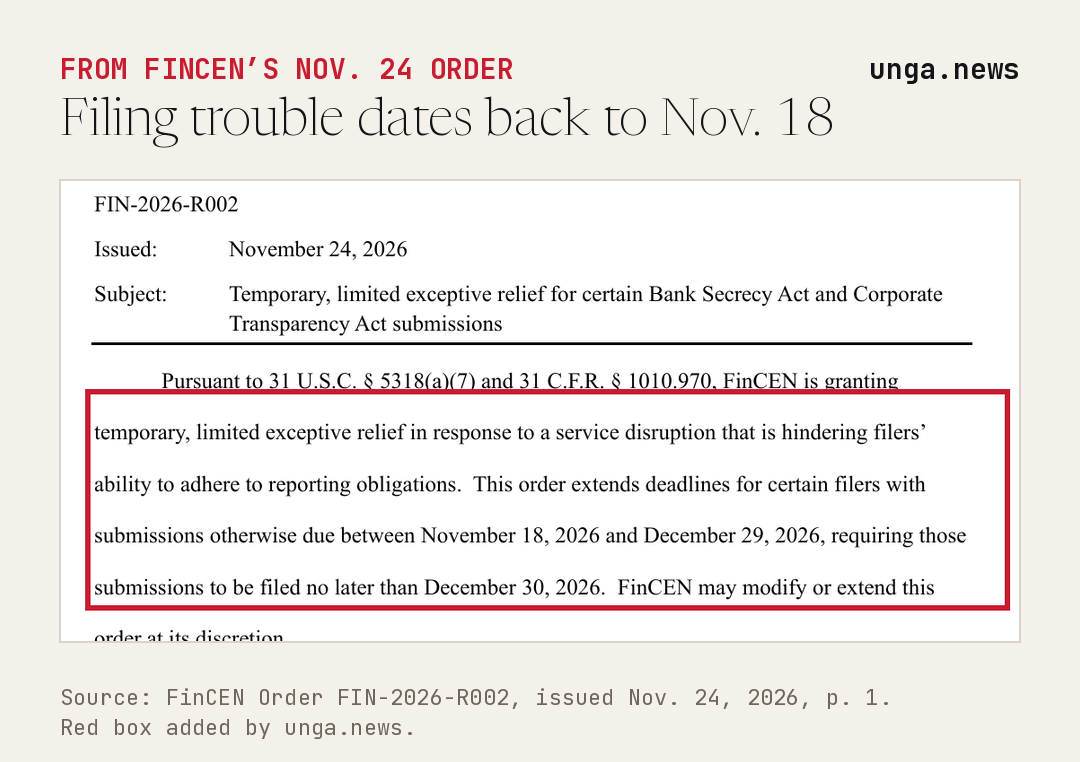
So the filing trouble reached back to last Wednesday, Nov. 18, six days before the public heard a word. FinCEN hasn’t said whether the break-in caused that disruption or whether pulling systems offline did, and it hasn’t said when the intruders first got in. But a federal agency doesn’t usually reach back nearly a week in a relief order unless the problem started then.
The order singles out banks that send reports through Secure Data Transfer Mode, the automated pipeline big institutions use to push thousands of filings at once instead of typing them in by hand. Those banks, the order says, still have to keep watching for suspicious transactions. For anything urgent, FinCEN pointed them to its Financial Institutions Hotline, which it says “is not impacted by this service disruption.”
A vault of everyday Americans’ money trail
This break-in hits closer to home than most government hacks. FinCEN is basically the federal government’s filing cabinet for your money trail.
By FinCEN’s own count in its latest Year in Review, banks and other businesses filed 4.8 million suspicious activity reports and 21.5 million cash reports in fiscal 2025. A cash report gets filed any time someone moves more than $10,000 in cash. That’s not drug lords. That’s car dealers, contractors, restaurant owners and folks buying a used truck.
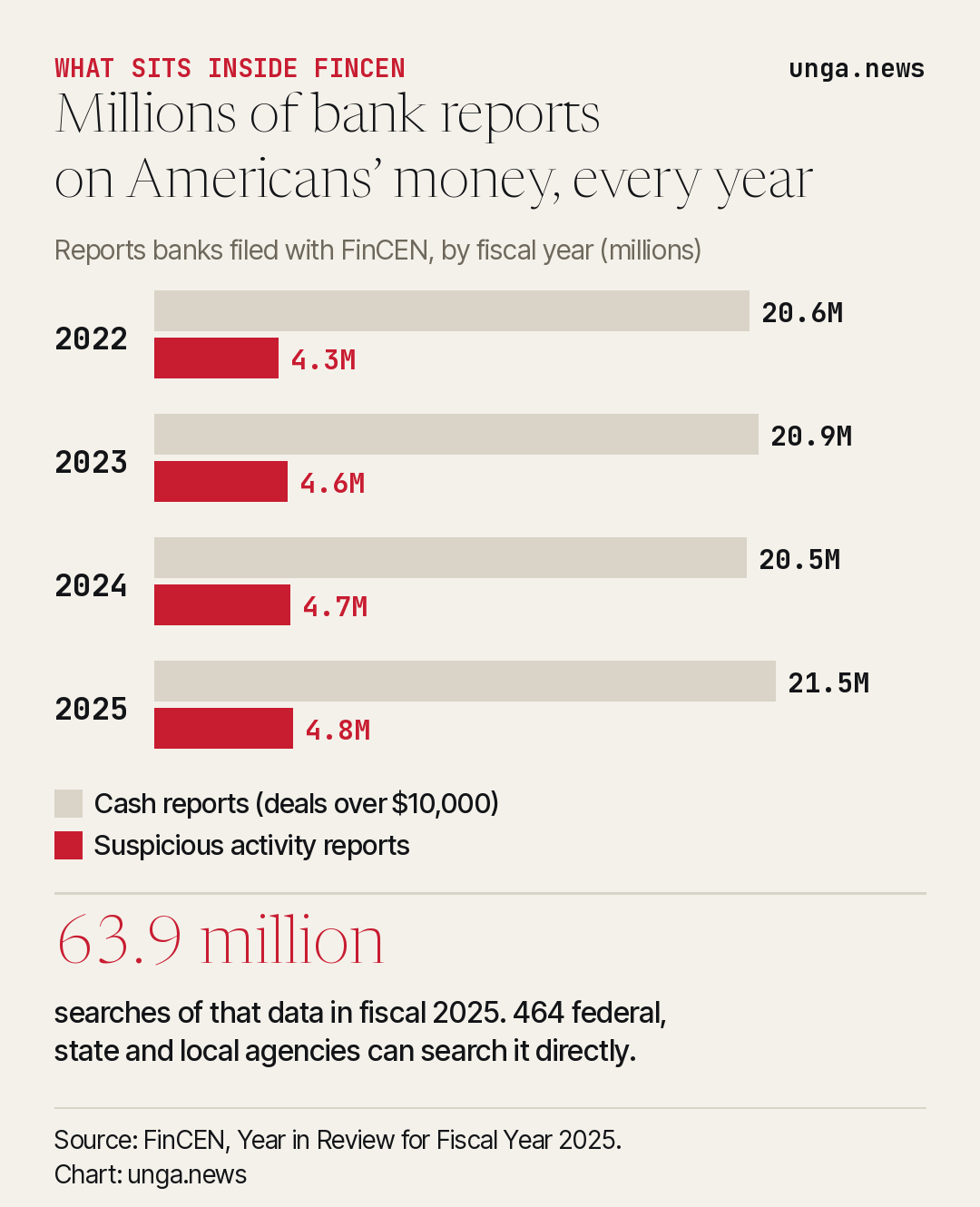
Those reports carry names, addresses, Social Security numbers, account numbers and a banker’s notes on why something looked off. Plenty of people named in them never did anything wrong and will never know a report exists. FinCEN says 464 federal, state and local agencies can search the database directly, and the data got searched more than 63.9 million times in that one year.
To a foreign spy service, that’s a gold mine. It shows who moves money, where and with whom. It shows which accounts American investigators are watching, which tells a criminal network or a hostile government exactly which of its people have been spotted.
Conservatives saw this risk coming
Republicans have warned for years that Washington collects far too much on law-abiding people’s finances, and they had receipts. In March 2024, the House Judiciary Committee under Jim Jordan released a report finding that after Jan. 6, FinCEN shared materials with banks pointing them to search customers’ transactions for terms like “MAGA” and “TRUMP,” and to flag purchases at sporting-goods stores such as Cabela’s, Bass Pro Shops and Dick’s Sporting Goods.
The argument back then was about who in our own government could read that data. This week adds a second problem. Every record the government piles up is one more record a hacker can steal. A database that big doesn’t just tempt bureaucrats. It tempts Beijing.
The Trump Treasury has already cut part of that pile down. In March 2025, Treasury announced it would stop enforcing the Biden-era beneficial ownership rule against American citizens and domestic small businesses, and an interim rule then exempted U.S. companies from filing. Under the Biden plan, tens of millions of small business owners would have had to hand FinCEN their home addresses, birth dates and copies of their driver’s licenses or passports. That information would now be sitting in the same agency that just got broken into. The ownership reports FinCEN still takes, which the new order also delays, come mostly from foreign-registered companies.
Part of a rough month
FinCEN’s notice came hours after word broke that hackers got into an unclassified computer system used by the CIA and the Office of the Director of National Intelligence, which unga.news covered Tuesday. Before that, the FBI’s crime-information database was hit. Nobody in government has tied the FinCEN break-in to either one, and it would be wrong to assume they’re connected.
Treasury has been a target before. In December 2024, under the Biden administration, the department disclosed that Chinese state-backed hackers had gotten in through a compromised outside remote-support tool and reached employee workstations and unclassified documents.
For regular folks, there’s nothing to do yet. FinCEN holds reports about people, not their logins, and it hasn’t said any personal records were taken. Your bank account isn’t suddenly exposed, and you can’t change anything about a report you never knew existed. The people who need answers right now are the ones in charge of protecting that database.
Two of them stand out. How did someone get inside a system holding millions of Americans’ financial records? And why did the public hear about it six days after the trouble started? Treasury owes taxpayers both answers, and the more data Washington insists on collecting, the faster it owes them.
Sources
- FinCEN — Order FIN-2026-R002: Temporary, limited exceptive relief for certain Bank Secrecy Act and Corporate Transparency Act submissions (Nov. 24, 2026)
- FinCEN — Temporary, Limited Exceptive Relief for Certain Bank Secrecy Act and Corporate Transparency Act Submissions (Nov. 24, 2026)
- The Verge — US financial crimes bureau discloses ‘cybersecurity incident’ (Nov. 24, 2026)
- ABC News — Treasury’s FinCEN says ‘cybersecurity incident’ includes ‘unauthorized access’ of some systems (Nov. 25, 2026)
- FinCEN — Year in Review for Fiscal Year 2025
- House Judiciary Committee — Financial Surveillance in the United States: How Federal Law Enforcement Commandeered Financial Institutions to Spy on Americans (March 2024)
- unga.news — First the FBI, Now the CIA: Hackers Broke Into a Spy Agency Computer System (Nov. 24, 2026)