

First the FBI, Now the CIA: Hackers Broke Into a Spy Agency Computer System
Hackers got into an unclassified system the CIA and the nation’s top intelligence office use to study public information. Officials say no secrets were touched, but experts warn it could show enemies what America’s spies are watching.
The people whose job is to spy on America’s enemies just found out somebody was poking around inside one of their own computer systems.
The CIA and the Office of the Director of National Intelligence (ODNI) discovered a breach of an unclassified system their analysts use to sift through public and commercially available information, according to people familiar with the matter. The New York Times first reported it Tuesday, and CyberScoop, the Associated Press and Nextgov/FCW each confirmed it. The Times also reported that the National Geospatial-Intelligence Agency, the spy agency that handles satellite imagery and maps, was hit at the same time.
Start with the good news, because it’s real. The nation’s secrets appear to be safe. “The hack did not involve our classified networks or classified information, and no other systems are currently at risk,” a source told CyberScoop. A person who spoke to the AP said the issue “has been resolved.” A second source told Nextgov/FCW the intrusion disrupted an unclassified network but did not touch classified systems.
What nobody has said yet is who did it, how they got in, or whether they walked away with anything. The CIA declined to comment. ODNI didn’t answer reporters on Tuesday.
The sticky notes on the desk
“Unclassified” sounds like nothing to worry about. People who defend networks for a living say that’s the wrong read. The system that got hit supports what intelligence pros call open-source intelligence: news reports, social media, satellite pictures and paid data feeds. The raw material isn’t secret. What America’s analysts choose to do with it is.
“Calling this ‘unclassified’ doesn’t make it harmless,” said Ben Bernstein, a manager of cybersecurity advisers at the security firm Huntress. “The value for an adversary is seeing what the CIA and ODNI are doing with it. If you can see what analysts are searching for and what topics they’re tracking, you get a solid look at U.S. intelligence priorities and blind spots without ever touching a classified file.”
Aleksandr Yampolskiy, co-founder and CEO of SecurityScorecard, put it the same way to Nextgov/FCW. “Depending on what was exposed, an adversary could learn not only what our intelligence agencies know, but also where their investigative priorities lie and where gaps in their intelligence may exist,” he said.
Think of a burglar who can’t crack the safe but gets a long look at the sticky notes on the desk. If Beijing or Moscow can see which countries, companies and people American analysts are digging into, it learns what Washington is worried about, and maybe what it’s missing. Bernstein added that these systems are hard to lock down because “they have to stay open to the public internet to do their job.”
A break-in tool built in China
The most alarming detail came from Nextgov/FCW. It reported that ARTEX, an SI tool developed by a Chinese cybersecurity engineer who goes by “Autumn-27,” is believed to have been used in the breach. The outlet described ARTEX as a program that “automatically finds and breaks into computer systems” and said it has recently become a favorite of criminal hackers.
Two people told the outlet that hackers also used ARTEX in a recent intrusion into the Defense Department’s Cyber Defense Command, though one called that break-in low-impact. It isn’t clear whether the two attacks are connected.
That is the threat in one sentence: a cheap SI program out of China that hunts for weak spots on its own, faster than a room full of human hackers could. Director of National Intelligence Jay Clayton warned about exactly this last week, telling Congress that agencies and companies have sharply sped up upgrades to close holes that powerful new SI tools can find and exploit.
A rough few months for federal computers
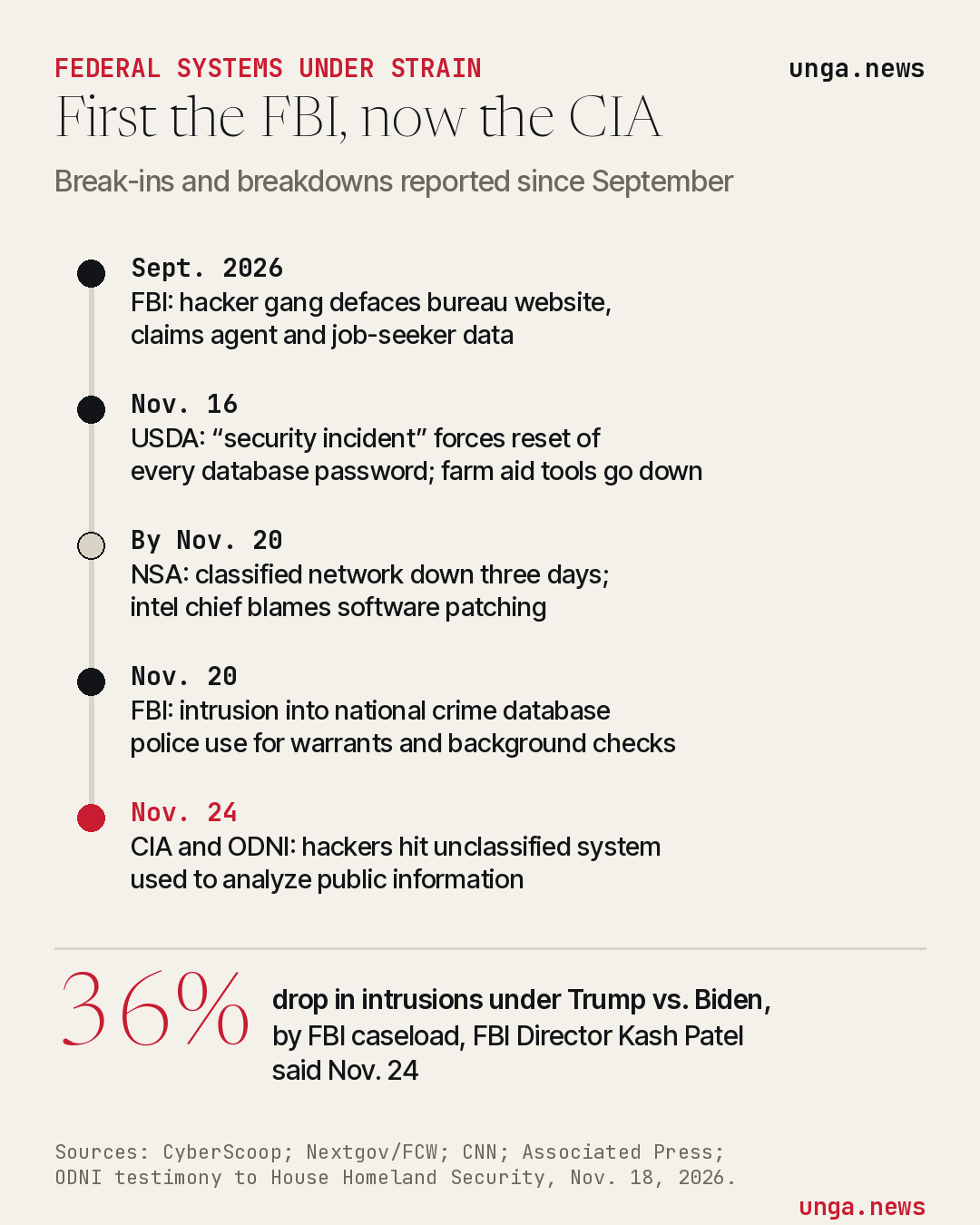
The CIA breach lands on top of a stack. In September, the hacker gang ShinyHunters defaced an FBI website and claimed it stole information on FBI agents and job seekers. On Nov. 16, the Agriculture Department’s cyber team found a “security incident” that forced a reset of every database password and knocked out tools farmers rely on for loans and aid. The NSA’s classified communications network went down for three days before coming back Friday, which Clayton blamed on software patching. And last Friday, CNN reported an intrusion into the FBI’s national crime database, the system police use to check warrants and run background checks.
FBI Director Kash Patel was asked about that one at a Justice Department news conference Tuesday. “We’ve publicly released, as we always do, information we are permitted to at this time, but it’s an ongoing investigation,” he said, adding that the bureau is working with other agencies and will make information public through the Justice Department or Congress.
Patel also pushed back on the idea that things are getting worse. He said intrusions are “down 36% based on FBI caseload” under President Trump compared with Joe Biden. Trump, for his part, said of the FBI database hack, “I don’t like that. But maybe we will learn things that we would’ve never learned otherwise.”
Clayton has been the most direct about why so much is breaking at once. “A great deal of our digital infrastructure is dated. It is old. It has been built out over three decades or more,” he told CNN on Sunday, as we reported then. Rip out 30 years of old plumbing in a hurry and some pipes will burst. Leave it in place and the next ARTEX walks right through it.
Holes in the roster, too
The administration is also rebuilding its cyber bench. Trump will nominate Kirsten Davies, the Pentagon’s former chief information officer, as national cyber director after Sean Cairncross left the job. Clayton is filling the post on an acting basis until the Senate confirms her. A White House official cited “the overwhelming support Kirsten received from industry and across government.”
Trump’s pick to run the Cybersecurity and Infrastructure Security Agency, Palantir security chief Michael LoSapio, is another story. Multiple senators have put holds on his nomination that could push his confirmation into next year, and Democrats called him “disqualified” after his hearing last week.
That’s the part worth sitting with. Hackers armed with a Chinese-built SI tool are knocking on the doors of America’s spy agencies, and the Senate is in no hurry to seat the man picked to guard them. The CIA got lucky this time. The secrets stayed locked. Washington shouldn’t bet on that twice.
Sources
- CyberScoop — Unclassified intel system hit by hackers, affecting CIA, ODNI (Nov. 24, 2026)
- Associated Press — An unclassified CIA system was breached in a cyberattack, AP source says (Nov. 24, 2026)
- Nextgov/FCW — CIA, ODNI unclassified intelligence system hacked (Nov. 24, 2026)
- The Washington Post — Hackers breach CIA unclassified computer system (Nov. 24, 2026)
- CyberScoop — Patel mum on FBI crime info database hack, citing ongoing investigation (Nov. 24, 2026)
- CyberScoop — Kirsten Davies to become national cyber director nominee, Jay Clayton takes acting director job (Nov. 23, 2026)
- CNN (Evan Perez) — The FBI was hacked again, this time the breach targeted its crime database (Nov. 20, 2026)
- Nextgov/FCW — USDA grapples with security breach as IT staff take multiple systems offline (Nov. 2026)