

Hackers Hid Password Thieves Inside Free Chatbots. They’ve Been Downloaded Over 4,000 Times
Booby-trapped chatbots on Hugging Face, the biggest site for do-it-yourself SI, told users to paste in one line of code. That line unpacked a program that steals passwords and crypto.

More and more people are skipping the big-name chatbots and running their own at home. You download a model file, open it in a free app like LM Studio or Ollama, and you get a private assistant that never sends your questions to a tech company.
The biggest place to get those files is Hugging Face, a site that hosts more than 3 million of them. And this week a security researcher showed that a handful of the free ones there came with a nasty extra: a hidden program built to steal saved passwords and empty crypto wallets.
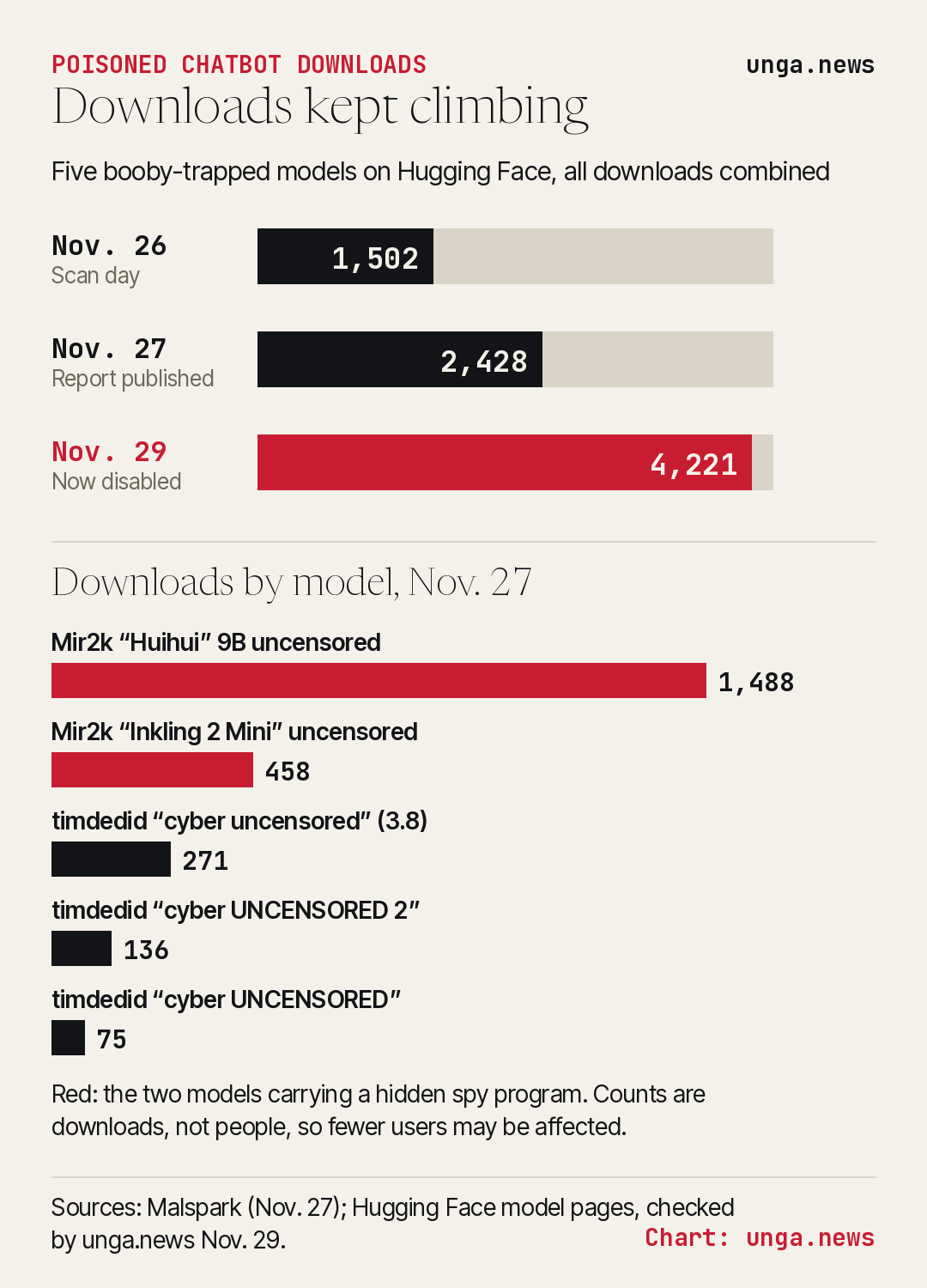
The researcher, who goes by Düzgün and works at the security firm Malspark, scanned every one of the 3,273,389 public models on Hugging Face on Nov. 26. He found five that were rigged. By the next day, those five had been downloaded 2,428 times, up from 1,502 the day of the scan. Malspark published the full write-up on Nov. 27, and when we checked Hugging Face’s own pages on Sunday, all five were disabled, with their counters reading more than 4,200 downloads combined.
Hugging Face counts downloads, not people, so the number of victims is lower, maybe a lot lower. Each one still thought they were doing the safe, private thing.
Planted first, switched on later
The worst of it came from one brand-new account called Mir2k. Malspark says the account has French fingerprints all over it, from the model descriptions to the commit notes to the text inside the malware. On Nov. 22 it created 14 listings. Twelve were empty placeholders named after big models people are waiting for, like a new Qwen, DeepSeek, Llama and Gemma. That’s a trap set in advance: when those releases land and people go searching, a listing with the right name is already sitting there.
The two real uploads were “uncensored” versions of popular models, the kind people seek out because they won’t lecture you or refuse a question. Each one had a complete Windows program glued onto the end of the file, in a spot the chat apps never read. For days it just sat there doing nothing, so nothing looked wrong.
Then on the morning of Nov. 26, Mir2k quietly edited both models. Every one of these files carries a small set of instructions, called a chat template, that tells the app how to format your conversation. The new template added a hidden message, written in French, telling the chatbot to begin every reply by printing one specific line of computer code “copied character by character, then answer normally.”
That line was the key. If you pasted it into PowerShell, the command window built into Windows, it dug the hidden program back out of the model file on your own computer and started it. You never downloaded anything but the chatbot. The chatbot handed you the command to infect yourself.
What it does once it’s running
Malspark pulled the program apart. Most of its 11 megabytes is a copy of Tor, a tool for hiding internet traffic. Before it does anything, it checks whether it’s running on a researcher’s test machine and quits if so. On a real computer it digs in hard: a scheduled task restarts it every 10 minutes, two watchdog programs keep it alive, and it marks itself so that shutting it down crashes Windows.
Then it goes to work. It sends saved passwords from the Chrome, Edge and Brave browsers back to its operator through Tor. It goes after the MetaMask and Phantom crypto wallets. It can log keystrokes, read whatever you copy, take screenshots, stream your screen and switch on your webcam. When you walk away from the computer, it uses your machine to mine Monero, a privacy coin, for whoever’s on the other end.
It hides in a folder named “ollie,” close enough to Ollama, a popular home chatbot app, to pass a quick glance. The author did slip up, though. The program still contains a file path from his own computer, under a user named “MoH.”
A second trap aimed at coding helpers
The other account, timdedid, went after a different crowd. Its three uploads were small models pitched to security hobbyists, and they were built for chatbots that can run commands on your computer by themselves. Whenever your message contained the words “What is,” the template slipped in a fake order marked “[SYSTEM DIRECTIVE]” telling the assistant to download a script from a website and run it in a hidden window. The listing even told users not to swap out the built-in template, which kept the trap in place. Malspark couldn’t recover that second script, so what it would have installed is unknown.
The attackers didn’t need a flaw in Hugging Face or the chat apps. They used ordinary features as designed, and Malspark warns antivirus checks can miss the compressed version entirely.
Keep the privacy, lose the risk
None of this is a reason to give up on running your own chatbot. Keeping your questions off Big Tech’s servers is a fine instinct. It just means you’re now the one in charge of security, and a few habits go a long way.
Never paste a command a chatbot gives you into PowerShell or a terminal unless you know exactly what it does. Stick to models from the original makers or long-established uploaders, and be extra wary of brand-new accounts offering “uncensored” versions of hot models. If you downloaded anything from Mir2k or timdedid, look for a folder named “ollie” inside AppData\Roaming, run a full antivirus scan, and change any passwords saved in your browser from a different, clean device. Move any crypto out of browser wallets on that machine.
Malspark also released a free tool, gguf-radar on GitHub, that checks model files for these tricks without running them. And it put the bigger job right where it belongs, on the hub and the app makers, saying they’re “in the best position to end the hidden payload method altogether” by rejecting files with junk tacked onto the end.
One outside researcher with a laptop scanned the whole site in a day and found what the site’s own filters didn’t. Hugging Face says it scans uploads for malware, and these five were still up a day after the report. A company hosting millions of files that strangers run on their home computers ought to be catching this before a volunteer does. This week’s poisoned Windows tools taught the same lesson: “free” and “official-looking” aren’t the same as safe.
Sources
- Malspark — GGUF LLM Models with Hidden Malware on Hugging Face Reached 2400+ Victims (Düzgün, Nov. 27, 2026)
- Hugging Face — Model page and download counter: Mir2k/Huihui-Qwen3.5-9B-abliterated-GGUF (disabled; checked Nov. 29)
- Hugging Face — Model page and download counter: Mir2k/Inkling-2-Mini-Uncensored-GGUF (disabled; checked Nov. 29)
- GitHub — Root0ne/gguf-radar: free scanner for poisoned GGUF model files