

Hackers Hit the Company Behind the SAT Over Thanksgiving. Its College Aid Form Is Shut Down.
Students got surprise password-change emails on the holiday. The College Board blames hackers armed with powerful new tools, and its private college aid form is offline with deadlines days away.
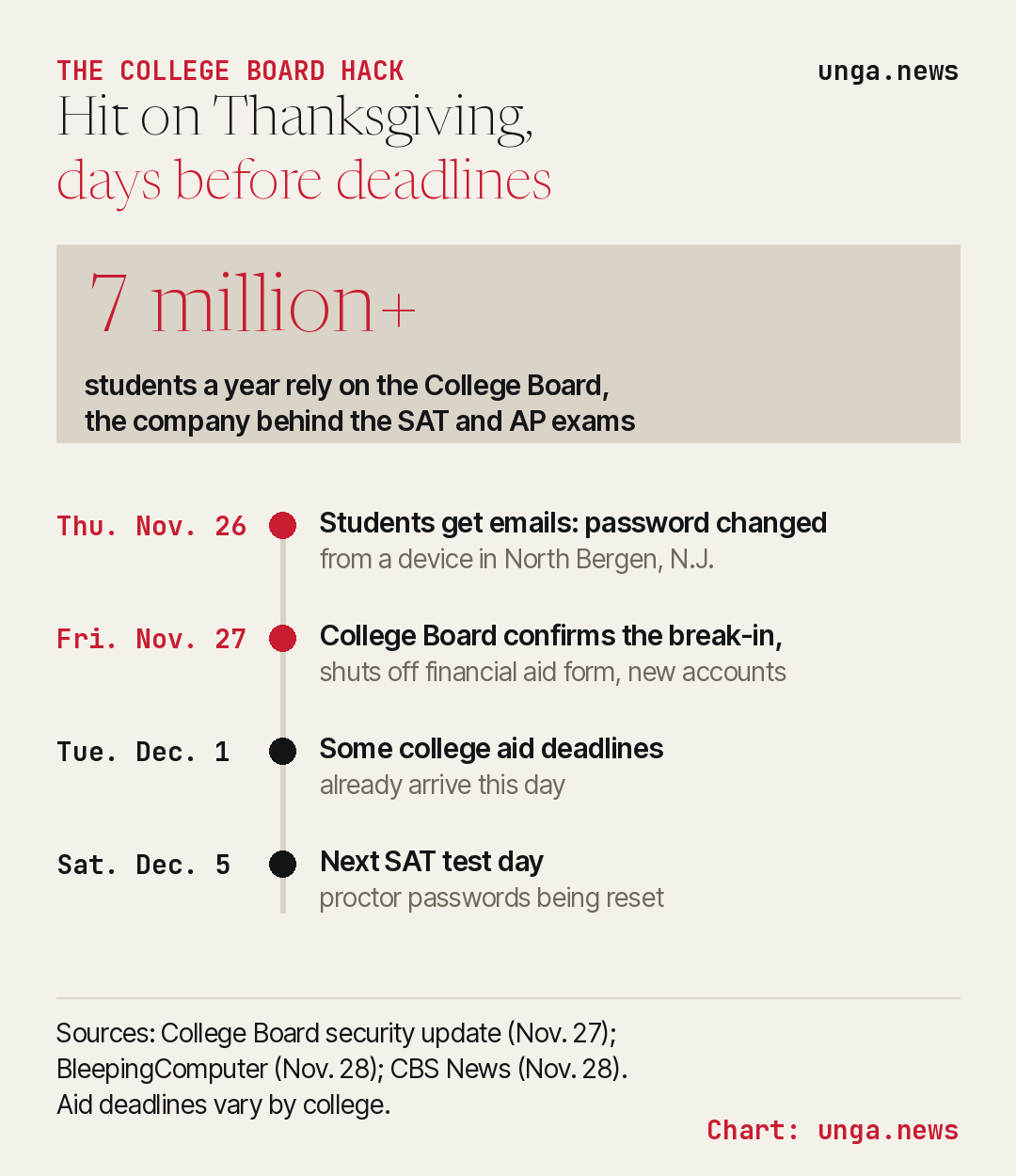
Some high school seniors spent Thanksgiving getting an email nobody wants: your password has been changed. They hadn’t changed anything. By Friday the College Board, the company behind the SAT and AP exams, confirmed that hackers had gotten into its systems, and it shut down the financial aid form that hundreds of colleges use to hand out their own grant money. For families racing December deadlines, the timing could hardly be worse.
The College Board posted a security update on Nov. 27 saying it had found “unauthorized activity affecting certain user accounts and College Board products.” The intruders got into the systems students and school staff use to open new accounts and to submit the CSS Profile, the online aid application. The access, the company said, let them see “basic account information for a subset of users and to initiate password resets in some cases.”
Then came the line that should get everybody’s attention. “Our preliminary assessment is that this activity involved sophisticated AI tools that have recently been leveraged to gain access to the systems of other major institutions worldwide,” the College Board wrote.
A break-in through the side door
The company gave more detail to BleepingComputer, the security news site that first broke the student reports. The hackers used SI-powered tools to find a weakness in the sign-up page for professional accounts, the kind used by school counselors and test proctors, and used it to get inside. A spokesperson said only a small share of users was hit and that names and email addresses were among the information exposed.
There is a second problem. The College Board told BleepingComputer that an outside vendor that stores submitted financial aid information was breached at the same time, in an attack it believes is connected. What was taken from that vendor is still under investigation. That matters, because the aid file is where the sensitive stuff lives. The CSS Profile and its document service, called IDOC, collect Social Security numbers, household income, assets and tax returns.
One parent told BleepingComputer that their son got a Thanksgiving email saying his password had been changed from a device in North Bergen, New Jersey. The boy had already filed his CSS Profile and uploaded the family’s tax returns. “We have no way of knowing how long an unauthorized individual had access to his account or whether any of this information was accessed or downloaded,” the parent said. Students on Reddit reported the same thing, with the change logged from the same New Jersey town. Some couldn’t get back in at all, and the company’s help line was closed for the holiday.
The College Board does say what wasn’t touched. It has “no evidence of improper access to our repository of test scores and content,” meaning SAT and AP scores and test questions appear safe. People with existing accounts can still log in, though with limited features. New accounts can’t be created, and the CSS Profile is offline until the company says it is safe. The company told Fox News Digital it has notified the FBI.
Deadlines don’t take the holiday off
This is a big deal for families paying for private colleges. The CSS Profile is separate from the federal FAFSA, which runs through the Education Department and wasn’t part of this attack. Colleges and scholarship programs use the Profile to decide who gets their own money, and the College Board’s own materials say nearly 350 colleges, universities and scholarship groups rely on it. Filing costs $25 for the first school and $16 for each one after that, though it’s free for most families making up to $100,000 a year.
Some of those aid deadlines land as early as Dec. 1, BleepingComputer reported, which is Tuesday. The College Board says it knows the outage will cause trouble and is working on ways to help students finish their applications or get deadlines pushed back. The next SAT is Dec. 5, and the company plans to reset passwords for affected students, proctors and other staff running that test. Families should expect those reset emails and treat any other unexpected message with suspicion.
If your kid has a College Board account, a few simple steps are worth taking tonight. Change the password, and change it anywhere else it was reused. Watch for emails or texts that ask you to click a link to “fix” your account, because a breach like this is a gift to scammers. If your student already filed the CSS Profile, call the aid office at each school on the list and ask whether it will accept a late or paper submission. Families who uploaded tax returns may also want to keep an eye on their credit.
A monopoly holding a lot of family secrets
The College Board isn’t a small shop. It reaches more than 7 million students a year, CBS News reported, and for many families it is the only door to the SAT, AP credit and private college aid. That gives one New York nonprofit a huge pile of information about American teenagers and their parents’ finances.
Its record with that information already drew a penalty. In February 2024, New York’s attorney general and education department announced a $750,000 settlement over claims the College Board licensed students’ personal data from the PSAT, SAT and AP exams to colleges and other customers for recruiting. The state said the company licensed data on more than 237,000 New York students in 2019 alone. The College Board disagreed with the state’s reading of the law and said there was no finding that students were harmed.
Conservatives have argued for years that the testing giant has too much power, and parents now have a fresh reason to agree. Florida, after its fight with the College Board over AP courses, began accepting the Classic Learning Test for its Bright Futures scholarships, giving families another option. Competition like that is healthy when one outfit holds so much private data.
The bigger worry is that this attack isn’t a one-off. The College Board itself tied it to tools that have been used against “other major institutions worldwide.” In recent weeks hackers have also gotten into the CIA and FBI and the Air Force’s main computing cloud. If attackers can now point SI at a sign-up page and find the crack, every school, testing company and aid office in America holding family tax files had better be checking its own front door this weekend.
Sources
- College Board Newsroom — Security Incident Updates (Nov. 27, 2026)
- BleepingComputer — College Board confirms data breach after unauthorized password changes (Nov. 28, 2026)
- CBS News — College Board financial aid profiles, student registration hit by cyberattack during college application season, company says (Nov. 28, 2026)
- Fox News — College Board cyberattack exposes user data, disrupts CSS Profile access (Nov. 28, 2026)
- College Board — CSS Profile Overview for Higher Ed Professionals
- College Board CSS Profile Help Center — What is the cost of the CSS Profile and what payment methods are accepted?
- New York State Attorney General — Attorney General James and NYSED Commissioner Rosa Secure $750,000 from College Board for Violating Students’ Privacy (Feb. 13, 2024)
- College Board Newsroom — College Board Statement Regarding Settlement with the New York State Attorney General and Education Department (Feb. 2024)