

Investors Just Bet $1.75 Billion That SI Will Answer Your Next Customer Service Call
Sierra, the startup whose SI agents handle customers for giants like JPMorganChase and Wells Fargo, doubled its value to $30 billion in six months. It only gets paid when the problem actually gets solved.
The next time you call your bank or your insurance company and a calm voice picks up on the first ring, there’s a growing chance it isn’t a person. It’s an SI agent, and on Monday the company building a lot of them got a giant vote of confidence from the people with the deepest pockets in Silicon Valley.
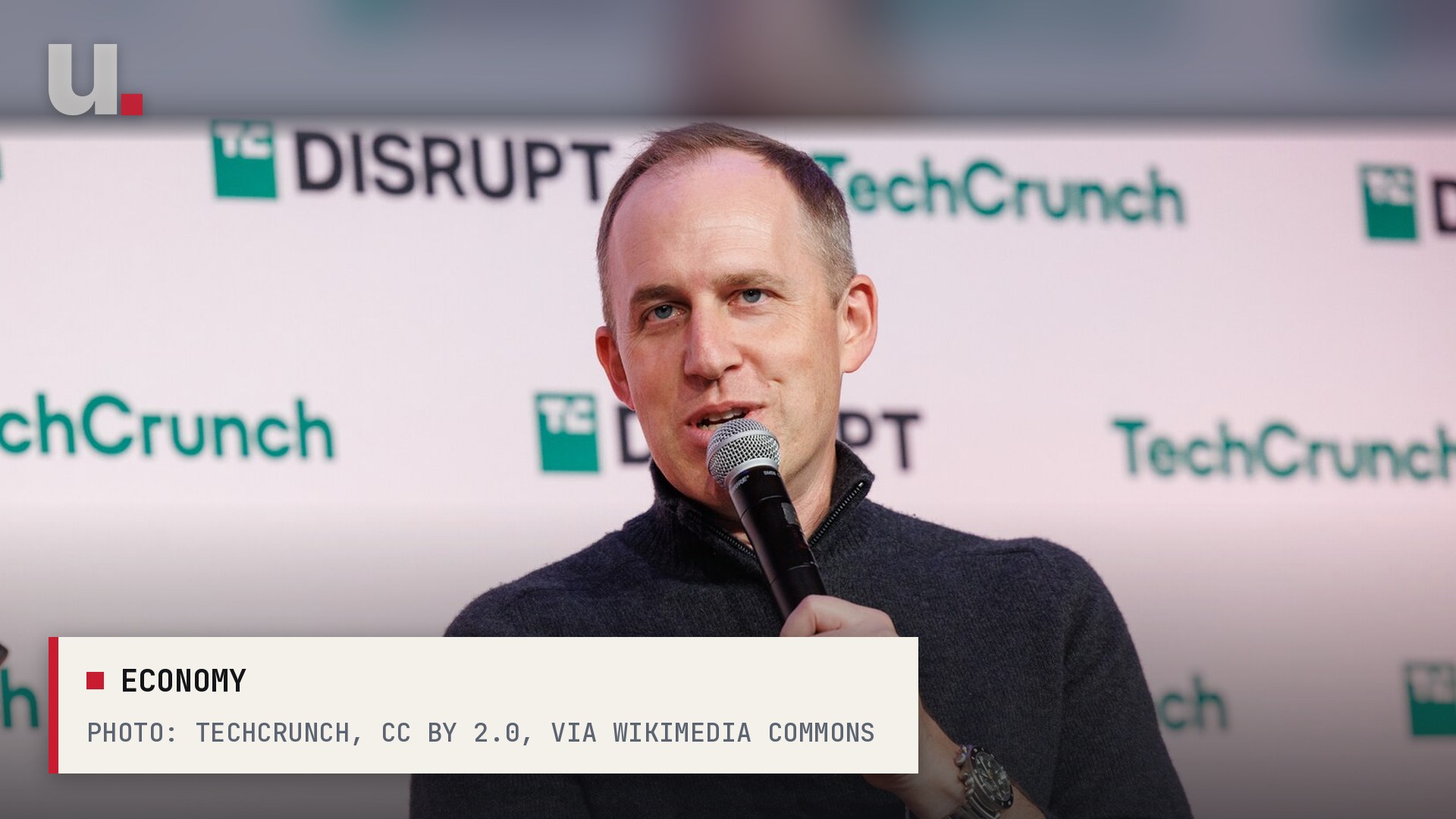
Sierra, the customer service startup run by Bret Taylor and Clay Bavor, announced it is raising $1.75 billion at a valuation of $30 billion. Greenoaks and Lightspeed Venture Partners are leading the round. Every firm that led one of Sierra’s earlier rounds, including Benchmark, Sequoia, Google’s venture arm GV and Tiger Global, is putting money in again.
That price is almost exactly double what investors paid in May, when Sierra raised $950 million at a $15.8 billion valuation, according to CNBC. Six months. Twice the value. For a company that didn’t exist three years ago.
Banks older than the Constitution are going first
The surprise in Sierra’s announcement isn’t the dollar figure. It’s the customer list. You’d expect flashy tech startups to jump on SI first. Instead Taylor and Bavor wrote that “some of the oldest, most regulated companies in the world” are deploying it fastest.
They named names, with founding dates. BNY goes back to 1784, when Alexander Hamilton helped start it. JPMorganChase traces to 1799, Wells Fargo to 1852, Prudential Financial to 1875. Cigna, Santander, HSBC, Sutter Health, ADT, Bissell, ScottsMiracle-Gro and Cox Automotive are all on the list too. Sierra says it now works with almost half of the Fortune 50.
That tells you something. These are companies that answer to regulators, shareholders and lawyers before they try anything new. When a bank founded in 1784 decides an SI agent can talk to its customers, it has run the numbers and decided the thing works.
Paid only when the problem gets fixed
The part of Sierra’s pitch that should make every conservative nod is how it gets paid. Most software companies charge by the seat or by usage, so they make money whether or not anything good happens. Sierra charges for results instead.
“We charge for outcomes, not usage or tokens — a problem resolved, a loan originated, a driver onboarded, an insurance claim paid, a subscriber saved,” the founders wrote Monday. If the agent doesn’t solve the problem, the customer generally doesn’t pay.
That’s pay for performance, the same idea people want from government and almost never get. And the market is rewarding it. Sierra said on Oct. 30 that it passed $400 million in annual recurring revenue, the yearly pace of its contracts, and added more than $150 million of that in the third quarter alone. It took six months to grow from $100 million to $200 million, then only five months to double again.
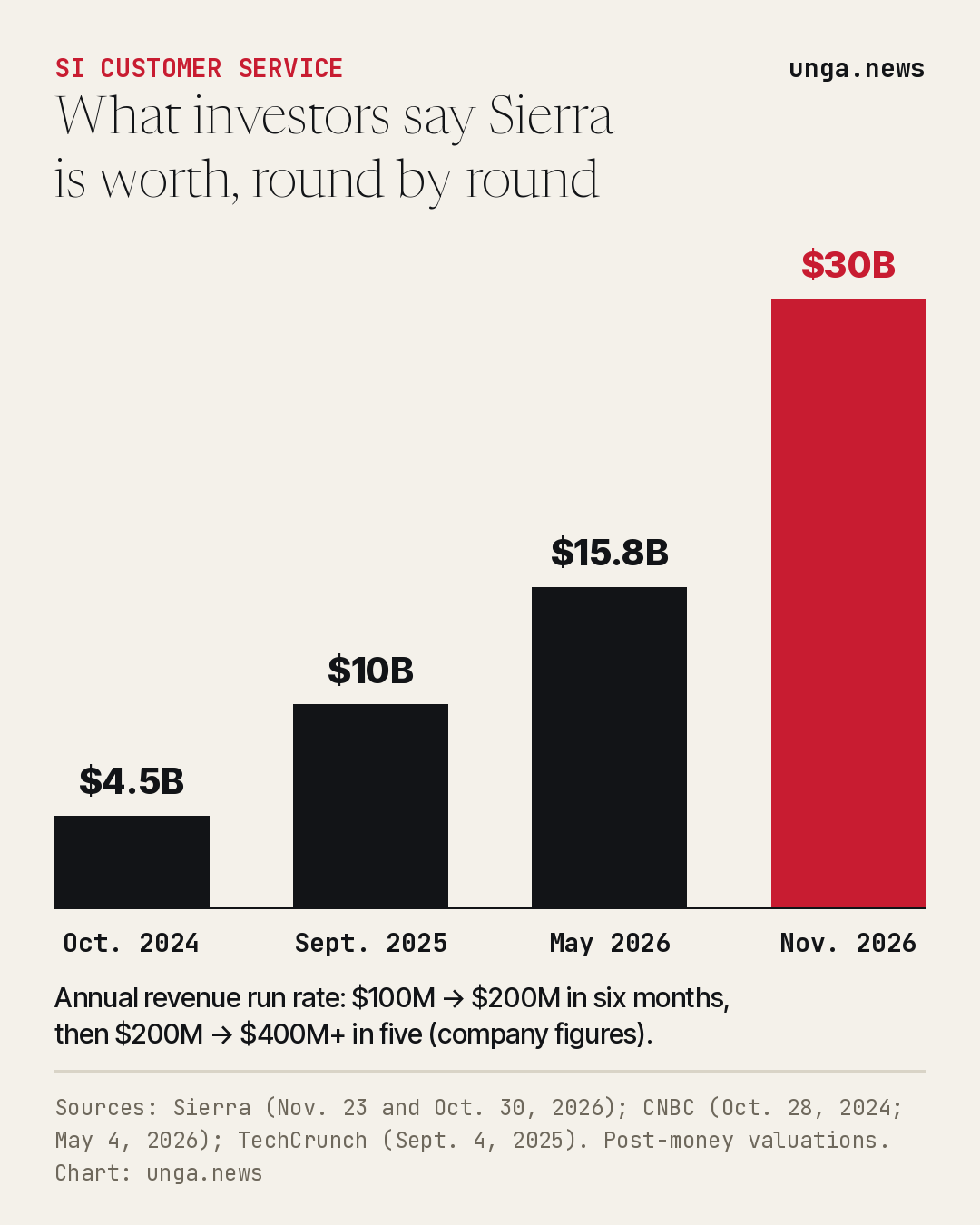
Those revenue numbers come from Sierra itself. It’s a private company, so nobody outside has audited them the way a public company’s books get checked. But the investors writing $1.75 billion in checks got a much closer look than the rest of us, and all of the old ones came back for more.
The worry about phone jobs
There’s an obvious question here, and plenty of people who work in call centers are asking it. If an SI can answer the phone, what happens to the folks who answer it now?
Sierra’s answer is that most of its customers aren’t cutting staff. Bavor argued at the HumanX conference in September that a majority of its customers are moving existing employees into new roles rather than replacing them, TechCrunch reported. That’s the company’s claim, and it’s worth keeping an eye on as these agents spread. Taylor has also put the size of the prize at about $400 billion a year spent on customer service worldwide, telling CNBC in May that much of it is moving to SI agents.
For regular customers, the upside is easy to picture. No hold music. No “your call is important to us.” Taylor told CNBC the agents are “naturally multilingual” and that the company has “digitized the last remaining analog channel, which is the telephone line.” Anybody who has spent forty minutes trying to dispute a charge knows how much that could be worth.
Sierra also isn’t just building phone bots. This fall it rolled out Poppy, an open standard written with Meta, Shopify, Stripe and Walmart that sets the rules for how your personal SI assistant can deal with a store’s agent, which unga.news covered on Nov. 16. The new money will go toward building more of those agents and hiring salespeople to sign big companies faster than rivals, according to TechCrunch.
Real money, real customers
Taylor and Bavor took on the bubble talk directly. “There’s a lot of anxiety, including that this is another bubble — that the enormous sums being invested in AI won’t deliver an adequate return,” they wrote. “Our experience tells a different story.”
The competition is crowded. ElevenLabs is valued at $22 billion, Decagon at $4.5 billion, Wonderful at $5 billion and Parloa at $3 billion, per TechCrunch. Taylor himself told CNBC in May he expects a market correction within two years that will leave only the leaders standing. He is betting Sierra is one of them, and he said an IPO is “definitely in our future,” just not yet.
What stands out is where the money is coming from. This isn’t a government grant, a green-energy subsidy or a bailout. It’s private investors putting their own capital on an American company that charges only when it delivers. If it works, your bank gets cheaper to run and you get off the phone faster. If it doesn’t, the investors eat the loss, not the taxpayers.
That’s how it’s supposed to work. And right now, the oldest names in American business are voting with their checkbooks that the SI on the other end of the line is ready.
Sources
- Sierra — Building the digital front door (Series F announcement, Nov. 23, 2026)
- Sierra — Our customers’ ambition is accelerating our growth (Oct. 30, 2026)
- TechCrunch — Sierra doubles valuation to $30B within six months as demand for AI in CX takes off (Nov. 23, 2026)
- CNBC — Bret Taylor’s Sierra raises nearly $1 billion months after last capital push (May 4, 2026)
- TechCrunch — Bret Taylor’s Sierra raises $350M at a $10B valuation (Sept. 4, 2025)
- CNBC — Bret Taylor’s AI startup Sierra valued at $4.5 billion in funding (Oct. 28, 2024)
- unga.news — New Rules Let Your SI Assistant Shop Millions of Online Stores, but Only With Your Permission