

Judge Lets 20,000 Flagged Ballots Count, Says Prosecute Instead. DOJ Subpoenas California Officials Next Day
Judge David Carter wrote that the fix for noncitizen voting is prosecution, not holding ballots. Within a day, federal prosecutors were sending subpoenas to California election officials, and Trump vowed to appeal.
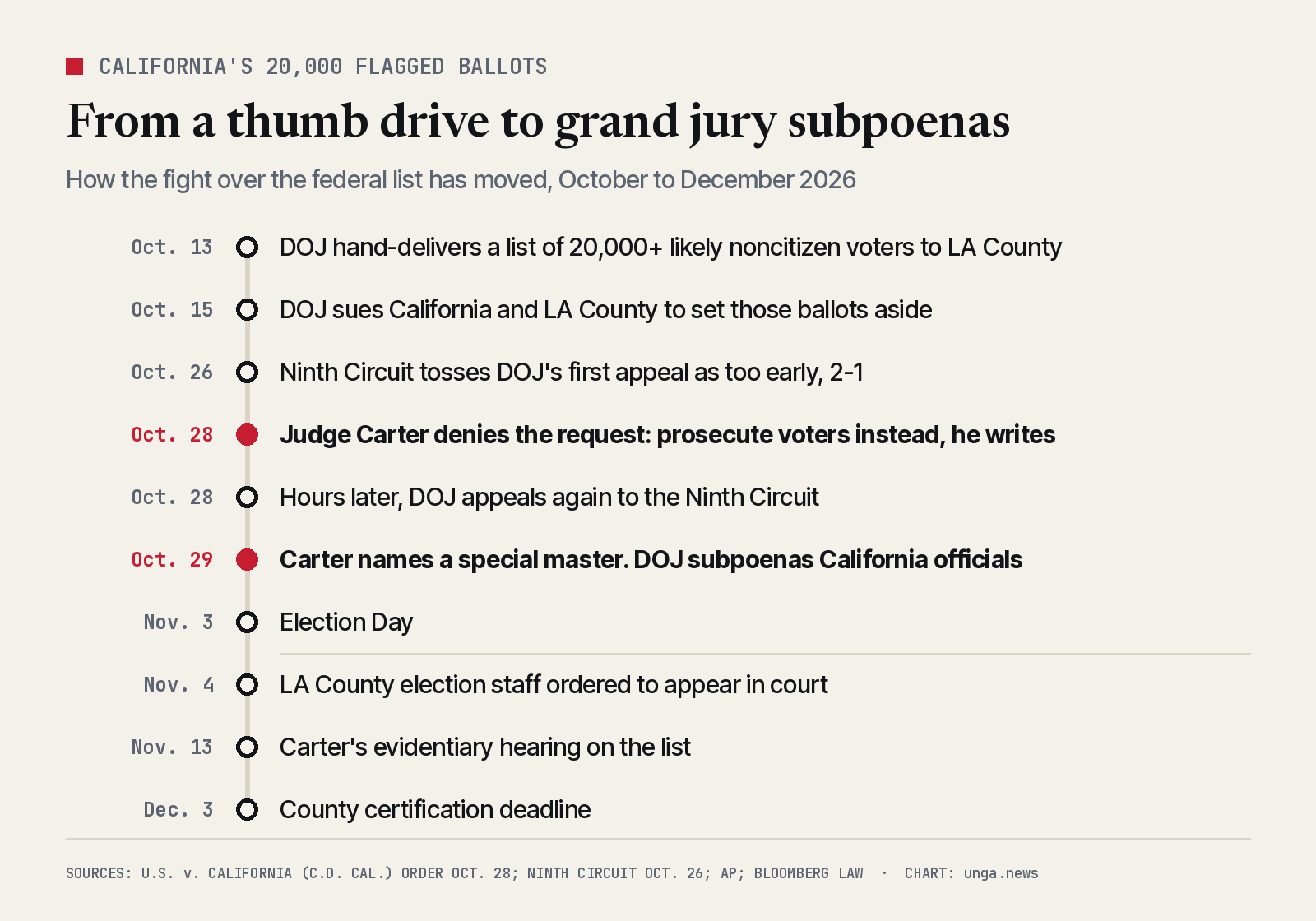
A federal judge refused Wednesday to make California set aside the mail ballots of more than 20,000 people the Trump administration flagged as likely noncitizens. In the same order, he told the government what it could do instead. "There is a clear remedy available," U.S. District Judge David O. Carter wrote. "The United States can prosecute individuals according to Section 611, as it has historically and recently done."
By Thursday, the Justice Department was sending subpoenas to California election officials.
All four U.S. attorneys in California were issuing them, a person familiar with the matter told the Associated Press, which obtained copies of two sent to employees of the Los Angeles County Registrar-Recorder. Both order the staff to appear in court on Nov. 4, the day after the election. Bloomberg Law reported that Justice Department leadership directed the state's top federal prosecutors to seek grand jury subpoenas of state and local officials over their role in handling the flagged ballots, and that the Los Angeles office, led by U.S. Attorney Bill Essayli, has been eager to investigate officials including Secretary of State Shirley Weber.
The department would not discuss the subpoenas, but it pointed straight back at the judge. "The Department of Justice does not comment on leaks about alleged grand jury subpoenas," a spokeswoman said. "But to be clear, the district court judge explained that voting unlawfully results in criminal exposure. Consistent with this, California also wrote in its filing that the remedy for unlawful voting is through criminal prosecution. Thus, while DOJ maintains that a civil remedy is still available, all agree that noncitizen voting is properly addressed through criminal law."
Trump: "We'll appeal that, of course"
President Trump was asked about the ruling Thursday morning at Joint Base Andrews, before flying to a rally in South Carolina. "California is very corrupt. The elections are extremely corrupt," he said. "The judge should not have done that, but we'll appeal that, of course. We found 20,000, but there are hundreds of thousands of bad ballots, bad votes in California. Millions, in my opinion."
The appeal is already filed. Hours after Carter ruled, the Justice Department asked the Ninth Circuit to act as soon as possible because of "irreversible ballot processing occurring on an ongoing basis." Essayli put it plainly on X: "Every day, more ballots are processed by election officials. This ongoing emergency disenfranchises American citizens through dilution."
That is the heart of the fight. Los Angeles County has already processed more than 500,000 mail ballots, according to court filings, and once a ballot is processed it can't be traced back to the voter. If a noncitizen's ballot goes into the count, there is no pulling it back out.
What the judge wrote
Carter, a Clinton appointee, said the request came too late. The federal list was hand-delivered to Los Angeles County on Oct. 13 on a password-protected thumb drive, after the county had mailed about 5.9 million mail ballots. Setting ballots aside now, he wrote, "would wreak havoc and disrupt the election that is already underway," and he called the move a violation of the federal rule against changing voter rolls within 90 days of an election.
He also attacked the list itself. He noted that the government first told California in July that "there may be as many as 190,832 non-citizens registered to vote," then narrowed it to about 20,000 "without sufficient explanation." He pointed to Nevada, where federal officials cut a list of 15,903 flagged voters to 185, all of whom Nevada officials later said were citizens.
The government disputes that its California list is sloppy. In court filings, Nicolas Bartell, a senior official at U.S. Citizenship and Immigration Services, said his office's review of names that Los Angeles County claimed were U.S.-born found none who were born in the U.S. Only four "might have a claim to U.S. citizenship," he wrote.
What happens next
On Thursday, Carter appointed a special master, Daniel B. Garrie, to build the factual record on the list and on California's claim that it can't pull the ballots in time for the county certification deadline of Dec. 3. Carter said he will rule on the government's request for a preliminary injunction after an evidentiary hearing on Nov. 13, 10 days after the election.
The Ninth Circuit will now look at the case a second time. The first time, as we reported Oct. 26, a 2-1 panel sent it back as premature, while Judge Patrick Bumatay, a Trump appointee, wrote in dissent that holding the ballots for review is "the bare minimum."
Los Angeles County Registrar Dean Logan answered the subpoenas by saying threats and intimidation "have no place in elections." The county's staff now has a court date the morning after the polls close.
Sources
- U.S. District Court, C.D. Cal. (via California AG) — United States v. California, Order Denying Temporary Restraining Order, Oct. 28, 2026
- The White House (YouTube) — President Trump Gaggles with Press Upon Departure from Joint Base Andrews, Oct. 29, 2026
- Bloomberg Law — DOJ Orders Criminal Probes of California Officials on Voting
- Associated Press (via KCRA) — Justice Department subpoenas California officials in escalation of its scrutiny of local election administration
- Associated Press (via ABC News) — Justice Department appeals ruling allowing California to count disputed ballots
- NPR — Judge denies DOJ bid to stop processing California ballots
- U.S. Court of Appeals for the Ninth Circuit — United States v. California, No. 26-7070, Oct. 26, 2026
- The Gateway Pundit — VIDEO… TGP Asks Trump about Clinton Judge Tossing Lawsuit to Set Aside 20,000 Illegal Noncitizen Votes in California
- The Daily Signal — California's 'Likely Noncitizen' List Just Got a Court Decision