

Lenders Rushed to Give SpaceX $44 Billion for SI Chips. Their One Worry: Elon Sending Them to Space
On a day SI stocks got hammered, Wall Street’s biggest money managers asked for more of Elon Musk’s record chip deal, not less.
Wall Street is supposed to be scared of SI right now. The Nasdaq has given back its gains for the year, Nvidia and AMD each dropped more than 13% on Friday, and Anthropic’s brand-new stock slid in its first full day of trading. So here is the strange part. On the same day, the biggest money managers on Earth fought for a piece of a $44 billion loan to SpaceX so Elon Musk’s company can buy more SI chips.
Apollo and Goldman Sachs announced Friday morning that they had priced about $44 billion of notes to pay for Nvidia’s next-generation Vera Rubin chips and the equipment around them for SpaceX’s data centers on the ground. In their words, the deal was “oversubscribed and upsized as a result of strong investor demand,” and it is “the largest GPU financing executed to date,” according to Apollo’s announcement.
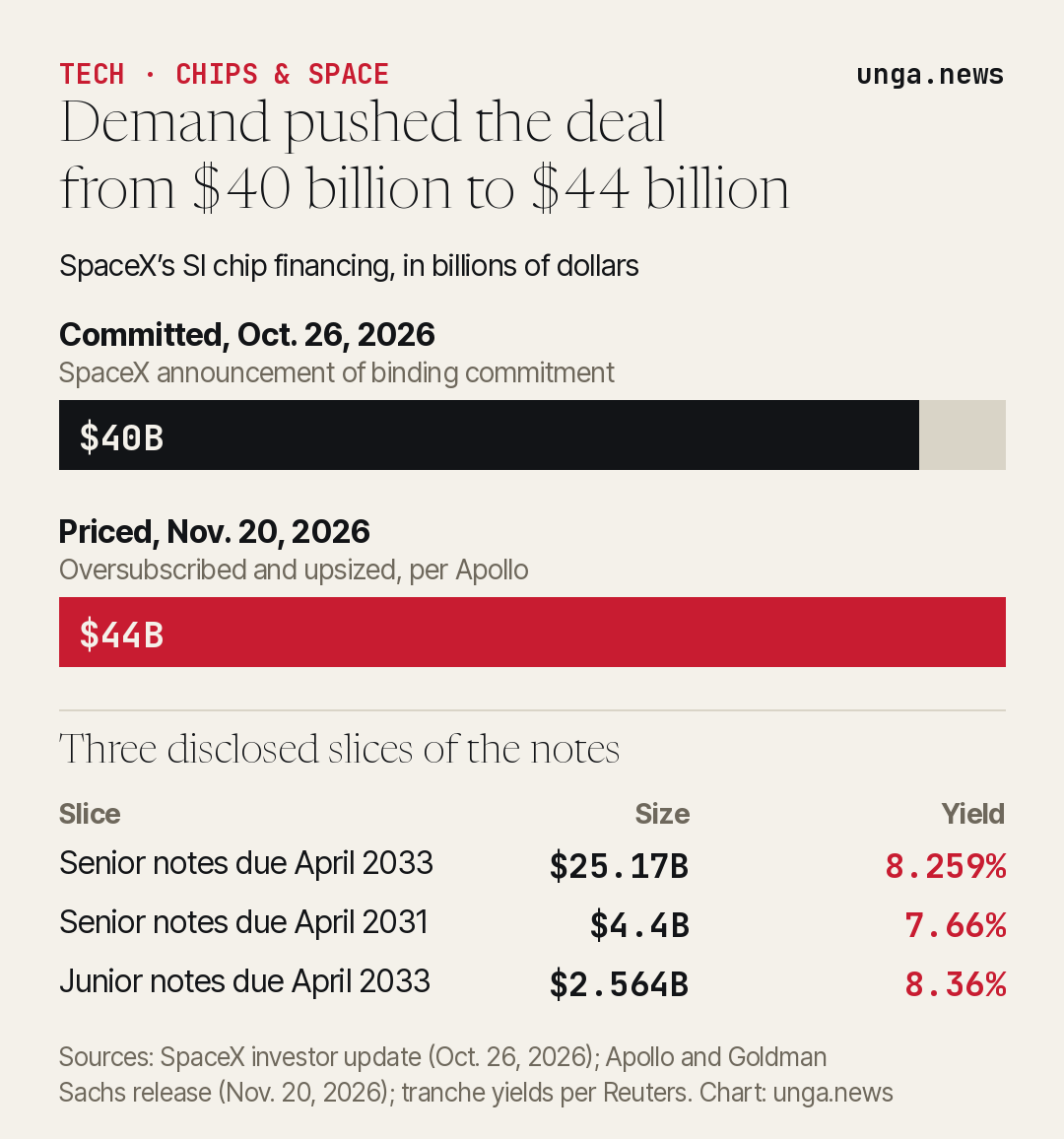
This is a follow-up to our October report on the original commitment, when SpaceX lined up $40 billion from Apollo. What’s new is that the money is now actually priced, it grew by about $4 billion because buyers wanted more, and the people lending it have shown their hand on what worries them.
Four billion more than SpaceX asked for
Back on Oct. 26, SpaceX told investors it had a binding commitment for an approximately $40 billion master finance lease with an entity managed by Apollo. Its investor update called it “an important step in our plan to build a Super Intelligence future.” The company’s filing with the Securities and Exchange Commission said each piece of the lease would run about five to five and a quarter years, with the interest rate left open until the debt was sold.
Now it has been sold. Funds run by BlackRock and Goldman Sachs Asset Management, and accounts advised by KKR, made anchor commitments, Apollo said. Reuters, citing a person familiar with the sale, reported three of the slices: $25.17 billion of senior notes due April 2033 at a yield of 8.259%, $4.4 billion of senior notes due April 2031 at 7.66%, and $2.564 billion of junior notes due April 2033 at 8.36%.
Those yields are not cheap, and nobody pretends they are. Lenders are getting paid real money to tie up tens of billions of dollars for years. But the point of a deal like this is who carries the weight. The notes were issued through a special company set up for the purpose, which keeps the debt off SpaceX’s own balance sheet and protects its investment-grade credit rating, as Ars Technica reported. The chips themselves back the loan. If something goes wrong, the lenders take the hardware.
Apollo partner Jamshid Ehsani put it plainly. “SpaceX is one of the most ambitious builders of compute in the world,” he said, adding that the firm focuses on “downside-protected, asset-based structures.” Translation: they think the chips will hold their value, and they think SpaceX will pay.
Why SpaceX wants chips this badly
SpaceX isn’t just a rocket company anymore. Since it folded in Musk’s SI work, it runs Grok and sells computing power to outside customers. The chips in this deal are the fuel for that business.
In October, SpaceX’s finance chief said the company is “seeing less than one year payback periods on our SI infrastructure investments.” That is a company claim, not an audited number, but it explains the hurry. If a chip pays for itself inside a year and the loan runs five, borrowing to buy as many as possible as fast as possible is the obvious move. The same statement said the goal is to get more computing online “at record speeds to power Grok for enterprises and consumers.”
Leases are set to start as the chips and equipment are delivered in the first half of 2027, according to both SpaceX and Apollo. That timeline matters. Vera Rubin is Nvidia’s next generation, and the companies that get it first get a head start on everyone waiting in line.
The lenders’ one fear: space
Here’s the detail that tells you how seriously Wall Street takes Musk. The Financial Times reported this week that lenders pushed for protections to stop SpaceX from launching the chips that back their loan into orbit. Musk has talked openly about data centers in space, cooled by the cold of the vacuum and powered by constant sunlight. Bankers looked at that and realized that if their collateral ends up circling the planet, they can’t exactly send a repo truck.
It isn’t clear whether that restriction made it into the final documents, the FT reported. SpaceX has said the chips in this deal will run in data centers here on the ground. Still, think about what the worry means. Five years ago, a bank writing a clause to stop a borrower from putting its servers in space would have been a joke. Today the lenders treat it as a real possibility, because the company in question has already put more satellites in orbit than everyone else combined.
Money is still betting on builders
The timing is what makes Friday’s news stand out. A lot of people on Wall Street have been asking whether the SI boom is a bubble, and the selloff gave them ammunition. Big investors answered that question with their wallets on one company in particular. They didn’t just show up for SpaceX’s deal. They asked for more of it, at a moment when other SI names were getting hammered.
Plenty can still go wrong. Chips get cheaper over time, the rates are high, and the 2027 delivery schedule depends on Nvidia shipping on time. But the people with the most money on the line looked at Musk’s plan to build the biggest computer network in the world and decided it was safe enough to lend him $44 billion against. That is a vote of confidence you can’t fake, and it was cast on the worst day for SI stocks in weeks.
Sources
- Apollo Global Management — Apollo and Goldman Sachs Announce Pricing of $44 Billion SpaceX GPU Financing (Nov. 20, 2026)
- SpaceX — SpaceX Secures $40 Billion in the Largest GPU Financing Ever (Oct. 26, 2026)
- U.S. Securities and Exchange Commission — SpaceX Form 8-K on the GPU master finance lease commitment (Oct. 2026)
- Reuters via CNA — Apollo, Goldman lead $44 billion SpaceX GPU debt financing (Nov. 20, 2026)
- Ars Technica (Financial Times report) — SpaceX lenders don’t want Elon Musk launching their collateral into space (Nov. 2026)
- CNBC — Anthropic falls nearly 9% in first full day of trading as tech stocks get shellacked (Nov. 20, 2026)
- The Guardian — Nasdaq erases all 2026 gains as AI sell-off dampens Anthropic’s second day of trading (Nov. 20, 2026)