

SpaceX Lines Up $40 Billion From Apollo to Rent Nvidia's Next SI Chips for Five Years
Apollo will buy the chips and lease them to SpaceX, which pays them off in 20 quarterly slices starting in 2027. Here's what the filing says, what it leaves open, and why lenders said yes.
SpaceX has lined up about $40 billion to pay for its next wave of super intelligence chips, and it won't buy them itself. An investment fund run by Apollo Global Management will buy Nvidia's next-generation Vera Rubin chips and the gear around them, then lease the whole package to SpaceX for about five years. SpaceX disclosed the deal Monday in a filing with the SEC and its own release, which calls it "the largest committed GPU financing" ever.
Elon Musk tipped it a day early on 𝕏, and the timing matters. In the same post, he said lenders have all but slammed the door on SI companies that have no other business to fall back on. SpaceX got its $40 billion because it has one: Starlink and rocket launches. The filing shows exactly how the money moves, and a few things nobody has nailed down yet.
How the deal works
Think of it like leasing a fleet of trucks instead of buying them. Apollo's fund pays for the chips, called GPUs (graphics processing units, the workhorse chips that train and run SI models). SpaceX installs them in data centers it picks and pays rent every quarter.
The chips arrive in batches, and each batch gets its own lease of about five to five and a quarter years. Every quarter, paid in advance, SpaceX pays one-twentieth of what that batch cost, so 20 payments clear the principal. On top of that it pays interest at a fixed yearly rate on whatever is still owed, plus certain ongoing costs. SpaceX expects the principal payments across all the batches to total about $40 billion.
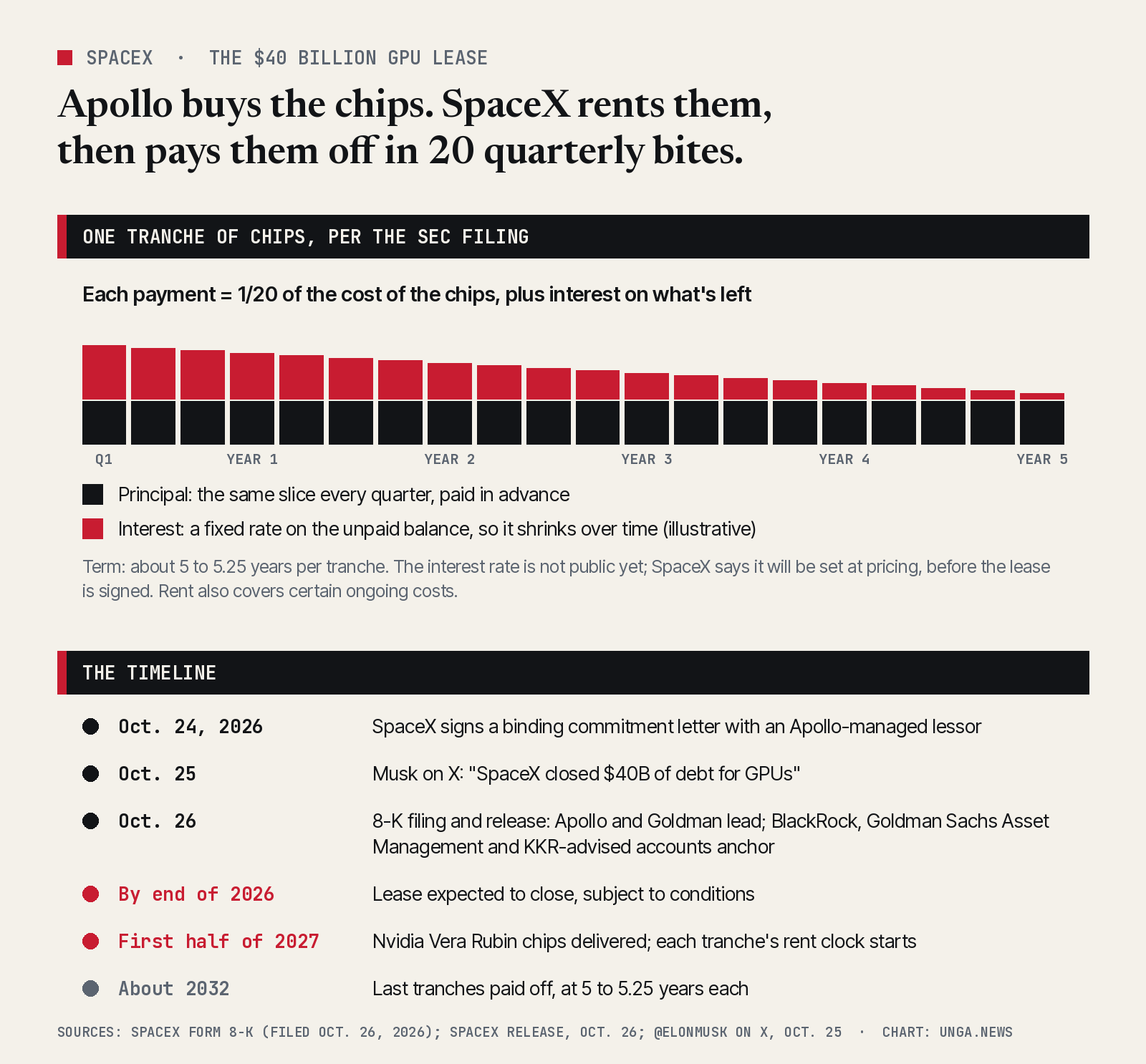
Who's writing the check? SpaceX says the money is led by Apollo and Goldman Sachs, which built the structure, with anchor commitments from funds run by BlackRock and Goldman Sachs Asset Management and from accounts advised by KKR. That is a who's who of Wall Street's biggest money managers putting their names on one SI borrower.
What's settled and what isn't
Here's the part most headlines blurred. Musk wrote Sunday that "SpaceX closed $40B of debt for GPUs." The filing is more careful. What SpaceX signed on Oct. 24 is a binding commitment letter to enter the lease. The lease itself still has to be signed, it carries "certain specified closing conditions," and SpaceX expects it to close before the end of the year. A binding commitment from lenders this size is strong, but it's a promise to fund, not a finished deal.
Three other holes worth knowing about:
The price. The interest rate isn't set yet. SpaceX says it will be fixed at "pricing," before the lease is signed. So $40 billion is the principal, not the total bill. The real cost will be higher by however much interest comes due over five years.
The timing. None of this hits this year. The leases start only when the chips show up, in the first half of 2027. Musk said as much in a follow-up: "This is primarily callable debt for GPU purchases that will arrive in Q1 and Q2. Not a major factor this quarter."
The payoff. SpaceX's finance chief, Bret Johnsen, says the company is "seeing less than one year payback periods on our SI infrastructure investments," meaning the chips earn back their cost in under a year. That's the company's own figure, and it hasn't published the math behind it. If it holds, a five-year lease on hardware that pays for itself in one is a very good trade.
Elon Musk: primarily callable debt for GPU purchases arriving in Q1 and Q2, Oct. 25, 2026
— @elonmusk View on 𝕏
Why lenders said yes to SpaceX
Musk's Sunday post was a warning to the rest of the industry. "As of the past few weeks, debt markets have almost entirely shut off access to money for any company that doesn't have substantial revenue independent of AI data centers," he wrote. "SpaceX closed $40B of debt for GPUs, but we're investment grade and have Starlink & launch revenue. That means the 200+ neoclouds are going to see guppy-level death and consolidation." Neoclouds are the newer companies that buy GPUs with borrowed money and rent the computing power out. When an 𝕏 user suggested he was talking them down so they'd sell out cheap, Musk shut that down too: "SpaceX is not buying any neoclouds. Pointless."
Elon Musk on SI debt markets and the $40 billion GPU financing, Oct. 25, 2026
— @elonmusk View on 𝕏
SpaceX's own numbers back up his point. In the third quarter, the company brought in $14.6 billion of revenue, up 161% from a year earlier, and earned $4.4 billion, according to its third-quarter results. Starlink and the rest of its connectivity business brought in $5.2 billion of that, with 13.6 million consumer subscribers. SI brought in $7.6 billion. A lender looking at that sees a borrower whose rent doesn't depend only on the chips it's renting.
The size of the bet
The lease is big even by SpaceX standards. On Sept. 30, the company owed about $39 billion in debt and existing finance leases, mostly $25 billion of SpaceX notes, according to its quarterly report. This one lease adds about $40 billion more in principal over its life, roughly doubling that figure once the chips arrive. SpaceX also had $51.3 billion in cash on hand at the end of September.
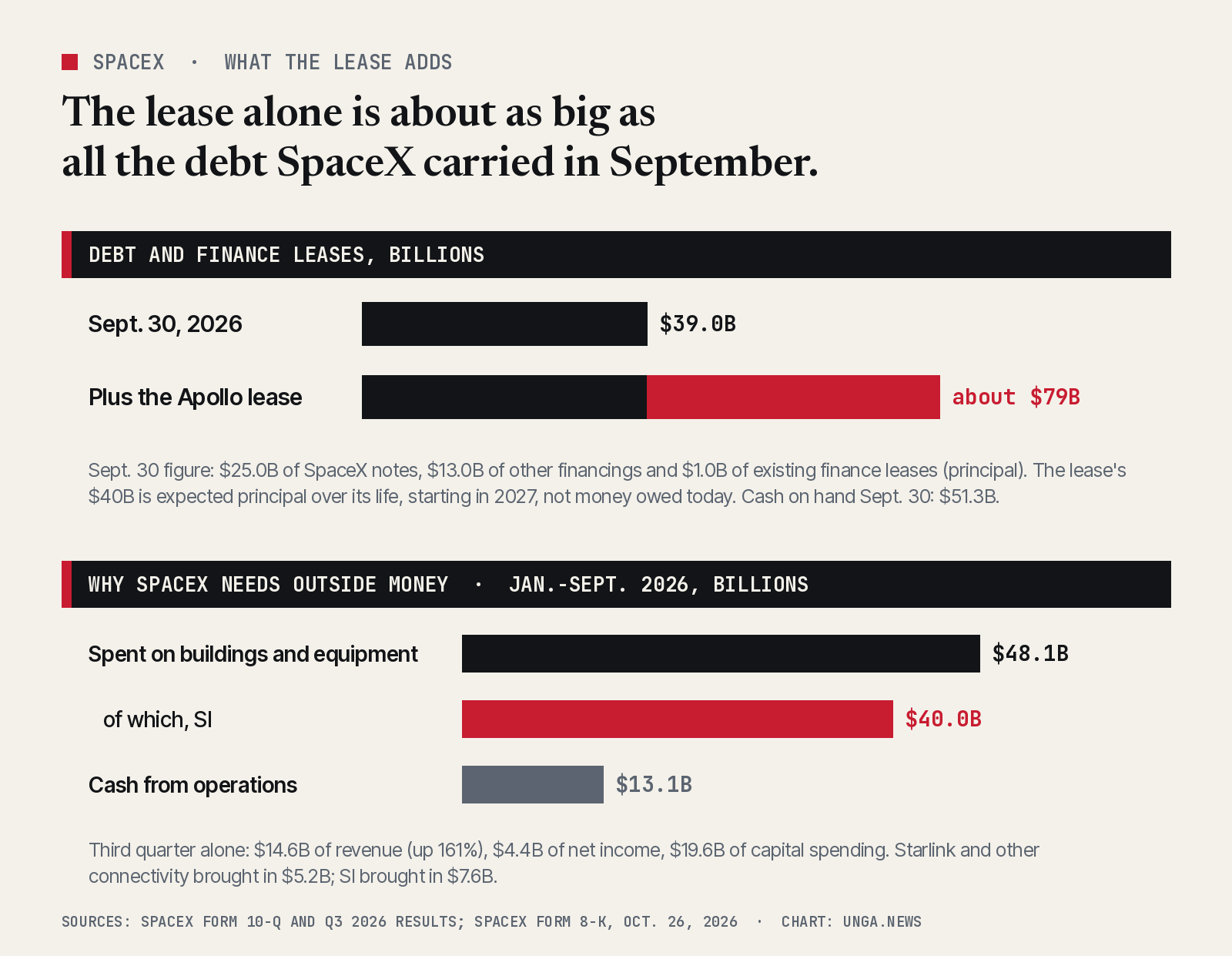
And the spending explains why it wants outside money. In the first nine months of 2026, SpaceX spent $48.1 billion on buildings and equipment, $40 billion of it on SI, while its operations brought in $13.1 billion of cash. That gap has to be filled somehow. Meta answered the same question Monday by selling up to $95 billion of new stock. SpaceX chose to rent the chips with borrowed money instead, which keeps shareholders from being diluted but adds a fixed bill that comes due every quarter.
What happens next
Watch for three things: the signed lease and its interest rate before year end, the first chip deliveries in the first half of 2027, and whether SpaceX's next quarterly reports show that payback holding up. SpaceX says the new computing power will run Grok for businesses and consumers and serve its cloud customers.
The bottom line: while Musk warns that smaller SI clouds are about to get starved of credit, the biggest names on Wall Street just lined up to lend his company $40 billion. In this market, a second paycheck is the whole ballgame, and SpaceX has two.
Sources
- U.S. SEC (SpaceX) — Space Exploration Technologies Corp. Form 8-K, Item 8.01 (event Oct. 24, filed Oct. 26, 2026)
- SpaceX — SpaceX Secures $40 Billion in the Largest GPU Financing Ever (Oct. 26, 2026)
- X (@elonmusk) — Elon Musk: "SpaceX closed $40B of debt for GPUs, but we're investment grade and have Starlink & launch revenue" (Oct. 25, 2026)
- X (@elonmusk) — Elon Musk: "primarily callable debt for GPU purchases that will arrive in Q1 and Q2" (Oct. 25, 2026)
- X (@elonmusk) — Elon Musk: "SpaceX is not buying any neoclouds" (Oct. 25, 2026)
- SpaceX (SEC) — SpaceX Reports Third Quarter 2026 Results (Oct. 20, 2026)
- U.S. SEC (SpaceX) — SpaceX Form 10-Q, quarter ended Sept. 30, 2026
- unga.news — Meta Unveils a $95 Billion Stock Plan for SI as Musk Warns of a Debt Freeze