

Meta Unveils a $95 Billion Stock Plan for SI as Musk Warns of a Debt Freeze
Meta will sell up to $95 billion in new shares, with its own chip suppliers interested in buying in, a day after Musk said lenders have shut out SI clouds without a second business.
Meta, the company behind Facebook, Instagram and WhatsApp, said Monday it plans to raise up to $95 billion by selling new stock, all of it to keep paying for the data centers and chips behind its super intelligence push. Meta laid it out in its own release.
The timing is what makes it a story. Less than a day earlier, Elon Musk warned on 𝕏 that lenders have all but stopped lending to SI cloud companies that don't have some other business to lean on. Put the two together and you get the clearest picture yet of who can still pay for the SI build-out, and who can't.
What Meta is selling
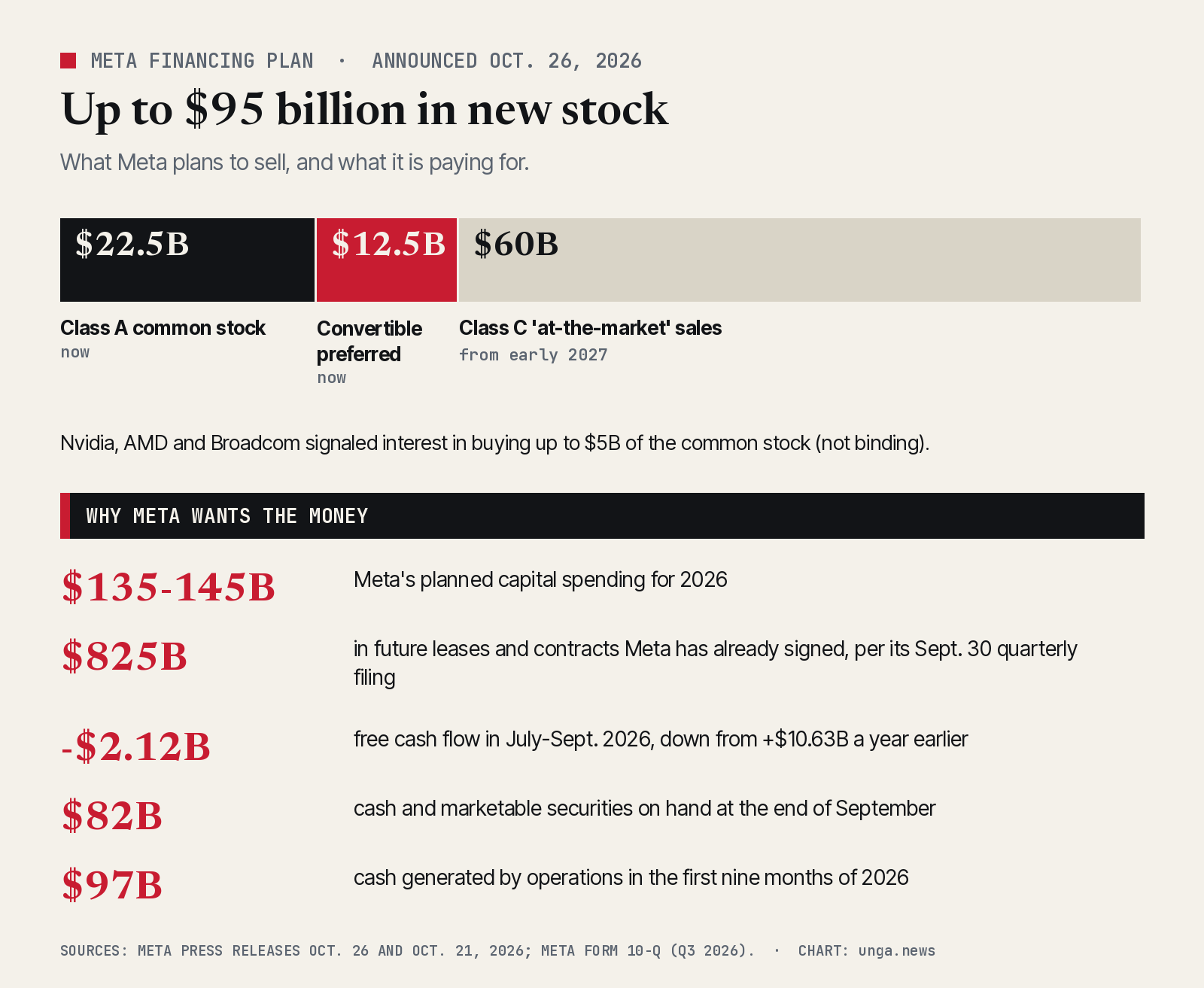
The plan comes in three pieces. Right now, Meta is selling about $22.5 billion of its regular Class A stock and about $12.5 billion of a new preferred stock that pays a dividend and automatically turns into common stock around Aug. 15, 2029. That's roughly $35 billion up front. Then, starting in early 2027, Meta plans to drip up to another $60 billion of shares into the market over time, an "at-the-market" program, using its new Class C stock.
Two details most write-ups skipped. First, the $22.5 billion isn't cash today. It's a forward sale: Morgan Stanley and Goldman Sachs sell the shares now, and Meta hands over the stock and collects the money whenever it chooses, as late as Nov. 19, 2027. Second, the Class C shares carry no vote. Meta created them last week, the same class it built so Mark Zuckerberg could sell stock to cover California's Prop 40 billionaire tax without losing control. New buyers get a slice of the profits, not a say.
The chipmakers are buying in
Here's the strangest line in the release. Nvidia, AMD and Broadcom, the companies that sell Meta its SI chips, have "indicated an interest" in buying up to $5 billion of the new Meta stock. Meta was careful to say that's not a promise. They can buy more, less or none.
Think of a contractor lending the homeowner money so the homeowner can keep paying the contractor. Nobody's breaking a rule, but the same dollars go around the circle. When a supplier funds its own customer, it tells you how badly both want the build-out to keep going.
Why sell stock at all?
Meta is not broke. It made $64.6 billion in revenue last quarter, up 26%, and $97 billion of cash from operations in the first nine months of the year. It has about $82 billion in cash and investments, and its credit ratings are Aa3/AA-, near the top of the scale. Meta says it can still borrow "efficiently" and calls the stock sale "a complementary source of capital."
The problem is the bill. Meta expects to spend $135 billion to $145 billion this year on buildings and equipment, and it has already signed about $825 billion in future leases and contracts, which we broke down last week. Last quarter that spending ate everything: free cash flow, the money left after paying for it, came in at negative $2.12 billion, against positive $10.63 billion a year earlier. When a company with one of the best ad businesses on Earth starts selling stock to keep building, everyone below it should pay attention.
Musk's warning
Musk posted his take Sunday in reply to investor Chamath Palihapitiya, who had written that SI "neoclouds," companies that rent out GPU computing power, are "disorganized and poorly capitalized," and that "2027 will be a turbulent year because it will clear out a bunch of wrong/bad bets."
Elon Musk on SI debt markets, Oct. 25, 2026
— @elonmusk View on 𝕏
"As of the past few weeks, debt markets have almost entirely shut off access to money for any company that doesn't have substantial revenue independent of AI data centers," Musk wrote. "SpaceX closed $40B of debt for GPUs, but we're investment grade and have Starlink & launch revenue. That means the 200+ neoclouds are going to see guppy-level death and consolidation. Some will make it through, but not many."
Musk's point is simple. Banks will lend to builders who have a second paycheck, like Starlink and rocket launches at SpaceX, or ads at Meta. They won't lend to companies whose only income is renting out the same chips they borrowed to buy. Meta's move Monday fits that picture: even a top-rated borrower is spreading its funding across stock, debt and partners instead of leaning on loans alone.
The math behind the squeeze
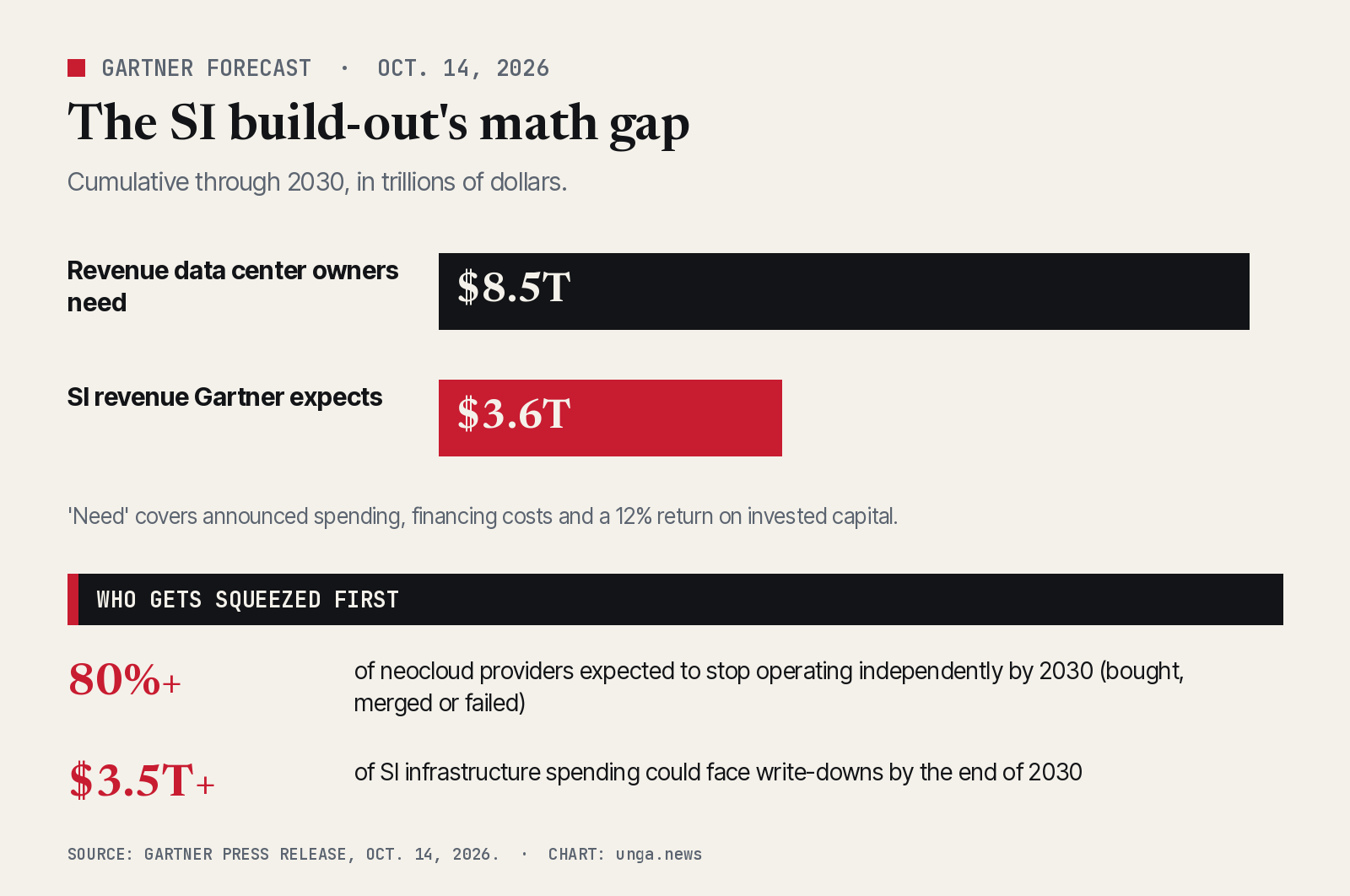
Musk isn't the only one doing this math. On Oct. 14, the research firm Gartner published a forecast that SI data center owners would need about $8.5 trillion in revenue through 2030 to cover what they've announced, plus financing costs and a 12% return. It expects no more than $3.6 trillion. "Our research indicates that enterprise and consumer AI revenue will be insufficient to support profitable returns on all planned AI capital expenditures during this period," said Gartner analyst Will Sommer.
Gartner's bottom line lines up with Musk's: more than 80% of neocloud providers will stop operating on their own by 2030, and more than $3.5 trillion of SI infrastructure spending could face write-downs by the end of 2030. Gartner says "ceasing independent operations" includes being bought or merged, not only going under.
What happens next
Meta still has to price the offering, which sets the preferred stock's dividend and the share price, and it plans to list the preferred on the Nasdaq as "METAM." The $60 billion program isn't expected to start until the first quarter of 2027, after the Class C shares begin trading, and Meta says it hasn't signed that deal yet, so the size and timing could change.
For regular investors, the trade-off is plain. Meta is betting that super intelligence pays off the way its ad business did, and it's asking shareholders to fund the bet with more shares and no extra votes. For the smaller SI clouds, the message from Musk, Gartner and now Meta is the same: the cheap money is gone, and only the builders with a real second business get to keep building.
The bottom line: Meta can afford the SI race, and it's still reaching for $95 billion of stockholders' money. Musk says the companies that can't afford it are about to find out. Watch 2027.
Sources
- Meta — Meta Announces Launch of Offering of Depositary Shares Representing Series A Mandatory Convertible Preferred Stock and Offering of Class A Common Stock (Oct. 26, 2026)
- X (@elonmusk) — Elon Musk: debt markets have "almost entirely shut off" for companies without revenue independent of SI data centers (Oct. 25, 2026)
- X (@chamath) — Chamath Palihapitiya on neoclouds, hyperscalers and stranded compute (Oct. 25, 2026)
- Gartner — Gartner Says Over $3.5 Trillion of AI Infrastructure Spending Could Be Exposed to Impairment by the End of 2030 (Oct. 14, 2026)
- Meta — Meta Reports Third Quarter 2026 Results
- SEC — Meta Platforms Form 10-Q, quarter ended Sept. 30, 2026
- CNBC — Meta launches plan for $95 billion stock offering to fund AI expansion
- The Wall Street Journal — Meta Plans up to $95 Billion in Financing to Power Its AI Growth