

Meta Revealed $825 Billion in SI Bills. The Nasdaq Had Its Worst Day Since June.
Mark Zuckerberg's company burned cash for the first time in over a decade and is creating a new class of stock to help pay for data centers. Investors dumped tech stocks, but the Dow finished higher and most of the market rose.
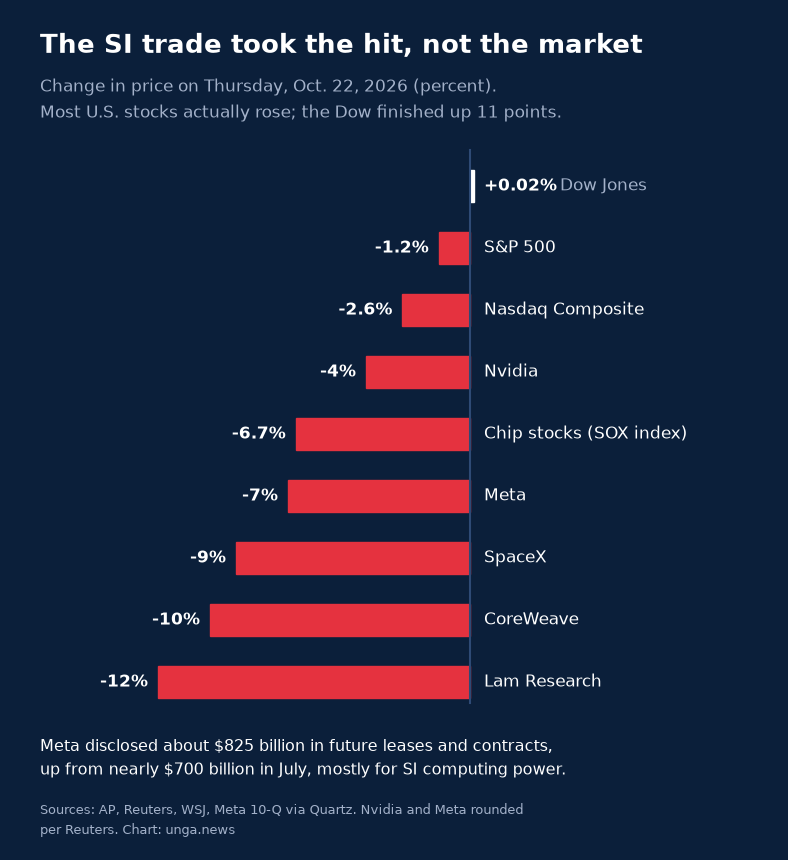
Meta, the company behind Facebook, Instagram and WhatsApp, told investors this week that it has signed up for about $825 billion in future leases and contracts, most of it to build the computing power behind super intelligence. On Thursday, Wall Street flinched. Meta's stock fell 7%, its biggest drop since July, and the tech-heavy Nasdaq lost 2.6%, its worst day since June 5, Reuters reported.
The selling stayed in one corner of the market. The S&P 500 fell 1.2%, but tech was so heavy that it hid the fact that most U.S. stocks actually rose, AP reported. The Dow Jones Industrial Average finished up 11 points.
Think of a family that already earns a great paycheck, then signs a 30-year contract for a much bigger house. Nobody doubts the paycheck. The question is how long the payments run before the new rooms start paying for themselves.
What Meta disclosed
The numbers sit in Meta's quarterly report to the Securities and Exchange Commission, its 10-Q. Leases that haven't started yet total about $355.73 billion, covering data centers, power infrastructure and network gear, with terms running up to 30 years. Another $454.52 billion are contracts Meta can't cancel, mostly for outside cloud capacity, servers, power deals for data centers and its Reality Labs hardware, Quartz reported. In July, the same list came to nearly $700 billion.
Meta also said it will create a new class of stock. The Class C shares carry no vote, and Meta said they can be used "for Capital Raising, Employee Compensation, Potential Acquisitions, and Other General Corporate Purposes," in its earnings release. Every current shareholder gets one Class C share for each share they own, which Meta says will work like a two-for-one split. The change takes effect Jan. 19, 2027. Because the new shares have no vote, Meta can raise money without weakening Mark Zuckerberg's control of the company.
Investors read that as a sign more stock sales are coming to pay for the build-out, which spreads each existing share thinner, Reuters reported.
"Meta is on the hook for about $825 billion in future spending." (@YahooFinance, Oct. 22)
— @YahooFinance View on 𝕏
The business is strong. The cash is tight.
Meta's core business is booming. Revenue jumped 26% from a year earlier to $64.6 billion, ad prices rose 14%, and 3.64 billion people use its apps every day, the company reported. Zuckerberg called it a quarter of "major milestones" toward "personal superintelligence for everyone" and said, "Our investments are paying off, the core business is strong, and we're seeing velocity across the board."
But the spending ate the cash. Meta put $34.91 billion into buildings and equipment in three months, and free cash flow, the money left over after that spending, came out at negative $2.12 billion. A year earlier it was a positive $10.63 billion. Reuters said it was Meta's first cash burn in more than a decade, per its report. Meta expects to spend $135 billion to $145 billion this year and said it will keep "investing aggressively" in 2027.
The quarter also carried a $9.89 billion charge from Meta's August deal with 52 state attorneys general over teen mental health and social media, a settlement worth up to about $18.59 billion, the company said. Its workforce is down 15% from a year ago.
"More spending, negative free cash flow, not enough revenue being generated from the spend (is) concerning investors that this is just sort of a bit of a money pit," Robert Pavlik of Dakota Wealth told Reuters. Meta's credit default swaps, which track how risky lenders think its debt is, hit a record on Thursday.
Nvidia's boss poured on fuel
Jensen Huang, the CEO of Nvidia, the chipmaker whose processors power most SI data centers, added to the jitters the same morning. Speaking to CNBC at a company conference in Berlin, he said demand for smaller SI cloud companies is "off the charts," but money is not keeping up. "What is missing in the middle is the working capital to fuel that growth… because there's just so much demand across so many sectors of AI, there's a scarcity of capital," he said, per CNBC. He added: "The demand of the capital is much greater than the availability of the capital. That's going to get solved."
Those smaller players got hit hardest. CoreWeave fell 10% and Nebius 7%, Nvidia dropped about 4%, and chipmaker Lam Research plunged 12% after its results, dragging the Philadelphia Semiconductor index down 6.7%, Reuters reported. SpaceX fell 9%. Tesla slipped too after it said it would rein in spending, NBC News reported.
"Nobody is worried about Meta or Amazon or Google getting the financing they need," Matthew Maley of Miller Tabak told Reuters. "But if it gets prohibitive for smaller companies, then you don't have to have an implosion of things to make people nervous."
Where the money went
Money that left tech went into safer places. "This is your classic rotation day," said trader Joe Saluzzi of Themis Trading. "You can see the money going into Treasuries, so it's a classic safety move... They are rotating out of techs, out of the AIs, and into the more safety trades, whether it's bonds or some of those big Dow Jones stocks," he told Reuters. The 10-year Treasury yield slipped below 5% for the first time since late September, NBC News reported.
Oil climbed at the same time. Brent crude, the global benchmark, rose nearly 4% to about $113 a barrel, its highest since May, per NBC News, after an Iran-backed Houthi attack on a Saudi airport, the Wall Street Journal reported, and reports that the U.S. and Israel are preparing strikes on Iran after the midterms. unga.news has covered the Iran plan and the Houthi attacks on Saudi Arabia.
What happens next
Even after Thursday, the S&P 500 sits near the record highs it set earlier this month, NBC News reported. The Federal Reserve meets next week and is expected to hold rates steady, CNBC reported. CoreWeave reports earnings next month, and a Bank of America analyst expects it will need to raise about $20 billion to fund its customer commitments, per Reuters.
For Meta, the test is simple. It is betting hundreds of billions that super intelligence will pay off the way its ad business has. Its own forecast says those bets "will take longer to generate returns" than the core business, Meta wrote. Wall Street spent Thursday deciding how long it's willing to wait. Zuckerberg, who recently told Meta's board he was leaving California, has made clear he isn't slowing down.
Sources
- Reuters (via Investing.com) — Steep bill for AI buildout punishes Meta, other tech favorites
- AP — Sharp drops for AI stocks overwhelm markets worldwide as oil prices jump
- AP — How major US stock indexes fared Thursday 10/22/2026
- NBC News — Markets tumble as concerns about Iran war and high AI spending collide
- The Wall Street Journal — Tech Stocks Fall on AI Concerns
- CNBC — Nvidia CEO Jensen Huang says neocloud demand is 'off the charts' but capital is scarce
- CNBC — AI credit risk grows as debt finances the infrastructure build-out
- Quartz — Meta has committed about $825 billion to future leases and contracts, many tied to AI
- Meta — Meta Reports Third Quarter 2026 Results
- SEC — Meta Platforms Form 10-Q, quarter ended Sept. 30, 2026
- 𝕏 / @YahooFinance — 'Meta is on the hook for about $825 billion in future spending'