

Microsoft Declares ‘Code Red’ After Its Worst Email Outage Ever. Its New Goal Is One Hour.
Internal memos show a thousand people on one call and engineers lost in a “fog of war” while Outlook was down for a day. Now Microsoft wants worldwide outages fixed within an hour.
Two weeks after Outlook went dark for most of a day, Microsoft has stopped calling it an incident and started calling it an emergency. The company has declared a “Code Red” inside the teams that run its business email, the top-priority alarm it keeps for real crises, according to internal memos first reported by Reuters.
The memos are blunt. Jason Henderson, the president of Microsoft 365 Core, told staff on Friday that the Nov. 12–13 failure was the most customer-impacting incident in the history of Exchange Online, the cloud email service behind Outlook at countless companies and government offices. Never before had so many customers been without email for so long, he wrote.
“Code Red means that this is the highest priority work for our team,” Henderson said. He also admitted something big companies rarely put in writing: “Unfortunately, all the work we have done over the years was not sufficient to protect us on Thursday.”
unga.news covered Microsoft’s final report on the outage last weekend, which traced it to a flaw shipped in July that the company’s testing missed. What’s new now is the view from inside the building while it was happening, and a concrete promise about the next one.
A thousand people on one call
Amanda Silver, the Microsoft vice president over the same core group, wrote in a separate memo on Monday that engineers had to work through a “fog of war” as the outage spread. Microsoft threw its best people at it. They traded more than 11,000 messages across 11 different Teams chats, and still struggled to keep one clear picture of what they suspected and what they had decided, because the diagnostic data was scattered across separate internal tracking systems, Silver wrote.
The Verge’s Microsoft reporter, who has covered the outage since day one, wrote that Microsoft ran an open bridge call through the whole thing, and at one point it hit its limit of 1,000 participants. His sources said the event was ranked “sev0,” Microsoft’s highest severity level, and that crews had trouble reviving servers that had slipped into maintenance mode and stopped answering under heavy processor load.
Picture that for a second. A company worth trillions, with some of the best-paid engineers on earth, needed a thousand-person phone call and a pile of group chats to figure out why people couldn’t open their inboxes. Governments from Australia and Japan to the United States lost email. Trading firms were delayed. Airline communications were disrupted, Reuters reported.
Charles Lamanna, Microsoft’s executive vice president over Copilot, agents and platform, told a Code Red review that the component that broke had experienced “roughly ten years’ worth of acceptable failures,” according to Silver’s memo. In other words, it had been creaking for a long time before it finally gave out.
One hour, not one day
The Code Red comes with a target, and it’s an aggressive one. Microsoft wants future worldwide outages resolved within an hour. Silver laid out five lines of work to get there, centered on shedding load when servers are swamped, walling off regions so trouble in one part of the world can’t spill into the rest, and faster ways to bring systems back.
Microsoft also plans to put SI agents to work helping engineers read system health data faster, Reuters reported. Henderson said he will meet daily with the leadership of Substrate, the engineering group behind the plumbing under Microsoft 365, and hold weekly reviews on top of that.
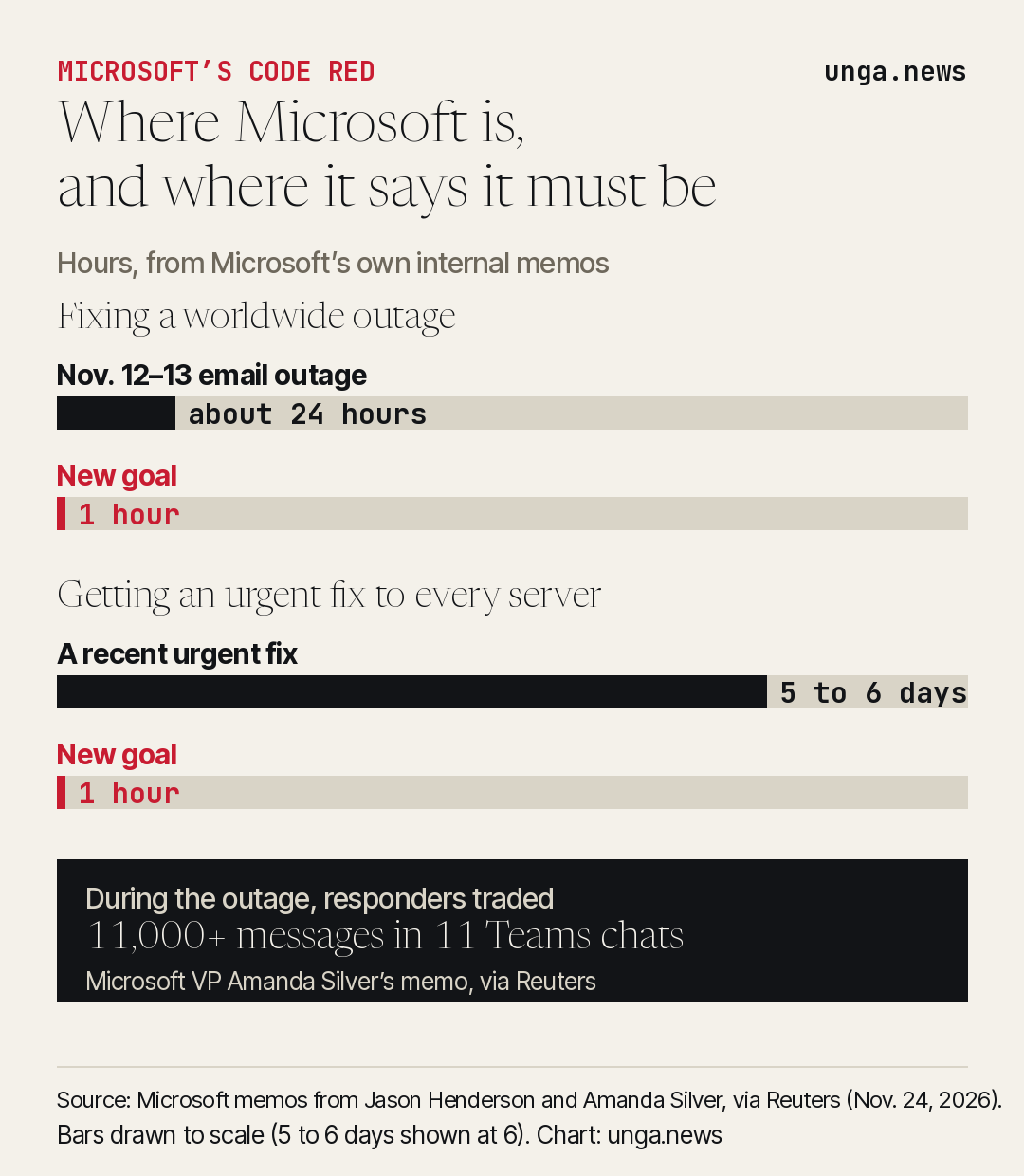
The gap is wider than one bad day. In an earlier memo this month, Henderson wrote that urgent patches to core Microsoft 365 services take too long to roll out worldwide. “In a separate recent incident, an urgent production fix took five to six days to reach worldwide saturation,” he wrote. “For our most urgent security issues, we need to get from detection to safe worldwide deployment in an hour. Needless to say, we aren’t here yet.”
Five to six days is a long time when the problem is a security hole and the customers include federal agencies. That one line may be the most important thing in the whole set of memos.
Credit where it’s due, and a warning
To Microsoft’s credit, nobody is spinning this. The company said from the start that the outage wasn’t a cyberattack and wasn’t caused by SI agents. Chief executive Satya Nadella apologized publicly. And a company spokesperson told Reuters, “Our work doesn’t end when service is restored. Our teams keep working around the clock to quickly implement any lessons learned, and our leadership makes sure this is our top priority.”
That’s the right attitude. But conservatives have warned for years about putting the whole government on one vendor’s servers, and this is what that risk looks like up close. When one company’s internal tracking is a mess, it isn’t only Microsoft’s problem. It’s every county clerk, hospital and small business that bet its daily work on Outlook, with no say in how Microsoft tests its software or how fast it ships a fix.
The federal government has been here before. In 2024, the Cyber Safety Review Board looked at a China-linked break-in to government email accounts hosted by Microsoft and concluded that the company’s “security culture was inadequate and requires an overhaul.” This outage wasn’t a hack, but the lesson rhymes. Size isn’t the same as reliability.
A one-hour promise is easy to put in a memo. The test comes the next time a Microsoft server farm starts choking at 9 a.m. on a Thursday. Washington agencies that sign Microsoft contracts should write that one-hour goal into the paperwork and hold the company to it, the same way any business would hold a supplier to a deadline it set for itself.
Sources
- Reuters (via CNA) — Exclusive: Microsoft declares ‘Code Red’ after historic outage, internal memos show (Nov. 24, 2026)
- The Verge — Microsoft declares ‘Code Red’ after huge Outlook outage (Nov. 25, 2026)
- Dow Jones via Morningstar — Microsoft Expands ‘Code Red’ Status to Resolving Major Service Outages (Nov. 24, 2026)
- CISA — Cyber Safety Review Board: Review of the Summer 2023 Microsoft Exchange Online Intrusion
- unga.news — Microsoft Tested on Old Servers, and That’s Why Your Email Went Dark Worldwide (Nov. 22, 2026)