

Nvidia Doubled Its Sales Without Its Founder and Says Next Quarter Will Be Even Bigger
The SI chip giant brought in $115.8 billion, beat Wall Street’s estimates and raised its growth forecast in its first report since Jensen Huang stepped down.

Nvidia just answered the question Wall Street has been asking for a month. With its founder gone and its stock in a six-week slide, the world’s most important SI chipmaker reported on Tuesday that sales more than doubled from a year ago, beat every major estimate and raised its forecast for next year.
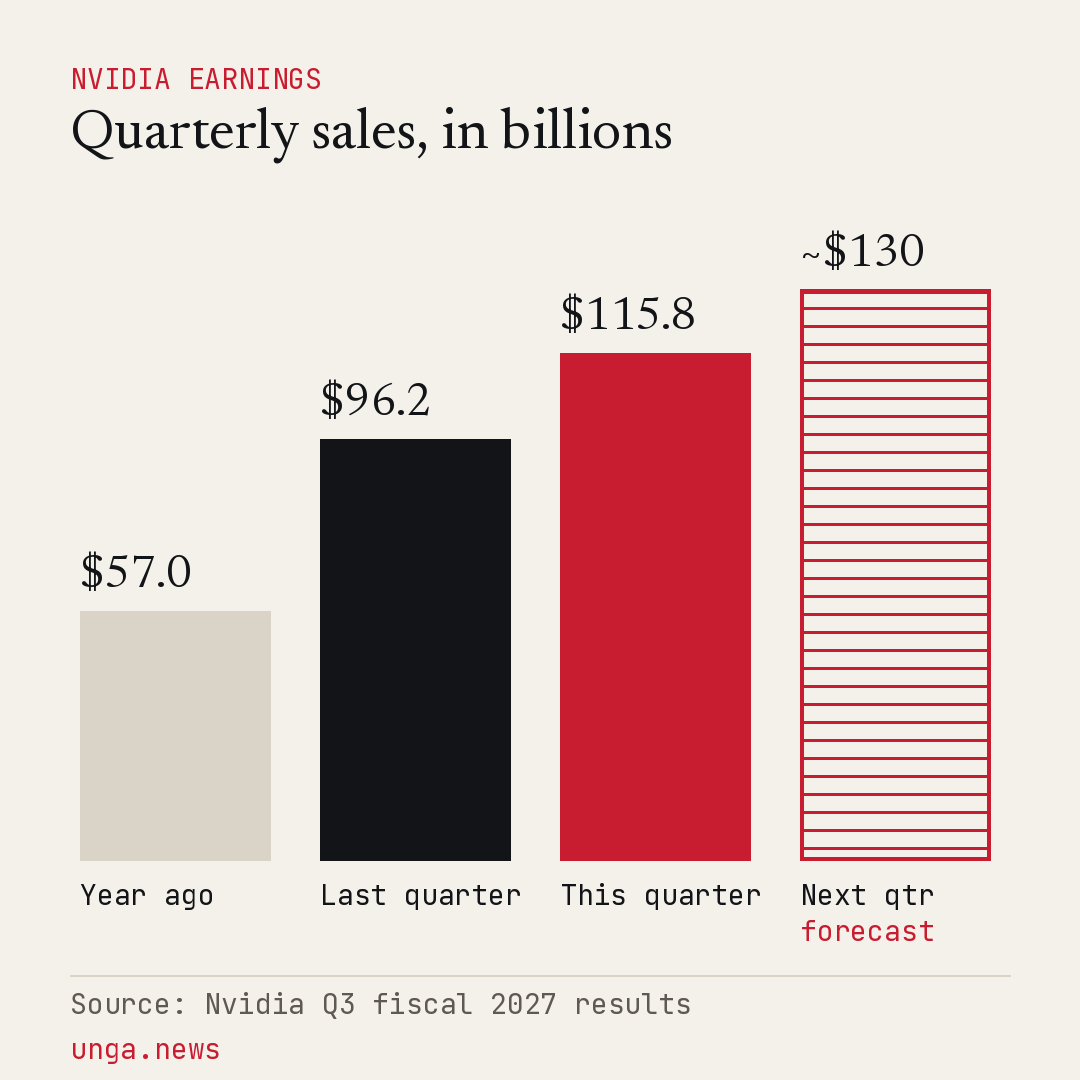
Revenue for the quarter ended Oct. 25 came in at $115.8 billion, up 103% from $57 billion a year earlier and up 20% from the summer quarter, the company said. Analysts surveyed by LSEG expected $109.1 billion. Adjusted earnings were $2.68 a share against $2.48 expected. Profit hit $65.3 billion.
This was the report we flagged over the weekend, when we noted that Nvidia had lost $1.9 trillion in value since October and would face investors without Jensen Huang. The numbers are now in, and they are huge.
The data center machine keeps running
Nearly all of the money comes from one place. Data center sales, the chips and systems that power SI in giant server farms, reached $107.6 billion, up 110% from a year ago and 21% from the prior quarter. That one business alone is now nearly twice the size of the entire company a year ago.
The company also said its newest system, Vera Rubin NVL72, has shipped. Nvidia called it “the most versatile and advanced computing platform ever built.” That matters because every major SI lab has been waiting on the next generation of hardware to train bigger models.
“Our momentum is real. NVIDIA is an exceptional technology leader, powered by the relentless innovation of our people,” said Colette Kress, the company’s longtime finance chief, who is serving as interim CEO. “Vera Rubin is off to an explosive start, our roadmap is on track and our ambition has never been greater.”
The company is also keeping more of every dollar. Gross margin, the share of sales left after the cost of making the chips, was 74.8%, up from 73.4% a year earlier. Operating income, what’s left after research, salaries and other running costs, more than doubled. For a company selling this much hardware, those margins are closer to what software firms earn than to what chipmakers usually do. Operating income came to $77.5 billion, up from $36 billion a year ago.
A bigger forecast, with China at zero
The forecast may matter more than the quarter. Nvidia expects about $130 billion in revenue this quarter, give or take 3%, which tops the $125.1 billion analysts expected, according to LSEG. The quarter includes an extra week.
Heading into the call, investors worried Nvidia might walk back its earlier forecast of 70% growth for the fiscal year ending January 2028. Instead, Kress raised it to 75%, CNBC reported. She said the outlook “considers data center readiness, the strength and durability of end customer demand, and our customers access to capital.”
All of that assumes nothing from China. “We are not assuming any Data Center compute revenue from China in our outlook,” the company said. On Monday the Commerce Department moved to stop Nvidia’s chips from being rented to Chinese companies, and Nvidia’s board on Tuesday created a committee to oversee export controls. Growing this fast while writing China down to zero says a lot about demand everywhere else.
Cash for shareholders, and a few big buyers
Nvidia returned $28.1 billion to shareholders during the quarter through stock buybacks and dividends. After the board added $150 billion to the buyback plan in September, the company has about $227.3 billion left to spend repurchasing shares. Its next dividend of 25 cents a share goes out Dec. 23.
The filing also shows how concentrated the business is. Four direct customers each accounted for between 11% and 13% of revenue, Nvidia said. The company also disclosed $118 billion in guarantees tied to data center financing, particularly an OpenAI project in Ohio, and said it has not made any payments under them.
The stock’s reaction
Shares rose about 2% in after-hours trading, CNBC reported. That followed a rough stretch: the stock is down 24% this month and on Friday finished its sixth straight weekly drop, its longest losing streak since 2012.
Much of that slide came from the turmoil at the top. Huang resigned as CEO last week after reports of a relationship with a businesswoman alleged to be a Chinese spy. At the start of Tuesday’s call, board chair Harvey Jones said the board doesn’t intend to bring him back. Many in tech, including Elon Musk, have called for Huang to return, and President Trump said he’d be open to it.
For investors, the takeaway from the numbers is plain. Whoever runs Nvidia, the world is still buying its chips as fast as it can make them.
Sources
- Nvidia (SEC) — NVIDIA Announces Financial Results for Third Quarter Fiscal 2027, Nov. 17, 2026
- NVIDIA Newsroom — NVIDIA Announces Financial Results for Third Quarter Fiscal 2027
- CNBC — Nvidia (NVDA) Q3 2027 earnings report: Live updates