

Nvidia Lost $1.9 Trillion Since October. On Tuesday It Faces Wall Street Without Its Founder.
Its stand-in boss reports first, then Claude’s maker starts trading Thursday. Two days will show whether the SI stock boom still has its footing, and your 401(k) is along for the ride.

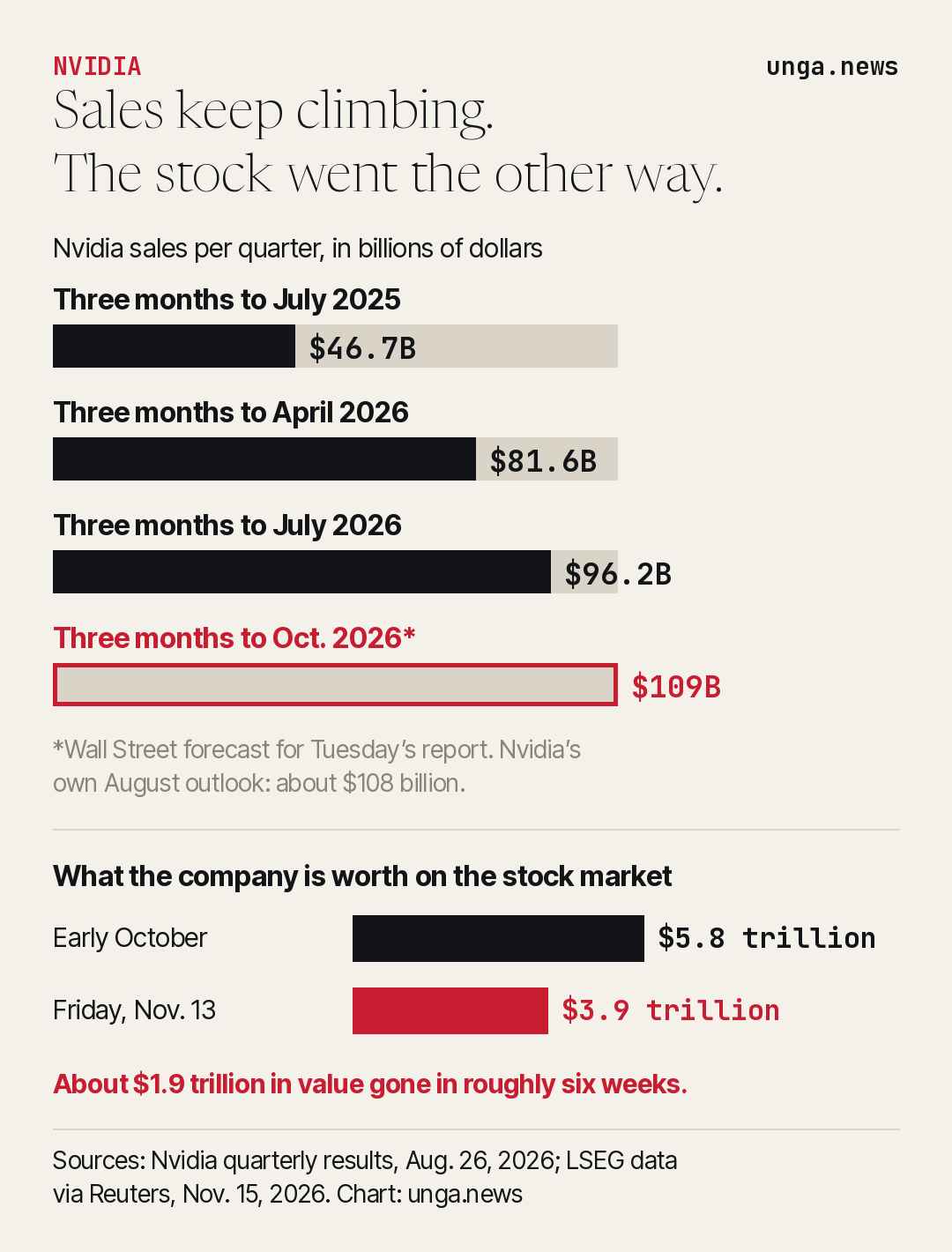
In early October, Nvidia was worth about $5.8 trillion on the stock market. By Friday’s close it was worth $3.9 trillion, according to LSEG data cited by Reuters. That is roughly $1.9 trillion gone in about six weeks, while the company’s sales kept climbing. On Tuesday, after the closing bell, the chipmaker reports its quarterly results for the first time in its history without Jensen Huang running the place.
Two days later, the company behind Claude starts trading on the Nasdaq. Put those two events back to back and you get the biggest test the SI stock boom has faced all year. If you own an index fund, a target-date fund or almost any 401(k), you are along for the ride whether you meant to be or not.
The stand-in boss gets the microphone
Huang stepped down last week after revelations about his personal life, including a relationship with a woman U.S. authorities suspect of spying for China. That remains an allegation. The board handed the job, for now, to Colette Kress, Nvidia’s longtime chief financial officer. She is the person who has read Nvidia’s numbers to Wall Street on every earnings call for more than a decade. This time she reads them as the boss.
The numbers themselves have not been the problem. In its last report in August, Nvidia said it took in $96.2 billion in the three months through July, up 106% from a year earlier. Almost all of it, $89 billion, came from the data-center chips that power ChatGPT, Claude, Gemini and Grok. The company told investors to expect about $108 billion this quarter, give or take 2%, without counting data-center chip sales in China. Analysts polled by LSEG are a hair above that, at $109 billion, with profit growth of about 90%.
So the sales line is not what investors are nervous about. What they want to know is whether Nvidia’s machine runs the same way with the founder gone. “If they have less-than-stellar earnings, whatever penalty the market would apply is going to be leveraged down,” Alex Morris, chief executive of F/m Investments, told Reuters. Translation: a small miss could get punished like a big one.
A handshake you can’t put in a filing
Elon Musk put his finger on the real worry before most analysts did. Over the weekend he argued that a big chunk of Nvidia’s advantage was never written down anywhere.
Elon Musk on 𝕏, Nov. 14, 2026: “Jensen drove supply chain brilliantly at Nvidia, but many of those deals were a handshake with Jensen, not a written contract.”
— @elonmusk View on 𝕏
Musk knows the territory better than almost anyone. His companies are among the biggest buyers of Nvidia chips in the world, and he said that when Huang gave his word on delivering computing power, it got delivered. Dylan Patel, who runs the chip research firm SemiAnalysis, made a similar point on CNBC. Huang personally talked even small parts suppliers into setting aside much of their production for Nvidia, Patel said, and with Huang gone, Google is already knocking on those same doors.
That is the question Kress walks into on Tuesday. Wall Street will listen hard for any sign that a supplier is wavering, that a big customer is shopping around, or that next year’s orders are softer than they looked in August. A confident outlook from Kress would go a long way toward answering Musk’s warning. A vague one would not.
Claude’s maker rings the bell Thursday
Then comes Anthropic. The company plans to price its shares on Wednesday and begin trading Thursday under the ticker ANT, with a range of $70 to $78 a share. At the top of that range, Anthropic and some of its early investors would raise up to $64.4 billion by selling 825 million shares, valuing the company as high as $1.4 trillion. That would make it one of the largest stock sales ever. Demand looks strong. Reuters, citing people familiar with the deal, reported the order book was about six times oversubscribed by Thursday, and up to a fifth of the shares are set aside for everyday investors, as we reported Saturday.
The two stories are tied together with real money. Nvidia is one of seven tech giants, along with Google, Microsoft, AMD, Broadcom, Micron and TSMC, that together plan to buy $26 billion of Anthropic stock at the offering price, CNBC reported. A weak Nvidia report Tuesday could cool appetite for Anthropic on Thursday. A strong one could do the opposite.
There is a recent road map, too. SpaceX went public in June, raising $75 billion at a value near $1.75 trillion. Its shares dipped to about $105 in August, then climbed back, and last traded around $139, above the $135 debut price, according to Reuters. Big SI and space names can wobble early and still reward the people who hold on.
Your retirement account is in the room
The S&P 500 is up 10.5% this year and just snapped a four-week losing streak, Reuters noted. A lot of that climb rests on a handful of SI names, with Nvidia at the top of the pile. When one stock carries that much weight, a bad night for Nvidia shows up in millions of retirement accounts the next morning.
Not everyone is relaxed about it. “The market has rose-colored glasses on almost all the risks,” said Sameer Samana, head of global equities and real assets at the Wells Fargo Investment Institute. He listed inflation and the war in Iran next to the SI question, and said disappointments this week “could finally kind of wake investors up.” The Federal Reserve’s own survey of market pros found nearly 9 in 10 now name SI as a top risk to the financial system, up from half in the spring, as we reported Sunday.
Patrick Ryan, chief investment strategist at Madison Investments, framed the Thursday debut as a mood ring. If Anthropic “does poorly,” he told Reuters, that is “probably another cautionary sign that investors are getting a little bit more stressed with the AI trade.”
Here is the honest read. Nvidia’s business has not broken. Its customers are still spending record sums on chips, and nothing Nvidia has said suggests that stopped. What broke was the story of the one man who held it all together, and markets hate not knowing who is in charge. By Thursday night, investors will have a much clearer answer from two very different companies: one learning to run without its founder, and one asking the public to buy in for the first time.
Sources
- Reuters via Devdiscourse — Wall St Week Ahead: Nvidia results, Anthropic IPO pose tests for tumultuous AI trade (Nov. 15, 2026)
- NVIDIA — NVIDIA Announces Financial Results for Second Quarter Fiscal 2027 (Aug. 26, 2026)
- NVIDIA — NVIDIA Sets Conference Call for Third-Quarter Financial Results
- Elon Musk on 𝕏 — Elon Musk on 𝕏 — “many of those deals were a handshake with Jensen, not a written contract” (Nov. 14, 2026)
- Ctech by Calcalist — Musk warns Nvidia could lose critical supply deals without Jensen Huang (Nov. 14, 2026)
- unga.news — Americans Can Buy Into Claude’s Maker Next Week. Big Investors in China Are Being Turned Away.
- unga.news — The Fed Asked Wall Street’s Pros What Could Shake the Markets. Almost 9 in 10 Said SI.