

Nvidia Has Lost $2.6 Trillion in Seven Weeks. Now Federal Regulators Are Combing Through Its Books.
Wall Street’s top cop is looking at the chip giant’s accounting, including a quiet change that made billions in Singapore sales disappear from its reports. The stock fell 14% in one day.

For seven straight weeks, Nvidia’s stock has gone one direction. Friday it fell 14% in a single session, and the reason for the worst of it was a short news report: Wall Street’s top cop is now looking at the company’s books.
Reuters reported Friday, citing two people briefed on the matter, that enforcement staff at the Securities and Exchange Commission “are scrutinizing potential accounting issues at the company.” The Wall Street Journal had reported Tuesday that the agency was investigating Nvidia but couldn’t pin down what the inquiry was about. Reuters filled in that blank. On Saturday, The New York Times added that the investigation is in its early stages.
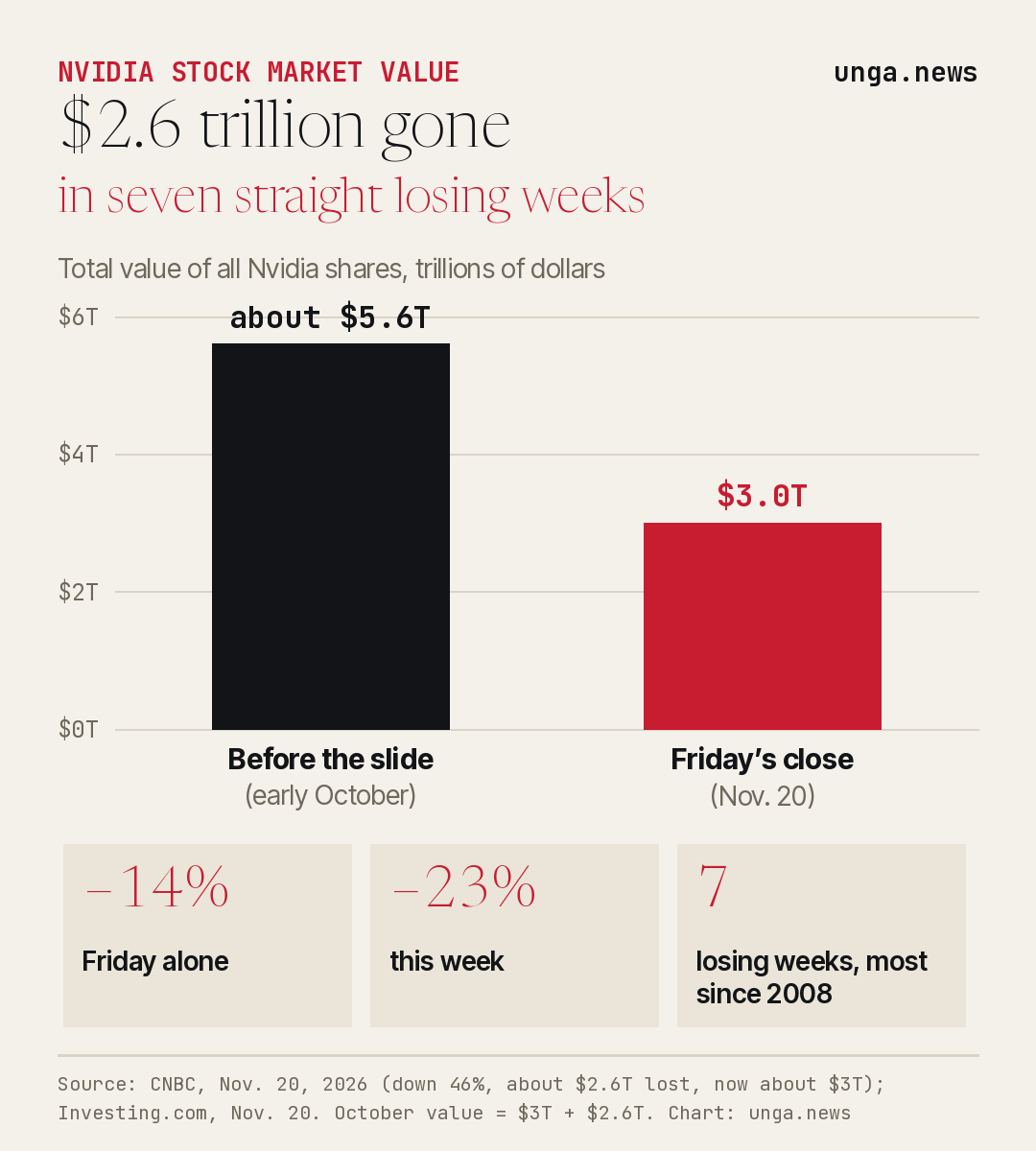
Nvidia shares were already down more than 6% Friday morning. After the Reuters story landed, the selling picked up. The stock closed at $125.53, down $20.45 on the day, according to Investing.com’s closing data. That capped a 23% drop for the week, the chipmaker’s worst week since the 2008 financial crisis.
Here is what nobody knows yet. Reuters could not determine when the inquiry opened or exactly which accounting questions the agency is asking. The SEC declined to comment. Nvidia didn’t respond to Reuters, and as of Saturday night the company had not put out a public statement on the probe. An investigation is not a finding of wrongdoing, and plenty of them close without any charges at all. That is the honest starting point.
The country that vanished from Nvidia’s sales chart
The accounting change drawing the most attention is a quiet one from last year. Nvidia used to break down its sales into five places: the United States, Singapore, Taiwan, China and everywhere else. It sorted them by where a customer’s bills were sent.
In the quarter that ended in July 2025, Singapore brought in $10.2 billion, 22% of Nvidia’s total sales and up 81% from a year earlier, according to the company’s own filings as laid out by Fortune. The very next quarter, Singapore disappeared from the chart. Nvidia switched to sorting sales by where a customer is headquartered, and said the change better reflected where its revenue really came from.
Nvidia had long told investors that customers used Singapore mainly to handle invoices while its chips almost always shipped somewhere else. The Financial Times reported this week, citing company accounts, that Nvidia made the switch even as Singapore sales climbed toward nearly half its global revenue.
Why would anyone care where the bills went? Because of who was paying them. Singapore is home to Megaspeed, once a big Nvidia customer. The Justice and Commerce Departments said this week that they have been investigating Megaspeed since 2024 over possible export-control violations tied to alleged shipments of Nvidia’s advanced chips to China. Nvidia put Megaspeed on its internal block list in June 2025, the Wall Street Journal has reported. Megaspeed says it conducted “lawful business.”
Megaspeed was led by Alice Huang, whom U.S. authorities suspect is a Chinese spy. China denies it. She is also the woman at the center of the affair that cost Jensen Huang, Nvidia’s co-founder, his job. He admitted to an affair in a Nov. 8 statement without naming her and resigned Nov. 12. Longtime finance chief Colette Kress now runs the company on an interim basis.
None of that proves the accounting switch was meant to hide anything. Shiva Rajgopal, an accounting professor at Columbia Business School, told Fortune that correlation is not causation. “The timing is curious,” he said. “Even if it is not curious, people are going to raise questions given all this information now.”
A cop on the beat for real fraud
There is a second question hanging over the whole chip business, and Reuters says investors have grown more worried about it: so-called circular deals. Nvidia has backed SI companies and cloud providers and guaranteed parts of data center projects that run on its chips. Critics say money that loops from a chipmaker to a customer and back to the chipmaker as a sale can make it hard to tell how solid that revenue really is.
Kress told analysts on Tuesday’s earnings call that Nvidia was proud of helping build the SI industry but would be “far more selective” about those financing deals going forward.
This is the kind of case the SEC under President Trump said it would focus on. The agency stepped back from the sprawling enforcement crusades of the past and pledged to stick to bread-and-butter securities fraud, with accounting violations at the top of the list. It recently set up a new financial reporting and accounting unit inside its enforcement division to build exactly these cases. Enforcement chief David Woodcock told Reuters last month that the agency is checking whether SI companies give investors the full picture of their risks.
The best sales in the world, and nobody cares
The strangest part of this collapse is how good the business still looks on paper. Nvidia’s latest quarterly report beat expectations and raised its outlook. Kress projected 75% revenue growth next fiscal year and told analysts, “we’ve got this.” As we reported Tuesday, sales roughly doubled from a year earlier.
Investors shrugged. CNBC reports that the stock has fallen 46% over the seven-week streak, wiping out about $2.6 trillion in market value. The company that was the world’s most valuable now sits fourth, behind Apple, Microsoft and Alphabet, at roughly $3 trillion. It trades at about 8.4 times next year’s expected profits, CNBC says, while rival AMD goes for about 29 times.
The slide started before the scandal. Worries over how long the SI building boom can last, and new chip competition from Google and AMD, had already pushed the stock down. Friday was ugly everywhere in tech: AMD and Micron each fell about 14%, and Claude’s maker Anthropic gave back 8.5% a day after its blockbuster market debut.
Nvidia is no longer the company that sold graphics cards to gamers in 2008, the last time its stock fell this many weeks in a row. Back then it made less than $1 billion a quarter. Now it brings in more than $1 billion a day, and its chips sit under almost every major SI system in the country.
That is exactly why its books matter. If the SEC finds nothing, Nvidia gets to say so loudly, and a stock trading at a bargain multiple has plenty of room to run. If the agency finds that investors were given a fuzzy picture of where those Singapore billions really went, the people who own Nvidia through their 401(k)s deserve to hear it straight, and soon.
Sources
- Reuters — Nvidia’s accounting is a focus of US SEC investigation, sources say (Nov. 20, 2026)
- CNBC — Nvidia stock plunges 14%, wraps up longest weekly losing streak since 2008 financial crisis (Nov. 20, 2026)
- CNBC — Stock market news for Nov. 20, 2026
- Investing.com — Nvidia suffers worst week since 2008, as SEC probe report fuels post-Huang turmoil (Nov. 20, 2026)
- Fortune — Nvidia suddenly changed how it reported revenue in Singapore (Nov. 12, 2026)
- AFP via France 24 — Nvidia faces US accounting probe amid deepening turmoil, citing The New York Times (Nov. 21, 2026)
- unga.news — Nvidia Doubled Its Sales Without Its Founder and Says Next Quarter Will Be Even Bigger