

One Tap on the Wrong Ad Let Thieves Raid Old iPhones for Crypto, Passwords and Photos
A crew armed with spy-grade hacking tools bought ads in more than 47 countries. No download needed. Updated iPhones look safe so far.

You don’t have to download anything. You don’t have to type a password or approve a payment. According to a new investigation, all it took was tapping the wrong ad on an out-of-date iPhone, and a criminal crew could start pulling your crypto wallet, your saved passwords, your messages and your photos off the phone while the page was still loading.
That is the finding in a Nov. 20 report from the ad-security firm Confiant, which tracked an operation it calls MoldyRoost. Between May 12 and Nov. 17, Confiant tied more than 480 ad web addresses to the scheme and found it aimed at people in more than 47 countries. The crew bought ordinary online ads at scale, the kind that show up in news apps, forums and games, and turned each tap into what Confiant calls “a drive-by exploit attempt against the visitor’s iPhone.”
Spy-grade tools, now for sale to thieves
The scariest part isn’t the ads. It’s what was behind them. Confiant says the payloads were “nation-state-grade iPhone exploit chains,” the kind of hacking tools governments and spyware vendors pay serious money for. MoldyRoost didn’t build them. It used two kits that Google’s threat researchers and the security firm iVerify exposed back in March, called Coruna and DarkSword.
Coruna, the older one, packs 23 exploits covering iOS 13 through 17.2.1. Google traced it from a surveillance vendor’s customer in early 2025 to a suspected Russian espionage group, and then to a money-driven crew in China that used it in broad campaigns. DarkSword hits iOS 18.4 to 18.7 and chains six flaws, three of them zero-days, meaning bugs nobody had patched when they were first used. Google described the whole pipeline as a sign of “an active market for ‘second hand’ zero-day exploits.”
In plain English, weapons built to spy on diplomats and dissidents are trickling down to regular crooks, and those crooks are aiming them at anybody with an old iPhone and a crypto app.
How a fake Agoda ad empties a wallet
Confiant walks through one example. Someone scrolling a Hong Kong forum on an iPhone taps an ad for Agoda, the travel booking site, written in Cantonese. A copy of Agoda’s Hong Kong page loads. At the same moment, an invisible window, zero pixels wide and shoved off the screen, checks the phone’s iOS version and asks a server which exploit to fire. If the visitor taps anything, an 18-second “loading” bar soaks up the clicks before sending them to the real Agoda, buying the attack the time it needs.
The crew hid all of this from the people paid to catch it. Its pages showed the poison only to iPhones running Safari or an in-app browser. Everybody else, including ad-network reviewers and security scanners, saw a harmless decoy site or a blank frame. Some versions even pushed people out of the Instagram or Facebook browser and into Safari, where the attack works best. Others showed a fake Cloudflare “Verify you are human” box just to keep the victim on the page.
Once a phone was hit, Confiant says, Coruna went after wallet apps like MetaMask, Phantom and Trust Wallet and hunted for recovery phrases saved in the phone’s notes or in screenshots of QR codes. DarkSword grabbed iMessage, WhatsApp and Telegram data, the keychain, saved Wi-Fi passwords, location history and wallet data in one sweep, and one of its backdoors could take screenshots and record the microphone.
The crooks left their own code out in the open
MoldyRoost ran like a business. In mid-November one of its servers left its source code exposed, and Confiant read the commit notes, written in Simplified Chinese, like release notes for a product. One gave every sales channel its own web address and payload so each stolen wallet was booked to the channel that brought the victim in. Confiant says that setup keeps open the possibility that the crew rents its machine out to affiliates. The ad accounts were verified business accounts, “most likely bought or hijacked.”
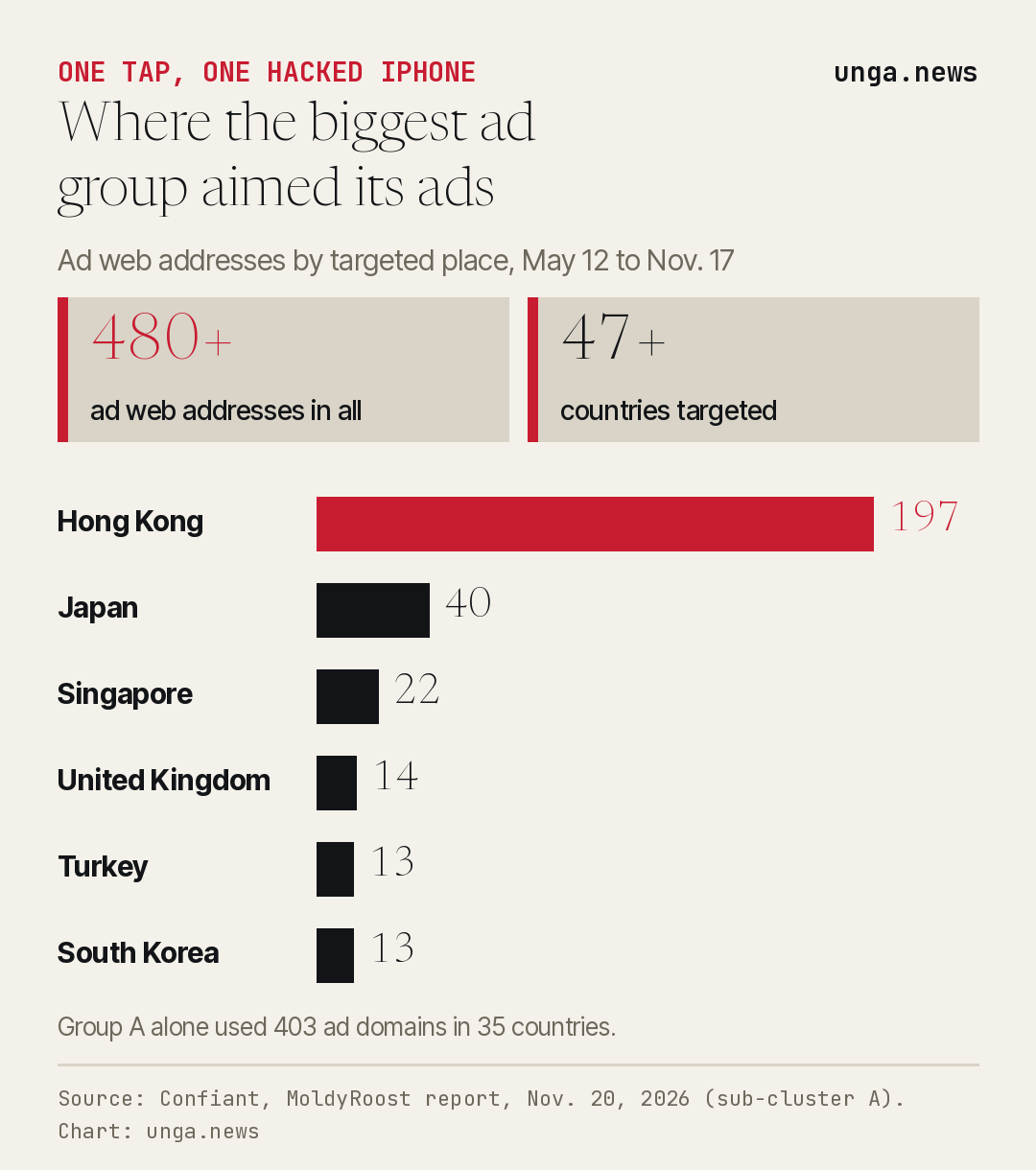
The biggest of the six ad groups, which Confiant labels A, used 403 ad domains across 35 countries. Hong Kong drew 197 of them, Japan 40 and Singapore 22. The United States showed up in several of the smaller groups. Confiant also says MoldyRoost is separate from the Nov. 16 Optimizely attack that hit 178 organizations’ websites, even though both used the same two iPhone kits.
Update the phone, and quit storing seed phrases in it
There is good news for people who keep their phones current. Apple had fixed all six DarkSword bugs by iOS 26.3. Confiant found code in the crew’s files pointing at iOS 26, but it says plainly, “We have seen no iOS 26 exploit code, and we cannot say whether any of these branches work.” The people at real risk are the ones still running older software, and there are millions of them.
The fixes are simple. Install the latest iOS. Don’t keep a wallet recovery phrase in a note or a photo on your phone, because that is exactly what this crew went looking for. And treat ads that rush you to “open in Safari” or prove you’re human with suspicion. The ad industry has spent years telling Americans that ads keep the internet free. MoldyRoost shows what happens when nobody is checking who’s buying them.
Sources
- Confiant — MoldyRoost: A Malvertising Machine Built to Deliver iOS Exploits (Nov. 20, 2026)
- crypto.news — Malicious iPhone ads target crypto wallet seed phrases in 47 countries (Nov. 22, 2026)
- unga.news — Hackers Slipped Card-Stealing Code Onto CNN, Zoom and BBC Websites Through One Hidden Tool