

Out of Work in a Job SI Can Do? The Fed Says the Search Now Takes Weeks Longer.
The Cleveland Fed found no wave of layoffs. The squeeze is on hiring, and it is landing hardest on young workers trying to get their first break.
If you lose a job in a field where SI can do a lot of the work, the Federal Reserve Bank of Cleveland says your next job search now runs more than two weeks longer than it used to. That is the number buried in a paper the bank posted on Nov. 9, and it points at something different from the layoff wave everyone keeps predicting.
The paper, by economists Alexander Cline and Barış Kaymak, asks a simple question. Since ChatGPT showed up in late 2022, has unemployment risen more in jobs that SI can do? Yes, a little. For workers aged 23 to 54, the unemployment rate has climbed about 1 percentage point more in the most SI-exposed occupations than in the least exposed ones, compared with the years 2015 through 2019.
Then they asked why, and the answer is the part worth your attention.
Nobody is getting fired faster
The Fed economists tracked the same people month to month using the Census Bureau’s Current Population Survey. They sorted 923 occupations into 20 equal groups by how much of each job’s work SI can handle, using three separate yardsticks. Then they counted two things: how often working people lost their jobs, and how fast unemployed people found new ones.
On the first count, nothing alarming. The authors write that they “do not find consistent evidence of elevated job separation rates” in jobs exposed to SI. Of the three yardsticks, one showed no link at all between SI exposure and people leaving jobs. The other two pointed in opposite directions, and none of it was statistically solid. If companies were swapping workers for software at scale, this is where it would show up. It didn’t.
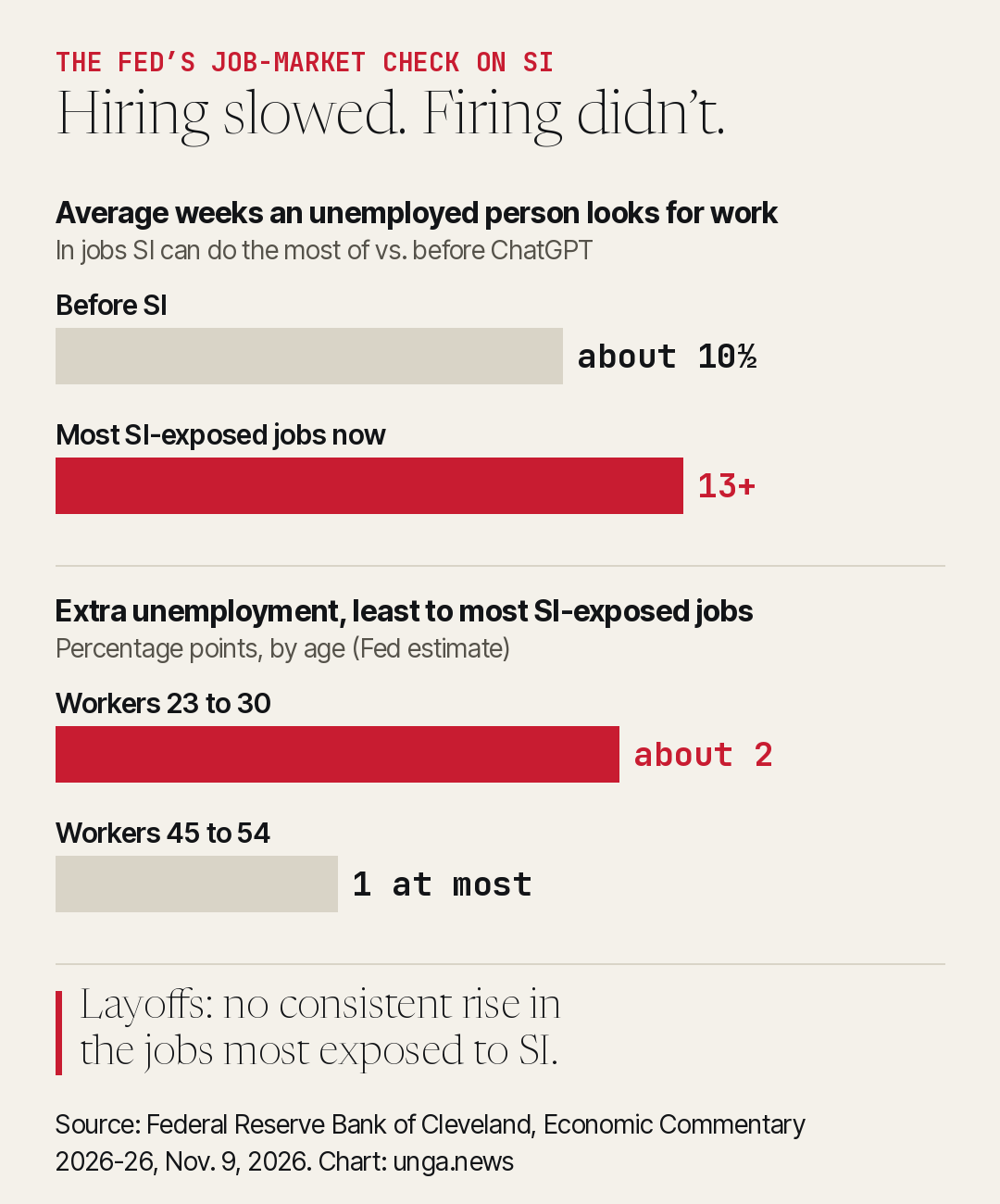
The second count is where the trouble sits. In the most exposed jobs, the share of unemployed workers who land a job in a given month fell by roughly 6 percentage points more than in the least exposed jobs. The average monthly rate for unemployed workers is about 34 percent, so losing 6 points is a big bite. The Fed puts the average stretch without work at about 10½ weeks before. In the most exposed jobs it is now more than 13.
The authors borrow a phrase from the labor market watchers: “no hire, no fire.” Companies aren’t showing anybody the door. They are just leaving the door to the front office locked, letting people retire or quit and not filling the seat.
The first rung is the one missing
Age is where this lands hardest. Moving from the least to the most SI-exposed jobs adds about 2 percentage points to the unemployment rate for workers 23 to 30. For workers 45 to 54, the gap is 1 point at most. The authors say the difference makes sense because young workers are the ones competing for entry-level jobs, and entry-level work is full of the routine desk tasks SI handles well. They describe it as a gradual restructuring of jobs “from the bottom up.”
Anyone with a kid finishing college or a nephew trying to land a first real job has already seen a version of this. The résumé goes out, the application sits, and the reply never comes. Nobody got laid off. There just wasn’t a seat to take. The same pressure showed up when we looked at SI and real freelance work, where the software now finishes a real share of paid projects start to finish.
Experienced workers inside these jobs mostly look fine. The paper says the people with years of expertise, contacts and know-how inside a company are harder to replace, at least for now. If you are already in the seat, the Fed’s data says you are mostly still in it.
What the study can and can’t prove
The Fed is careful here, and so should everyone else be. The authors call it “an early and necessarily incomplete look” at a change that will play out over years. The findings show a pattern, not proof that SI caused it. And the survey sorts jobless people by their last job, not the job they want next, so a person who has never held a job can’t be placed in an occupation at all.
The yardsticks also disagree a little. Two measure what SI could do in theory, using a list of tasks rated by experts and by a chatbot. The third looks at what people actually ask a chatbot to do, drawn from more than four million Claude conversations in an earlier Anthropic study. That third measure shows a weaker link, and the Cleveland Fed says one reason may be that people use SI to do their work better, not to replace it. Anthropic’s data put about 43 percent of use as replacing a task and 57 percent as helping a person do it.
That is the honest middle of this story. The scariest talk says SI will wipe out millions of jobs overnight. The Fed’s numbers say that hasn’t happened. They also say the comfortable line, that nothing is changing, is wrong for the people on the outside looking in.
Companies are waiting to see what SI can do before they commit to new headcount. Waiting is cheap for a company and expensive for a 24-year-old with rent due. A few extra weeks between jobs adds up to real money for a family, and the Fed says the extra weeks are landing on people at the start of their careers.
We covered the Fed’s other big look at SI this weekend, when its financial stability survey found nearly nine in ten market pros naming SI as a risk. Same central bank, two different lenses, and both end up in the same spot. Everyone is betting on this technology, and the people who have to find the next paycheck are the ones living with the bet.
For anyone job hunting in a field full of desk tasks, the Fed’s paper offers one practical lesson. Budget more time for the search, cast a wider net, and lean on the things a chatbot can’t fake, like a person who vouches for you and work you can show in front of someone. The jobs are not gone. The doorway just got narrower for those still trying to get through it.
Sources
- Federal Reserve Bank of Cleveland — Job Finding and Unemployment in the Age of AI, Economic Commentary 2026-26 (Nov. 9, 2026)
- Eloundou, Manning, Mishkin and Rock — GPTs Are GPTs: An Early Look at the Labor Market Impact Potential of Large Language Models (2023)
- U.S. Census Bureau — Current Population Survey (CPS), the monthly survey behind the Fed’s job-finding data
- Anthropic — Which Economic Tasks are Performed with AI? Evidence from Millions of Claude Conversations (Handa et al., 2025)