

South Korea’s Government-Run Power Company Got Hacked Again, Exposing Bank Details for 650,000 Customers
Hackers took card numbers, bank accounts and national ID numbers from the country’s only power company, a month after its CEO apologized for an earlier leak.
Every family in South Korea buys its electricity from the same place. Korea Electric Power Corp., known as KEPCO, is controlled by the government, runs the country’s grid and sends the monthly bill. There is no other power company to switch to.
Now that monopoly has handed a hacker the bank details of 650,487 of its customers.
KEPCO said in a statement on Sunday that an outside attacker broke into two of its computer systems and walked off with personal data on more than 1.5 million people. The worst of it hit KEPCO ON, the website and app Koreans use to check and pay their power bills. For those 650,487 customers, the stolen records include names, national ID numbers, phone numbers, home addresses, bank names, bank account numbers, card companies, card numbers, the names on the cards and their billing history.
South Korea’s national ID number works a lot like a Social Security number here. Pair it with a home address and a bank account, and a crook has most of what he needs to pose as you.
The hacker sent the first email
KEPCO did not catch this on its own. According to the country’s privacy regulator, the Personal Information Protection Commission, a hacker emailed KEPCO on Thursday, Nov. 19, claiming to have stolen its data. The next day KEPCO found the data posted on the dark web and checked a sample the hacker had sent. It confirmed the leak Friday afternoon, cut off outside access, and shut down both KEPCO ON and its procurement system, called SRM, which contractors use to bid on construction and service jobs.
The second system turned out to be just as leaky. KEPCO says data on 869,761 SRM users was taken: 426,827 business owners lost their names, national ID numbers, emails and company addresses, and 442,934 KEPCO and contractor employees lost their names, employers, employee ID numbers, cell numbers and work contact details. That count is every SRM user on file. KEPCO told Yonhap it can’t yet pin down exactly whose records left the building, so it is treating everyone as exposed.
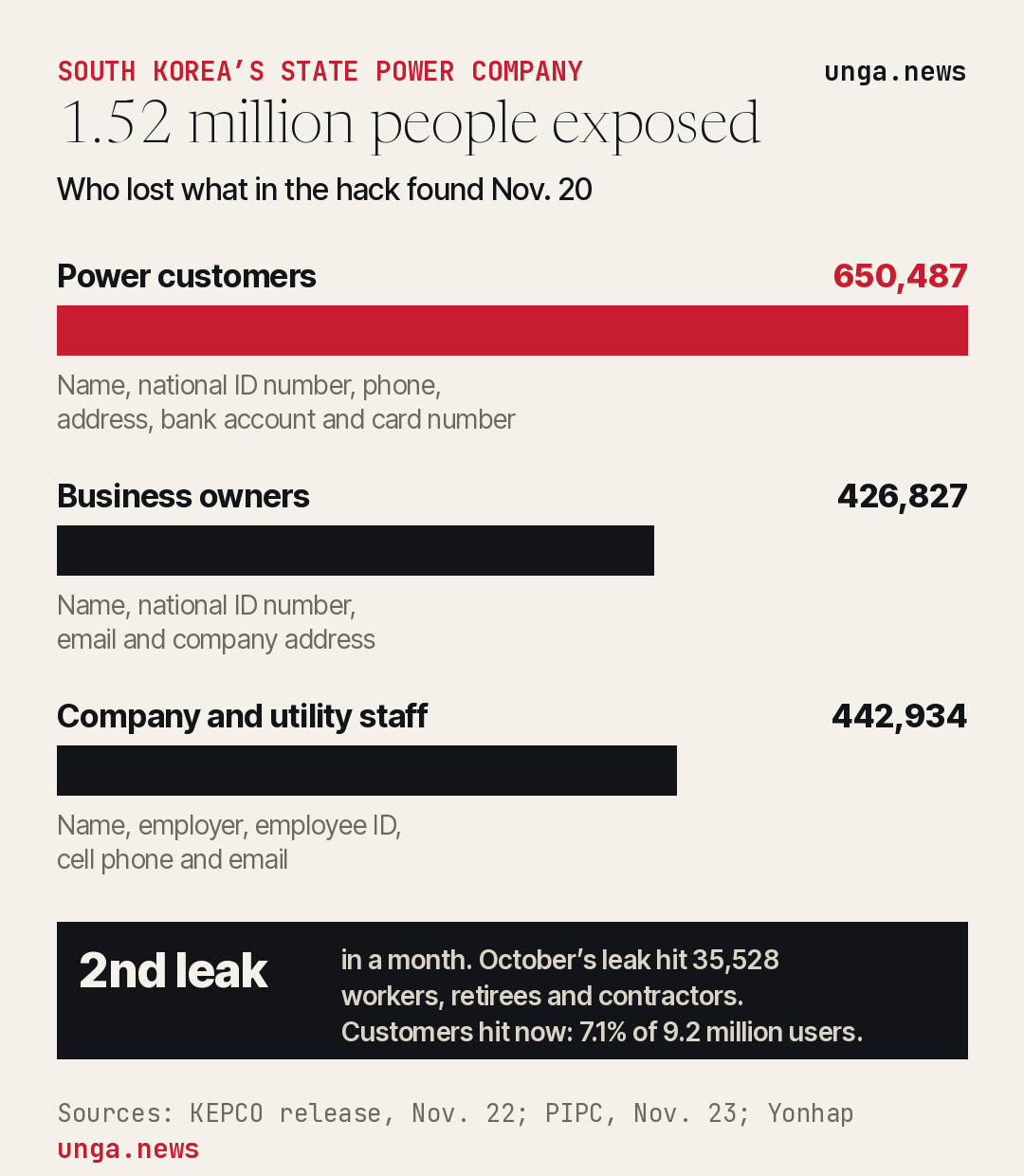
Add the two systems together and you get about 1.52 million people. KEPCO ON alone has about 9.2 million users, so roughly one in 14 of them just had their payment details stolen, according to Yonhap.
KEPCO hasn’t said how the attacker got in. Its statement points to cyberattacks that use “advanced technologies such as AI” and are getting smarter, and says it is investigating the route and method of the attack with the National Intelligence Service, the energy ministry’s cyber safety center and outside experts, with a police referral coming. A hacker going by “Noiem” advertised KEPCO data on a hacker forum on Nov. 19, the same day the email arrived, according to BleepingComputer, though nobody has officially confirmed that person did it.
Twice in two months
This is not KEPCO’s first leak this fall. Last month the company admitted the names and phone numbers of 35,528 employees, retirees and contractor workers had gotten out. CEO Kim Dong-cheol went before the National Assembly and apologized, promising a “fundamental innovation” of the company’s entire information security operation so it would not happen again.
About a month later, it happened again, and this time it reached customers’ bank accounts. On Sunday, Kim apologized a second time. “I sincerely apologize for causing great concern to the public,” he said, adding that he feels keenly responsible for failing to fully protect customers’ information.
Apologies are cheap when your customers can’t leave. If a private bank or phone company loses your card number, you can close the account and walk across the street. A KEPCO customer can’t. The lights stay on only if the bill gets paid, and the bill gets paid through the same company that just lost the bank details. That is the trouble with a government-run monopoly. Nobody can fire it, and the threat of losing customers never comes.
Seoul seems to know it. The privacy commission opened a formal investigation Monday and sent a rapid-response team for an on-site inspection. It noted that, as of Sept. 11, fines for public agencies that leak personal data were raised from 2 billion won to as much as 5 billion won for serious, repeated violations, and that agency heads now face tougher discipline. KEPCO has now leaked twice in roughly two months.
What about the military bids?
KBS, South Korea’s public broadcaster, reported Monday night that the hacker was shopping the stolen procurement data on the dark web and claimed it included bidding records. That set off alarm, because KEPCO does a lot of work for the government and the military. The U.S. Army says KEPCO produces 93% of South Korea’s electricity and powers Camp Humphreys, the biggest American military base overseas.
KEPCO pushed back Tuesday. It told KBS it never negotiated with the hacker, received no ransom demand and only exchanged messages to get a sample file to verify. It also said the military and government facility bid information found in a separate sample obtained by the National Intelligence Service was already public on the government’s procurement website. That is reassuring if it holds up, but it is the company’s word, and this is a company that has had a rough two months on keeping secrets.
KEPCO began emailing affected people Sunday evening, texting those it had no email for and posting a notice on its website. It runs a call line for damage claims and says it will ask banks and financial regulators to watch for unusual transactions. The regulator is warning people to ignore login requests, strange links and app installs that may follow, since scammers love a fresh list of names, numbers and bank accounts.
South Korea is having a bad run. On the same day, the brokerage Samsung Securities said personal data on more than 8,000 clients had been taken from its customer website, which the Korea Times called the latest in a string of attacks on the country’s financial firms. And on Monday, Canada’s biggest phone company said a hacker using SI tools had gotten inside its systems.
For Americans, the KEPCO case is a warning worth taking. Our own utilities hold the same goods: account numbers, payment cards, home addresses and the names of the people who keep the grid running. Most of us can’t pick our power company either. South Koreans just learned what that costs when the only power company in town gets careless twice, and American utilities would be wise to make sure the first warning they get never comes from the hacker’s own email.
Sources
- KEPCO — 한전, 사이버 침해로 개인정보 유출 (KEPCO statement on the cyber breach, Nov. 22, 2026)
- Personal Information Protection Commission — 개인정보위, 한전 개인정보 유출사고 조사 착수 (PIPC opens KEPCO investigation, Nov. 23, 2026)
- Yonhap — 한전, 고객 등 개인정보 152만여건 유출 (KEPCO leaks 1.52 million records, Nov. 22, 2026)
- KBS — 한전 “해커와 협상하지 않아…자료 진위 확인했을 뿐” (KEPCO: no negotiation with hacker, Nov. 24, 2026)
- BleepingComputer — South Korea’s power giant KEPCO confirms data breach impacting 1.5 million (Nov. 23, 2026)
- The Korea Times (Yonhap) — Personal information of more than 8,000 clients at Samsung Securities breached (Nov. 23, 2026)
- unga.news — Canada’s Biggest Phone Company Says an SI-Driven Hacker Took Customers’ Names, Addresses and Account Numbers