

Tesla Now Has More Driverless Cars Cleared for Texas Roads Than Waymo
Six months ago Waymo had 619 robotaxis on the state’s new register and Tesla had 42. Now Tesla leads, and more than half its fleet has no steering wheel.
Two years ago the experts had Tesla’s self-driving plans filed under hype. Waymo, the Google sister company with spinning roof sensors and a head start of more than a decade, was supposed to own the driverless future. In Texas, at least, the paperwork now tells a different story.
As of Sunday, Tesla Robotaxi LLC had 1,507 driverless vehicles registered with the Texas Department of Motor Vehicles under its state authorization. Waymo had 1,364. That makes Tesla No. 1 of the 17 companies on the state’s automated vehicle register, with about 41% of all 3,718 vehicles on it, according to the EVwire Robotaxi Tracker, which checks the DMV’s public register several times a day.
A list that didn’t exist two years ago
The register exists because Texas wrote a law that lets companies build. Senate Bill 2807, which Gov. Greg Abbott signed on June 20, 2025, requires any company running driverless vehicles commercially, with no human behind the wheel, to get an authorization from the Texas DMV. The state can restrict or pull that permit if a company operates unsafely. Enforcement began May 28, 2026.
That is a simple deal: show the state who you are and what you’re running, follow the rules of the road, and you can get to work. No years-long permit maze, no city-by-city approval fights. Tesla got its authorization on May 14 and Waymo on May 5, according to the DMV record the tracker reproduces.
When enforcement started, the race wasn’t close. On May 28, Waymo had 619 vehicles on the list and Tesla had 42.
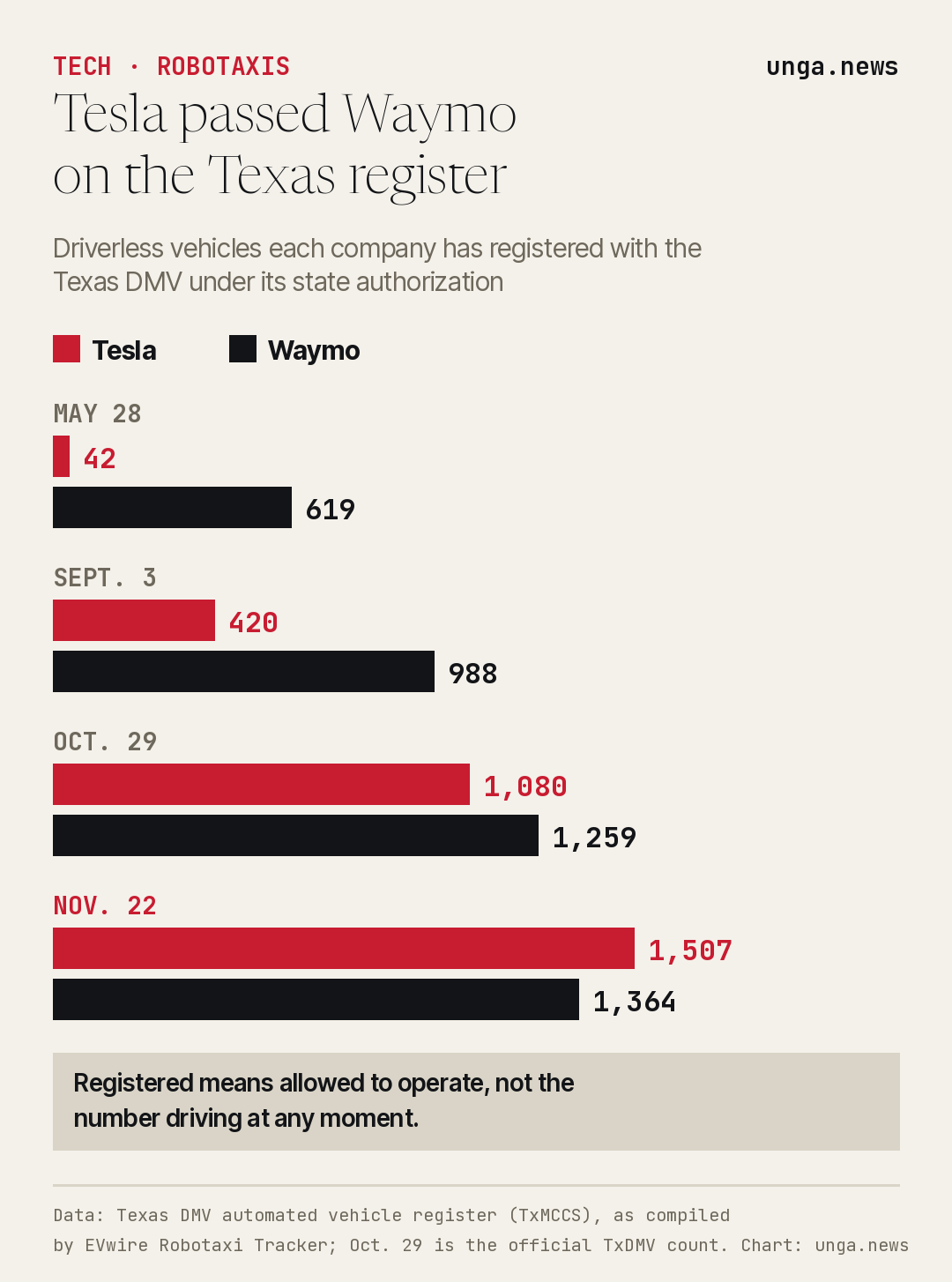
Tesla climbed every month after that. By early September it had 420. The DMV’s own official count for Oct. 29 showed Tesla at 1,080 and Waymo at 1,259. Then came November. The tracker shows Tesla adding vehicles on Nov. 10, enough to pass Waymo on the register that day, and then a single batch of 201 on Nov. 17 that took it from 1,306 to 1,507. Waymo added 19 of its own on Nov. 20.
Half the fleet has no steering wheel
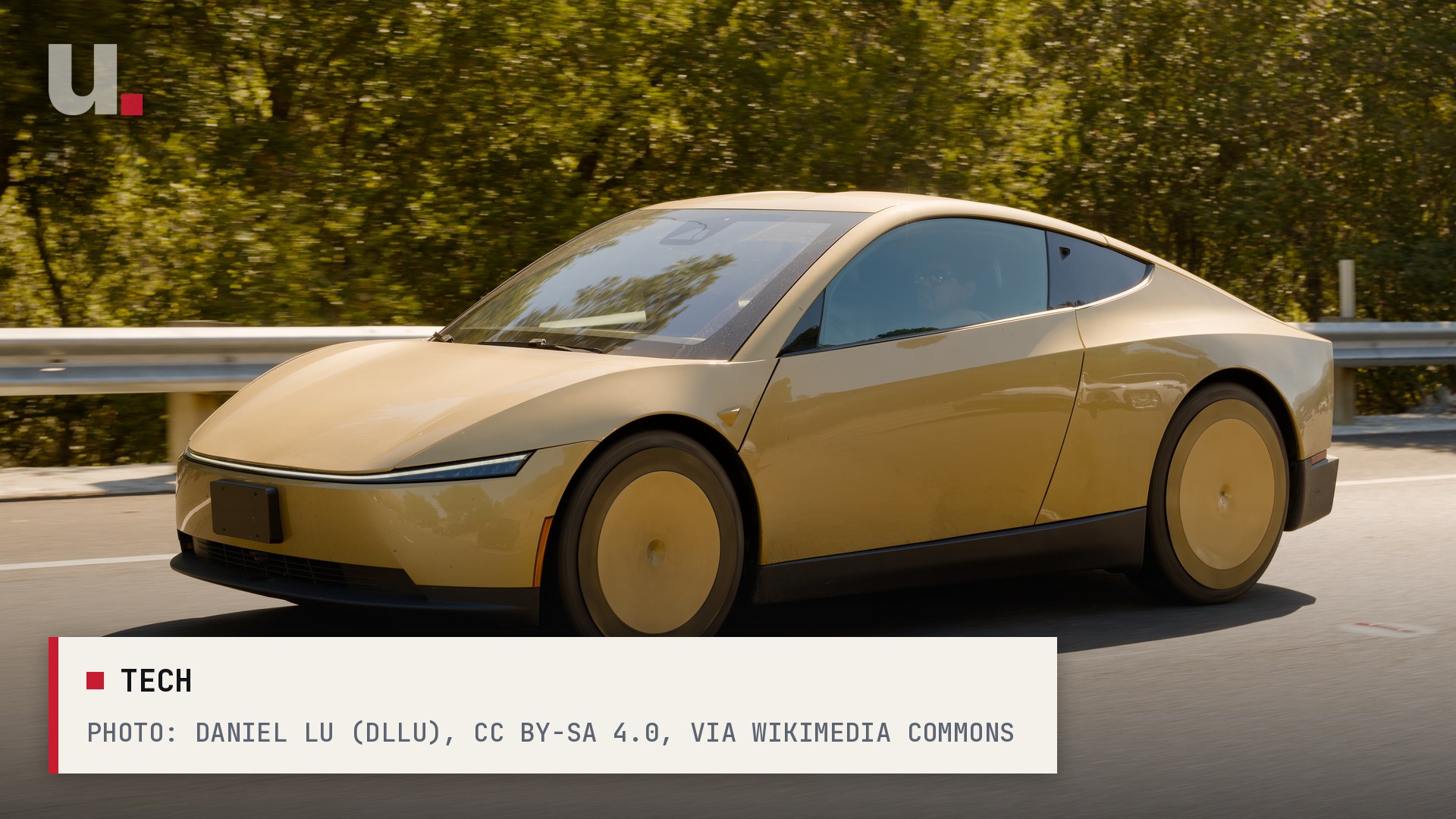
The makeup of the two fleets says even more than the totals. Decoding each vehicle identification number with the federal government’s own VIN tool, the tracker counts 773 Cybercabs and 734 Model Ys on Tesla’s list. The Cybercab is the two-seat robotaxi Tesla built from scratch with no steering wheel and no pedals. More than half of Tesla’s Texas fleet is a car a human can’t drive even if he wanted to.
Waymo’s list is 881 Jaguar I-PACEs, an electric SUV Waymo outfits with its sensor package, and 483 of its newer Ojai vans.
Elon Musk has argued for years that the money is in the cost of the car. Cameras and a computer are cheap. A rack of lidar and radar on a luxury SUV is not. Replying to the news on Sunday, he put it plainly.
Elon Musk on 𝕏 — “Most people don’t yet realize that Cybercab would win even at price parity and its cost will be much less” (Nov. 22, 2026)
— @elonmusk View on 𝕏
If a company can build a purpose-made robotaxi for a fraction of what a converted luxury SUV costs, it can put more of them on the road and charge riders less. That’s the bet, and Texas is where it’s being tested at scale.
Texas and California went different ways
The contrast with California is hard to miss. This month California’s DMV moved to keep driverless cars off its freeways over construction-zone problems, and Waymo pulled its driverless rides off every U.S. freeway on Nov. 17, as we reported. Texas went the other direction years ago: one clear statewide rulebook, a permit that doesn’t expire unless it’s suspended or revoked, and the power to yank it from anyone who operates unsafely. Accountability without a bureaucratic chokehold.
That’s why companies keep filing in Texas. Seventeen are on the register now, from robotaxi outfits like Avride (344 vehicles) and Zoox (85) to trucking companies like Aurora (91), Kodiak (36) and Waabi (13). The jobs, the factories and the testing are following the friendlier rules. Tesla itself moved its headquarters from California to Austin in 2021.
What the number does and doesn’t mean
A fair reading needs one caution, and the tracker says it up front: registered means allowed to operate, not out driving at any given moment. The register counts vehicles a company has put under its authorization. It doesn’t show miles, rides or how many cars are running on a Tuesday night. Waymo has been giving paid driverless rides far longer, and ride counts are where the next scorecard will be kept.
But registrations aren’t nothing. Nobody signs up hundreds of vehicles with a state regulator for fun. Each one is a car a company plans to put to work on Texas roads, and on that list the company everybody wrote off as a follower is now in front.
For riders, competition is the win. Two well-funded American companies fighting over the same cities means more cars, shorter waits and pressure on prices. For Texas, it’s proof that writing rules that welcome builders brings the builders. And for everyone who spent years saying a camera-only robotaxi with no steering wheel would never work, the Texas DMV now has a number for them: 773.
Sources
- Texas DMV — Automated Vehicles Regulatory Program (SB 2807 authorization requirements)
- Texas Legislature Online — 89(R) SB 2807 — actions (signed June 20, 2025; effective Sept. 1, 2025)
- EVwire Robotaxi Tracker — Registered automated vehicles in Texas by company (Texas DMV TxMCCS data, checked Nov. 22, 2026)
- EVwire Robotaxi Tracker — Tesla vs Waymo on the Texas register
- EVwire Robotaxi Tracker — Tesla in Texas: authorization and models
- EVwire Robotaxi Tracker — Waymo in Texas: authorization and models
- Elon Musk on 𝕏 — — on Cybercab cost (Nov. 22, 2026)
- unga.news — Driverless Waymo cars kept driving into work zones (Nov. 18, 2026)