

The Senate Just Voted to Let America Build Power Lines and Mines Again
After a decade of talk, 47 Republicans and 15 Democrats passed the bill to cut years of red tape off energy projects. Now it’s the House’s turn before Democrats take over.

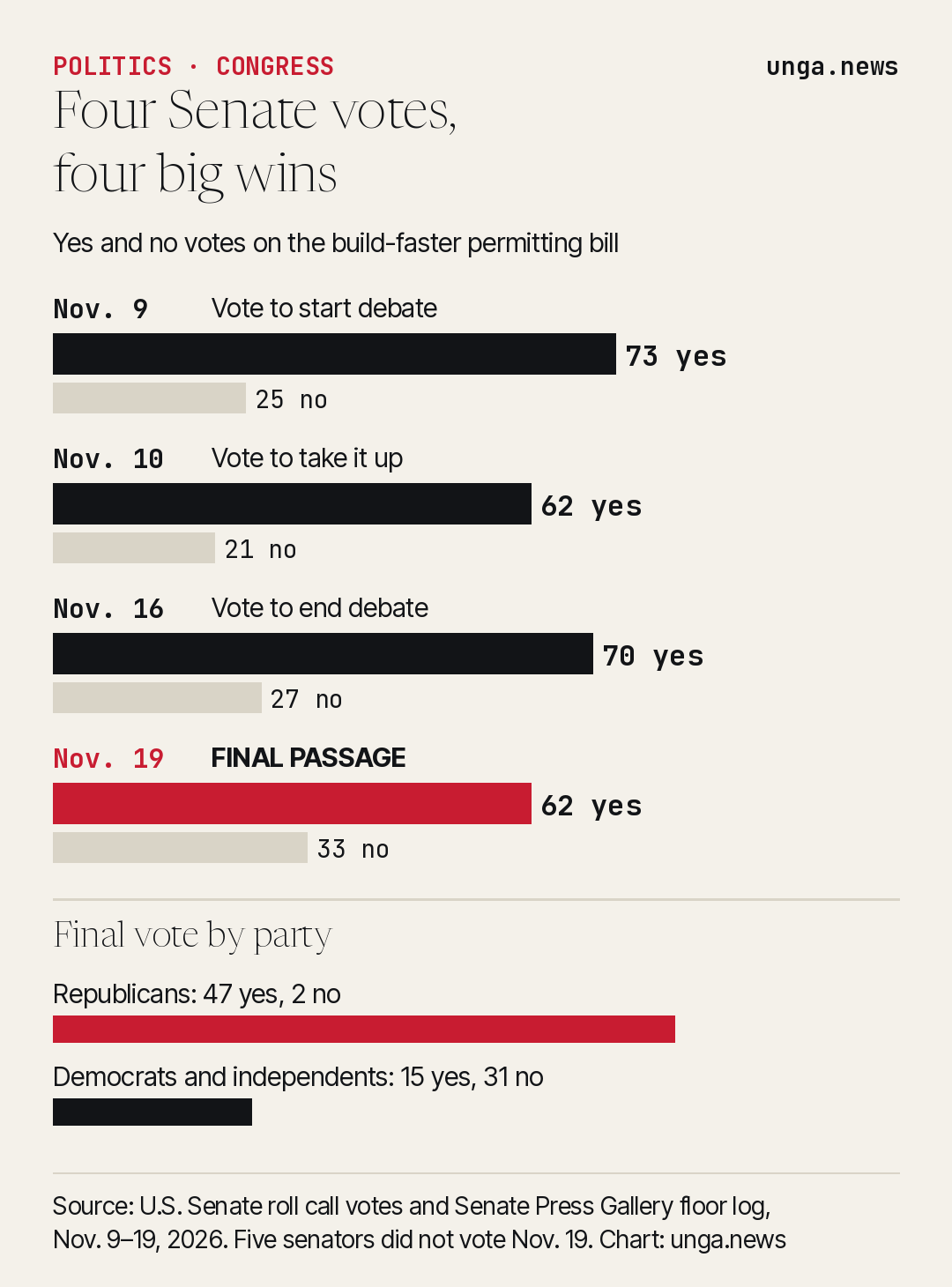
The Senate finally did the thing Washington has talked about for a decade. Late Thursday night, by a vote of 62 to 33, senators passed the Bipartisan American Affordability and Jobs Act, the bill meant to stop power lines, mines, pipelines and power plants from sitting in paperwork for years before a single shovel hits dirt. We covered the 70–27 vote that cleared the last procedural hurdle on Monday. Thursday was the real thing. It’s now through the Senate and headed to the House.
The Senate floor log puts the final roll call at 10:02 p.m. Fifteen Democrats and independents voted yes, including Senate Democratic Leader Chuck Schumer, John Fetterman of Pennsylvania, Amy Klobuchar of Minnesota, Elissa Slotkin of Michigan and Angus King of Maine. Two Republicans, Josh Hawley of Missouri and Mike Rounds of South Dakota, voted no. Five senators didn’t vote: Bill Cassidy, John Cornyn, Mitch McConnell, Chris Murphy and Tommy Tuberville.
Do the math and it was 47 Republicans carrying the bill, with 15 Democrats along for the ride. Roll Call counted 31 Democrats against it. That’s more than half the Democratic caucus voting to keep a system that leaves big American projects stuck for years.
Capito’s long road to 62
The bill belongs to Sen. Shelley Moore Capito of West Virginia, the Republican who chairs the Environment and Public Works Committee. She wrote it with Utah Republican Mike Lee, who chairs the Energy and Natural Resources Committee, and the two top Democrats on those panels, Sheldon Whitehouse of Rhode Island and Martin Heinrich of New Mexico.
“Tonight, the passage of permitting reform in the Senate finally became reality and we took a major step towards addressing the affordability concerns of the American people,” Capito said in a statement after the vote. She thanked her three fellow negotiators, “the support from the Trump administration and over one thousand stakeholders,” and told House leaders to pass it “expeditiously.”
The Trump White House backed the bill in a formal statement of administration policy this month, Roll Call reported. That matters, because any permitting bill needs the president’s signature, and Heinrich and Whitehouse made that exact argument to fellow Democrats who wanted to wait. Trump has two more years in office. A deal with his blessing beats a wish list he would veto.
Majority Leader John Thune made the pocketbook case on the floor Monday. “Mr. President, the federal permitting process is broken,” he said. “Too often, projects are bogged down in bureaucratic delays for months, and often years, at a time. Delays cause project budgets to balloon, which then leads to higher costs for American consumers.” He tied it to jobs on hold because a new factory won’t open on time, and to towns still waiting on broadband because the lines are stuck in review.
What changes if it becomes law
The bill rewrites how reviews and permits work under five big federal laws: the National Environmental Policy Act, the National Historic Preservation Act, the Endangered Species Act, the Federal Power Act and the Clean Water Act. Those are the laws that environmental groups and blue states have used for decades to sue projects into the ground, one delay at a time.
It covers nearly everything that powers the country: electric lines, wind and solar farms, hard-rock mines and oil drilling. It gives the Federal Energy Regulatory Commission new power over interstate transmission lines, which today can take a decade or more to string across state borders.
There’s a piece aimed straight at your electric bill, too. Roll Call reported that the bill includes language meant to keep regular ratepayers from getting stuck with the cost of hooking up the giant data centers that SI companies are racing to build. With power demand from those facilities spiking, that’s the kind of protection families in data-center country have been asking for.
The bill also gives builders legal recourse if a future administration tries to yank a permit for ideological reasons or play favorites among kinds of energy. For anyone who watched a Democratic administration slam the brakes on pipelines and drilling, that “project certainty” is the whole ballgame. Investors don’t pour billions into a project that the next president can kill with a pen stroke.
The Oregon holdouts
Not everything went smoothly Thursday. The sponsors had lined up a final package of fixes, including a tweak to make sure big SI “hyperscalers” couldn’t wriggle out of the ratepayer protections and changes to address eminent-domain worries Hawley and Rounds raised about transmission lines. Those changes never got a vote.
Oregon Democrats Jeff Merkley and Ron Wyden refused to agree to a time deal for amendments, according to Roll Call. Wyden wanted a vote banning data centers on federal public lands. Merkley wanted to strip data centers out of the permit protections and limit the president’s tariff power on wind turbine parts. When Republicans wouldn’t give his amendments simple-majority votes, Merkley objected, and the cleanup package died with it.
Merkley is in line to chair the Environment and Public Works Committee when Democrats take over in January. He made clear before the vote that he wanted another shot at the bill. Some of the biggest environmental groups, including the Sierra Club and the Natural Resources Defense Council, oppose it, along with 17 Democratic-led states, Roll Call reported.
A narrow window in the House
The House is the last stop, and the clock is the problem. Democrats take control of both chambers in January, and many of them would rather start over on their own terms. Roll Call reported the measure is expected to come up after Thanksgiving, and that Speaker Mike Johnson said last week it can pass the House. Some Democrats, including Reps. Scott Peters of California and Nikki Budzinski of Illinois, have spoken in favor.
That gives Johnson a few weeks to finish a job Congress has fumbled since the Obama years. A bill with oil drillers, solar companies, the Chamber of Commerce, manufacturers and the White House all on the same side doesn’t come along often. If the House sends it to Trump’s desk before Christmas, the country gets the biggest change to how it builds in a generation, and Capito gets the win she spent years chasing.
Sources
- U.S. Senate Daily Press Gallery — Thursday, November 19, 2026 (floor log and roll call on H.R. 2347)
- Senate Environment and Public Works Committee — Senate Passes Capito’s Bipartisan American Affordability and Jobs Act (Nov. 19, 2026)
- Sen. John Thune — Thune: Permitting Reform Will Help Lower Costs, Get America Building Again (Nov. 17, 2026)
- Roll Call — Sweeping permitting overhaul passes Senate, on to House
- Politico — Senate passes landmark permitting deal
- unga.news — Senate Votes 70–27 to Cut the Red Tape Keeping New Power Lines Stuck for a Decade