

Your Next Flight Could Get a Faster Route From SI. The First 180 Saved 10 Minutes Each.
The FAA’s SI planning system now covers the sky over the entire country after a test over Washington. Controllers still make every call.
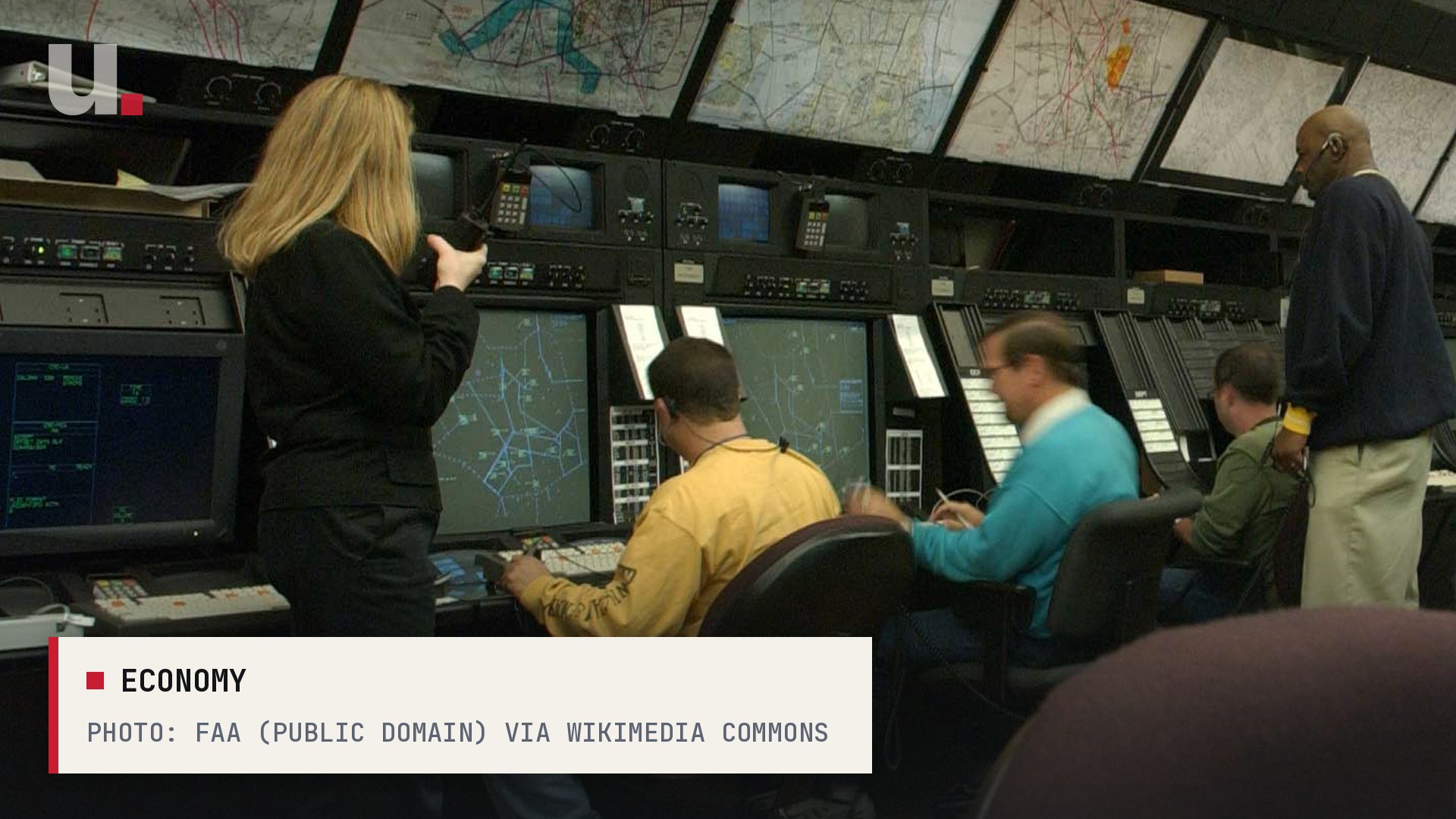
Every morning, before the first plane pushes back from the gate, thousands of flights across America are already doomed to run late. Too many of them are scheduled to squeeze through the same patch of sky at the same time. Add a line of thunderstorms over Atlanta or a short-staffed control center in New York and the whole country backs up. You feel it at the gate, staring at a board that keeps sliding from “On Time” to “Delayed.”
The FAA thinks it finally has a tool to see that mess coming. This week it said its SI-powered planning system, called SMART, is now in use over the entire country. In an FAA statement posted Monday, the agency said that after “a successful initial rollout to the National Capital Region in September, the FAA will now use SMART in the airspace of all 22 centers across the country to reduce delays, reduce fuel consumption and improve the travel experience for the flying public.”
Those 22 centers are the big regional facilities that handle planes once they climb out of an airport’s neighborhood and cruise across the country. As of this week, SMART is advising all of them.
Seeing the jam before it forms
The old way of running the sky is mostly reactive. A storm pops up, traffic stacks up, and the FAA scrambles to reroute flights or shut down chunks of airspace while passengers sit on the tarmac. SMART is built to flip that around.
It pulls 200 separate streams of data into one place, including weather patterns, flight paths, traffic flow and how many controllers are on shift. Its SI engine then works out where congestion and weather are likely to cause trouble, and suggests schedules, better routes and the best order for planes to land. According to the Transportation Department’s launch announcement, it lets planners look hours, days and even weeks ahead and fix problems “before they arise.”
Transportation Secretary Sean Duffy unveiled it with FAA Administrator Bryan Bedford on Sept. 21 and didn’t undersell it. “By fundamentally reshaping how we manage our airspace and preventing problems before they happen, SMART will slash those frustrating delays, reduce stress on air traffic controllers, and lower travel prices,” Duffy said. “The Trump Administration is committed to making flying hassle-free and affordable again.”
Bedford said the administration was “moving at record speed to build the modern air traffic control system America needs,” alongside the hardware upgrades already underway.
The early numbers
Here’s what the FAA says SMART has done since it switched on over Washington, D.C., on Sept. 21. It helped reroute 180 flights. Those flights saved an average of 10 minutes each, and almost 80 gallons of fuel each.
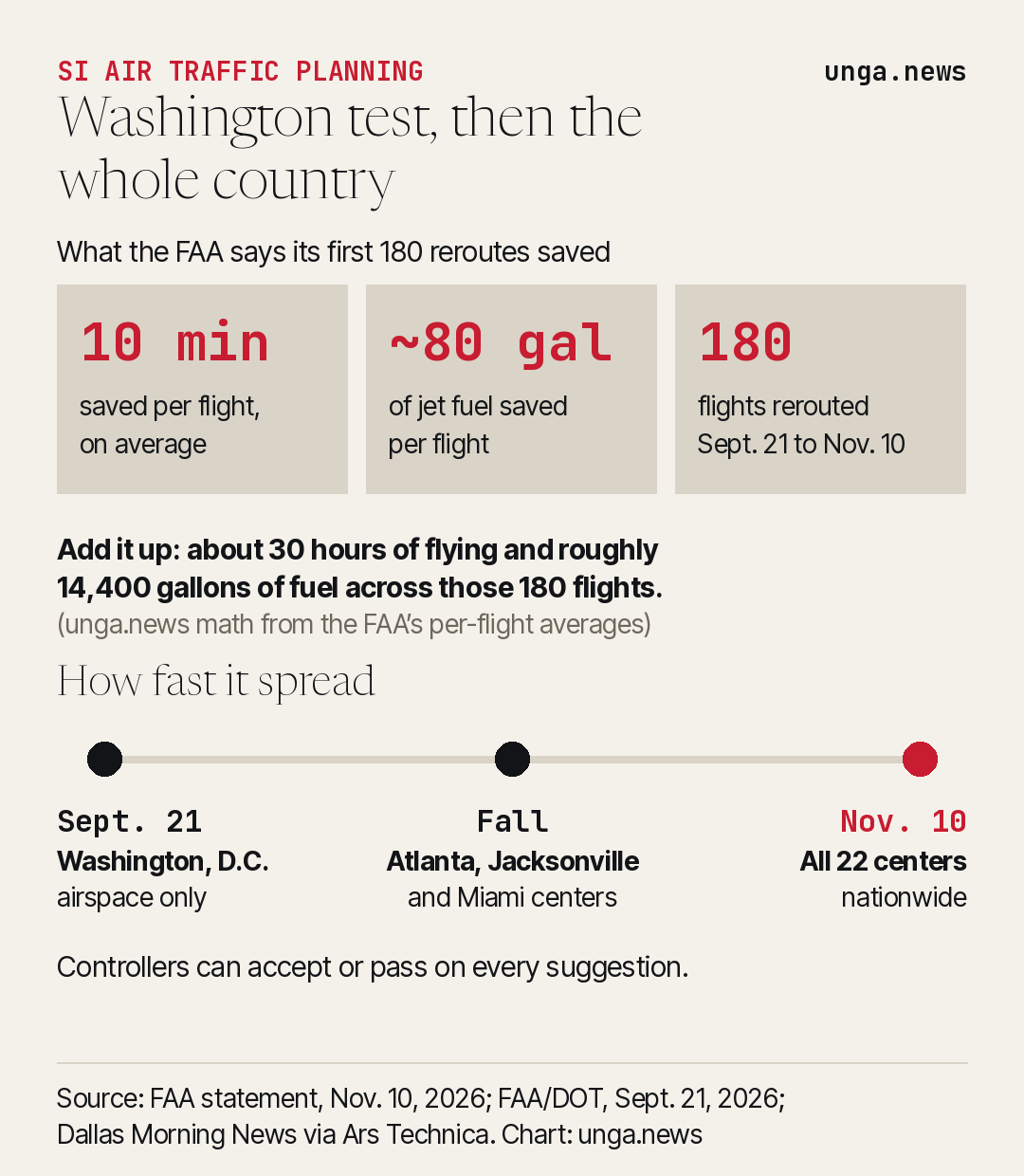
Do the math and that’s about 30 hours of flying and roughly 14,400 gallons of jet fuel saved across a small test in a single region. Those are the agency’s own figures, and 180 flights is a sliver of what crosses the country on a normal day, so nobody should treat them as a national forecast yet. But the direction is what matters. Ten minutes on one flight is a nuisance avoided. Ten minutes multiplied across a whole country’s worth of airline schedules is the difference between making your connection and sleeping in an airport.
Fuel is where the money lives. The Transportation Department argues that when carriers burn less fuel, pay less overtime and get more planes in on time, ticket prices feel it. That’s a promise, not a measured result, but it’s the right target.
After Washington, the FAA spread SMART to the centers covering Atlanta, Jacksonville and Miami, according to The Dallas Morning News, which Ars Technica cited. The agency also gave the paper an example of SMART finding a shorter, faster route for a cargo flight headed into Dallas-Fort Worth.
Humans still hold the stick
If the idea of a computer program steering American air traffic makes you nervous, the FAA has an answer. SMART doesn’t fly anything and doesn’t talk to pilots. A team of FAA specialists at a new SMART center in Washington checks its recommendations and sends them to the agency’s command center in Warrenton, Virginia. From there they go out to local facilities, and the people running those facilities decide whether to use them.
The FAA put it bluntly in September: SMART “cannot be used to replace the critical role air traffic controllers play or take over control of an aircraft.” Controllers keep doing the job they’ve always done, keeping planes apart. SMART just tries to hand them a less crowded sky to work with.
The controllers’ union, the National Air Traffic Controllers Association, told Flying magazine it wasn’t consulted on the “design, testing, or implementation of SMART and therefore cannot speak to its effect on the air traffic control workforce.” More than two dozen lawmakers had also written to the FAA on Oct. 9 asking it to pause the rollout and answer questions about testing and training. The agency kept going, and its early numbers back that call.
The airlines are all in. United CEO Scott Kirby said that if SMART works as his company thinks it can, “it will do more to reduce delays and cancellations than anything that’s happened in decades.” Southwest CEO Bob Jordan called it a system with “real potential” to cut delays and cancellations, and American, Delta and the airline industry’s main trade group backed it too.
Not a cure for broken wires
Thursday showed what SMART can’t do. A communications failure at several of those same regional centers forced the FAA to freeze departures at every airport in the country for about four hours, and Duffy blamed old legacy equipment. We covered that nationwide ground stop as it unfolded. No planning tool can keep decades-old gear from dying.
That’s why SMART is only half the plan. The software side runs under a 12-year, $875 million contract with Air Space Intelligence, an American company whose routing platform already works with major airlines and the Air Force. The hardware side is the brand-new air traffic control system Duffy has been pushing for, with new radios, radars and network gear to replace the parts that failed Thursday.
Put them together and you get the pitch: a sky where the machines on the ground don’t quit, and the planning is smart enough to stop jams before they start. One half of that is now live coast to coast. With the year’s busiest travel weeks coming, plenty of travelers will find out firsthand whether those 10 minutes hold up.
Sources
- FAA — SMART Expanding Across the Nation, FAA general statement (Nov. 10, 2026)
- FAA / U.S. DOT — Trump’s Transportation Secretary Sean P. Duffy Delivers State-of-the-Art Air Traffic Control Management Tool (Sept. 21, 2026)
- Ars Technica — FAA expands AI advice to manage air traffic congestion across entire US airspace (Jeremy Hsu, Nov. 13, 2026)
- Flying — FAA’s SMART AI System Now Active at All 22 ARTCCs (Jack Daleo, Nov. 10, 2026)
- AVweb — FAA Expands AI-Assisted Traffic Management Nationwide (Nov. 2026)
- ASI — ASI awarded $875 million multi-year software and AI contract by FAA
- unga.news — Old Equipment Grounded Every Flight in America for Four Hours. Duffy Wants It Gone. (Nov. 13, 2026)