

A Ship Ignored Warnings and Ran America’s Blockade of Iran. One U.S. Strike Stopped It Cold
The cargo ship had just left Iran’s biggest port and refused to turn back. An American aircraft hit its stern, knocked out its engines and left the crew unhurt. It’s the sixth ship stopped that way since July, while 158 others turned around.
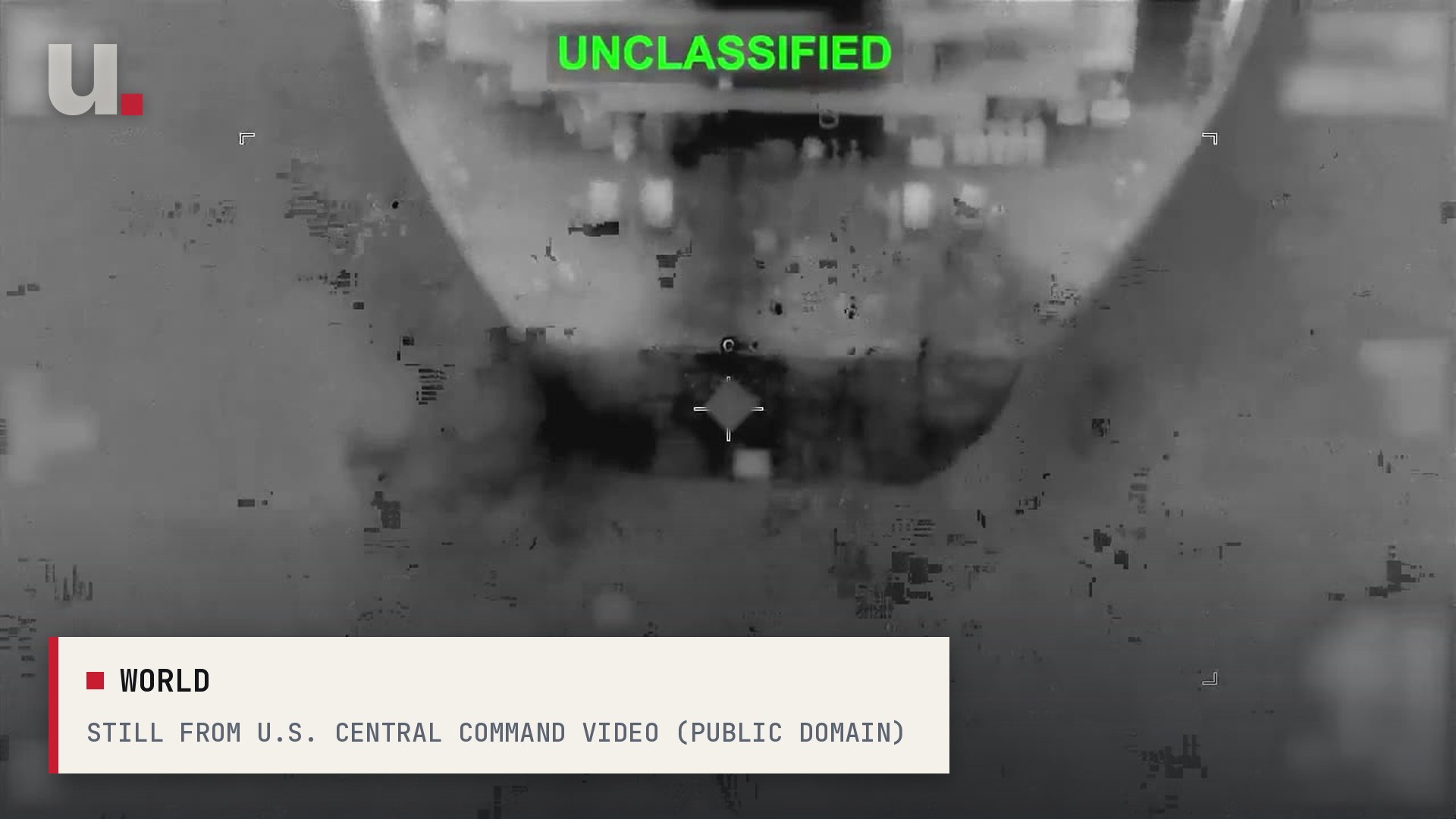
The captain of the Pacific Archer had every chance to turn around. American forces warned the ship again and again as it pushed out of the Gulf of Oman on Thanksgiving Day. The crew kept going. So a U.S. military aircraft put precision munitions into the back of the ship, right where the engines and propellers sit, and the Pacific Archer stopped.
Nobody aboard was hurt.
That’s the short version of what U.S. Central Command announced Friday. The Pacific Archer is a bulk carrier flying the flag of Palau, a tiny island nation in the Pacific. According to the command, it had just left Bandar Abbas, Iran’s biggest port, and tried to sail out through the American blockade “despite multiple warnings.” Ship tracking sites listed its destination as Singapore, the Associated Press reported.
“A U.S. military aircraft launched precision munitions that struck the stern of Palau-flagged M/V Pacific Archer,” the command said in its official release. “The ship’s propulsion was ultimately disabled and the civilian crew was unharmed.”
Central Command posted the strike video on 𝕏. It’s grainy black-and-white targeting footage, and it shows the ship’s stern before and after the hit.
U.S. Central Command on 𝕏 — “CENTCOM disabled a commercial vessel in the Gulf of Oman, Nov. 26, after the crew attempted to run the U.S. naval blockade, despite multiple warnings, following departure from Bandar Abbas.” (Nov. 27, 2026)
— @CENTCOM View on 𝕏
Aim for the engines, spare the sailors
The way this was done matters. The aircraft didn’t sink the ship or set it ablaze. It hit the stern, where a ship’s propulsion is, the one part you have to break to stop it from moving. When American forces disabled the St. Kitts-flagged cargo ship Huda on Nov. 7, Central Command said they first ordered the crew to get out of the spaces they were about to hit. The command has said over and over that ships get several warnings before anyone fires a shot.
Compare that with how Iran fights at sea. When the U.S. brought the blockade back on July 14, Adm. Brad Cooper, the commander of Central Command, laid out why. “Over the past seven days, Iran has intentionally targeted civilians across the region by attacking seven commercial ships, resulting in nearly a dozen civilian crew members killed, missing or injured,” he said. One side aims at the crew. The other side aims at the propellers.
And this all played out on the same Thanksgiving that Kuwait says Iranian drones killed two Italian repairmen working on its air defenses.
Most captains get the message
Here’s the number that tells you the blockade works. Since it resumed in July, Central Command says 158 commercial ships have been redirected after being told to turn back. Only six have refused and been disabled, and the Pacific Archer is the sixth. Put another way, more than 96% of the ships American forces have stopped simply did what they were told.
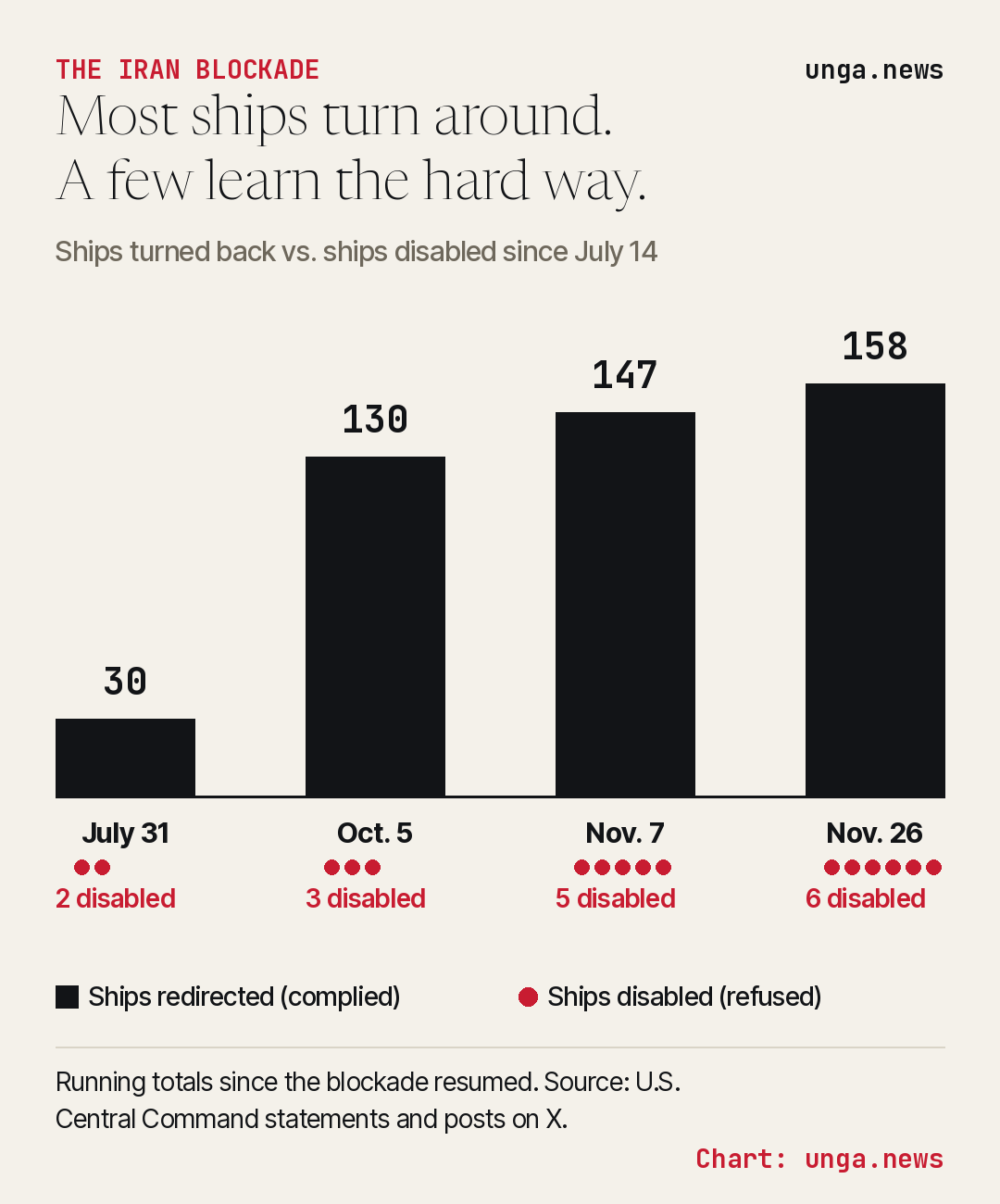
Central Command said it had turned back 30 ships and disabled two by July 31, two weeks after the blockade came back. By Oct. 5 it was up to 130 redirected and three disabled. The Nov. 7 release counted 147 and five. Now it’s 158 and six.
Those are only the ships that tried to go through and were told no. The command has also gone after Iran’s money pipeline directly. Its Nov. 7 release said U.S. forces had already destroyed 10 Iranian commercial oil tankers that were part of what it called the Islamic Revolutionary Guard Corps’ “multibillion-dollar shadow network,” the fleet of ships Tehran uses to sell oil around sanctions.
The blockade first went up in April. It was lifted while Washington and Tehran tried to talk out a deal, and that deal fell apart over who gets to control traffic through the Strait of Hormuz, the narrow waterway that carries a big share of the world’s oil. After Iran started hitting commercial ships again in July, the blockade came back. Counting the spring, the Pacific Archer is at least the 15th ship the U.S. has publicly said it disabled, according to the AP.
Cooper has never been shy about what happens next to ships that try it. “The U.S. military remains intensely focused on this mission,” he said in October. “We will swiftly act against any vessels trying to run the blockade. Our forces are highly trained, professional, and lethal.”
Tehran’s answer is more threats
Iran isn’t backing down, at least on television. On Friday, the commander of Iran’s navy, Shahram Irani, said Iran will carry out operations “that will not only break the naval blockade but also drive the enemy out of the region’s waters,” according to Al Jazeera and the AP.
The Revolutionary Guard also claimed Friday that two tankers tried to cross the Strait of Hormuz by an “unauthorised” route, that one hit a naval mine and the other was forced back. Nobody has been able to confirm that. If it’s true, it means Iran is mining a waterway that ordinary merchant crews have to sail through, which is exactly the kind of thing the blockade is there to stop.
For now, the U.S. still keeps two aircraft carriers in the region, along with a crowd of other warships, and Central Command is telling every captain the same thing. “All mariners operating in the Gulf of Oman and approaches to the Strait of Hormuz are urged to heed blockade warnings issued by CENTCOM forces,” its Friday release said.
Back home, some Democrats have talked about shutting the government down to cut off money for the Iran mission. The Pacific Archer shows what that money buys. A ship tried to sneak cargo out of a regime that has been killing sailors and firing drones at its neighbors, and it got stopped with one careful shot and zero dead.
There are 158 captains out there who heard the warning and turned around. The captain of the Pacific Archer ended Thanksgiving on a ship that couldn’t move under its own power. He could have been the 159th.
Sources
- U.S. Central Command (via DVIDS) — U.S. Forces Disable Commercial Vessel During Blockade Enforcement Against Iran (Nov. 27, 2026)
- U.S. Central Command on 𝕏 — Strike video and statement on the M/V Pacific Archer (Nov. 27, 2026)
- U.S. Central Command — U.S. Forces Disable Cargo Vessel Attempting to Violate Naval Blockade (Nov. 7, 2026)
- Associated Press — US military says it disabled another ship that tried to breach naval blockade on Iranian ports (Nov. 27, 2026)
- Al Jazeera / AP — US military says it disabled merchant ship trying to breach Iran blockade (Nov. 27, 2026)
- Anadolu Agency — CENTCOM commander accuses Iran of targeting civilians (July 15, 2026)
- Iran International — CENTCOM says 130 vessels redirected under US blockade of Iran (Oct. 5, 2026)
- TASS — US redirects 30 vessels amid Iran naval blockade — CENTCOM (Aug. 1, 2026)
- Marine Log — CENTCOM Hellfire missile strike disables would-be blockade buster (May 31, 2026)