

California's Own Rules Say Challenged Ballots 'Shall Be Set Aside.' DOJ Asks the Supreme Court to Hold 20,000
Solicitor General D. John Sauer filed an emergency application the day before Election Day, asking the justices to stop California from mixing the mail ballots of 20,000 suspected noncitizens into the count. He isn't asking to throw out a single one.
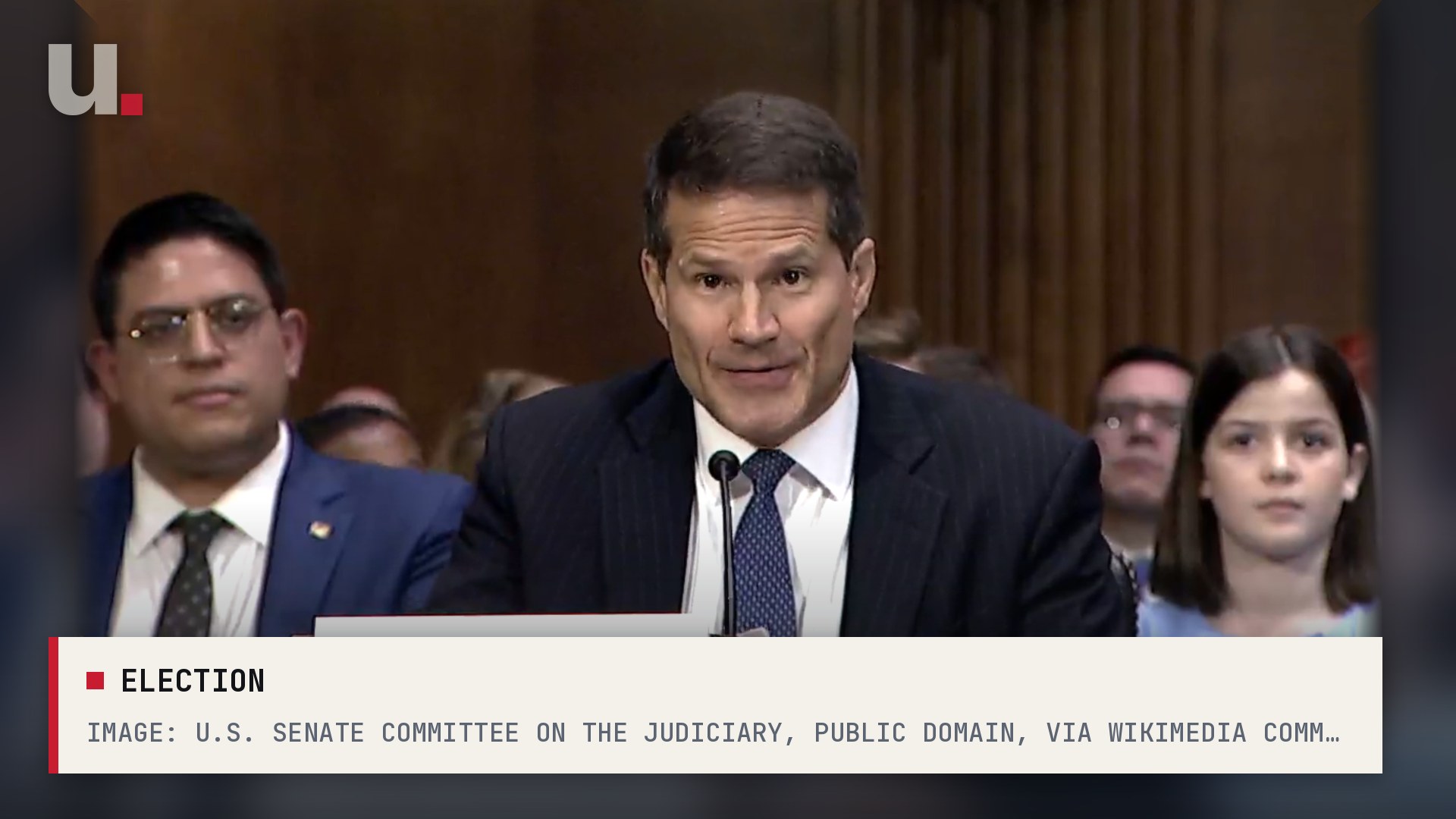
California already has a rule for ballots whose lawfulness is in question. Its election regulations say a challenged ballot "shall be set aside," and that the dispute be settled "in a segregated area" to "avoid confusion and mixing of ballots."
On Monday, the day before Election Day, the Justice Department asked the Supreme Court to make California follow that same idea for roughly 20,000 mail ballots. Solicitor General D. John Sauer filed an emergency application asking the justices to order the state and Los Angeles County to keep the ballots of people the federal government flagged as likely noncitizens separate from everyone else's until a court decides whether they count.
"Once California commingles the challenged ballots with lawful ones, there is no way to get the challenged ballots back," Sauer wrote. He also asked for an immediate administrative order to hold the ballots while the justices weigh the request. The application goes first to Justice Elena Kagan, who handles emergency matters from the Ninth Circuit, the NY Post reported.
Hold, not toss
The filing borrows its framing from Ninth Circuit Judge Patrick Bumatay, the lone dissenter when an appeals panel turned the government down Friday. It calls the request a "modest remedy" that "would not cancel any vote" and would only "allow time to verify the eligibility of suspected noncitizens."
Sauer points to a precedent from the last close fight over mail ballots. In November 2020, Justice Samuel Alito ordered Pennsylvania to set aside mail ballots that arrived after the legislature's Election Day deadline and count them separately. Those ballots, the filing notes, did not end up changing the outcome. It also quotes the Court's own words from earlier this year: "Count first, and rule upon legality afterwards, is not a recipe for producing election results that have the public acceptance democratic stability requires."
Under federal law, it is a crime for a noncitizen to vote for president, senator or a member of the House. The government's argument is that if voting is illegal, counting the vote is illegal too, and California can't do it just because a voter signed a form saying he is a citizen.
How the list was built
The filing lays out the government's process for the first time in this court. U.S. Citizenship and Immigration Services ran a public version of California's voter roll through Accurint, a data platform that pulls Social Security numbers, birth dates and phone numbers from a name and address. It removed anyone it could confirm as a citizen. Investigators then reviewed the remaining names by hand, and Homeland Security Investigations checked them again. The list went to California's secretary of state and the Los Angeles County registrar on Oct. 13. The state, Sauer says, refused to share its full unredacted voter roll.
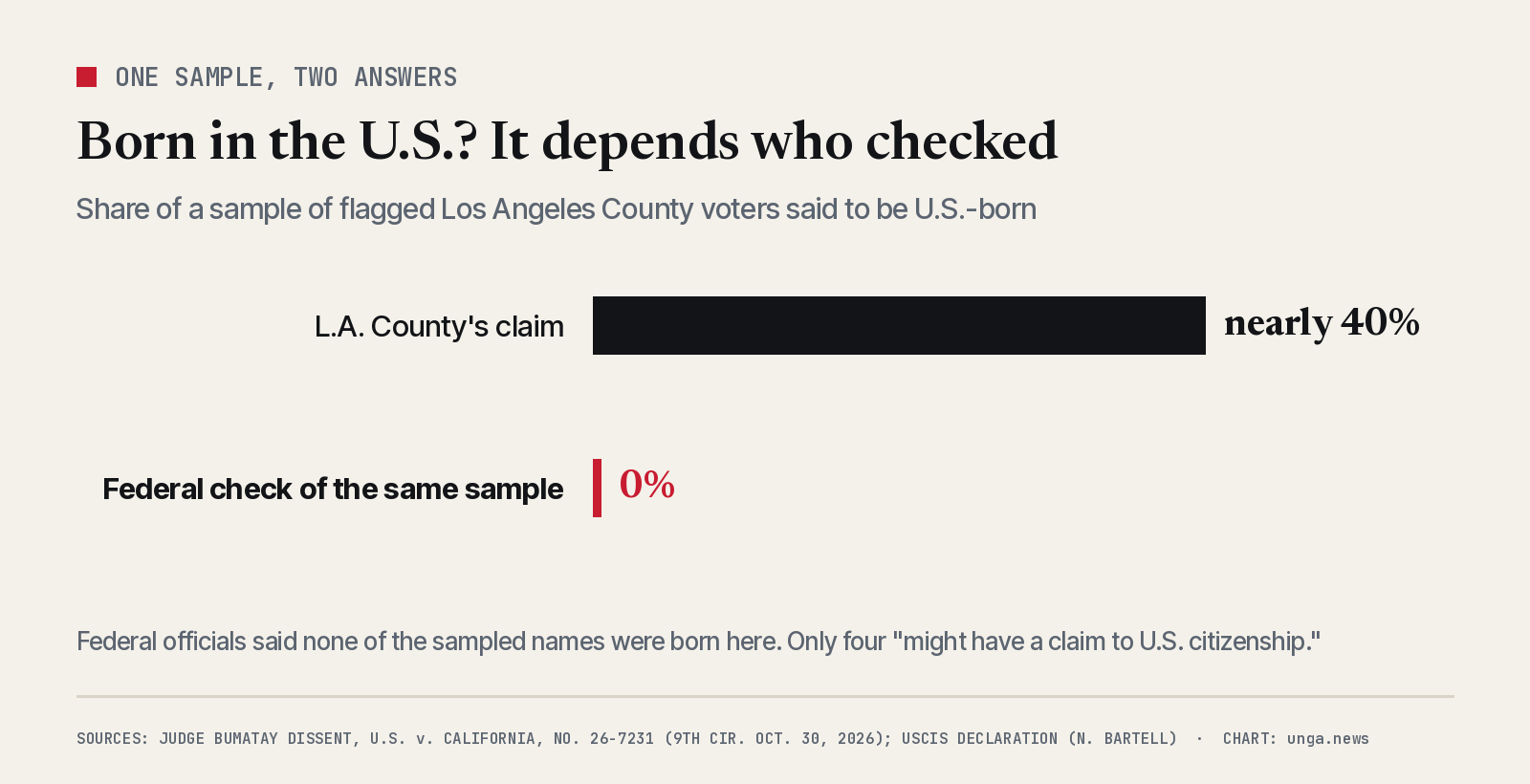
California says the list is full of errors. Los Angeles County told the courts that nearly 40% of a sample of flagged voters were born in the United States. When the federal government ran the same sample, it found none were, as we reported Friday.
Sauer also says the trial judge never heard the government's witnesses. U.S. District Judge David O. Carter, who denied the request Oct. 28 and called the government's evidence "not credible," decided the case on paper even though DOJ's witnesses were ready to testify, the filing says.
The clock
California counts mail ballots postmarked by Election Day that arrive up to seven days later. That puts the last day at Tuesday, Nov. 10, and Sauer says the harm "grows every day" until then, because once a ballot is pulled from its envelope and counted, it can't be traced to a voter. The lower courts cited the Supreme Court's Purcell rule against changing election procedures close to an election. Sauer answers that Purcell protects voters before they vote, not ballots after they're cast.
Acting Deputy Attorney General Trent McCotter announced the filing on X.
Acting Deputy Attorney General Trent McCotter on X: California has refused to work with the Federal Government to protect against noncitizen voting.
— @PADAGMcCotter View on 𝕏
"California cannot continue counting noncitizen votes," wrote Bill Essayli, the top federal prosecutor in Los Angeles. "Today we seek a Supreme Court emergency injunction to preserve American elections."
California's answer
California Attorney General Rob Bonta called the filing desperate. "The Trump Administration lost three times in court last week and those victories give us strong reason to believe we'll prevail again," he said in a statement quoted by the NY Post. "This latest move reeks of desperation and is another attempt to undermine our elections and trample on the rule of law." Los Angeles County officials have said only 7,035 of the 20,000 names had county addresses.
Nobody on either side has proved who is on the list. That is the government's point: hold the ballots until someone does. If the justices say no, the ballots go into the count on California's word, and at least three Los Angeles County election workers are due before a federal grand jury in Santa Ana on Wednesday morning. Carter's next hearing is Nov. 13. California certifies its results Dec. 3.
Sources
- U.S. Supreme Court filing (via Just Security) — United States v. California, Application for Injunction Pending Appeal and Request for Administrative Injunction, Solicitor General D. John Sauer (filed Nov. 2, 2026)
- @PADAGMcCotter on 𝕏 — Acting Deputy Attorney General Trent McCotter on the emergency application (Nov. 2, 2026)
- @USAttyEssayli on 𝕏 — First Assistant U.S. Attorney Bill Essayli on the emergency application (Nov. 2, 2026)
- NY Post — Trump takes fight over 20,000 California mail-in ballots to Supreme Court day before election (Nov. 2, 2026)
- Fox News — DOJ appeals to Supreme Court to reverse block on segregating 20K California ballots (Nov. 2, 2026)
- Washington Examiner — DOJ pursues long-shot appeal at Supreme Court over bid to isolate 20,000 California mail ballots (Nov. 2, 2026)
- The Washington Times — Trump takes California case to Supreme Court in last-ditch bid to block noncitizen ballots (Nov. 2, 2026)
- AP News — Trump administration appeals to Supreme Court in California mail ballots case (Nov. 2, 2026)
- Los Angeles Times — Trump lawyers ask Supreme Court to set aside 20,000 California ballots (Nov. 2, 2026)