

LA Said 40% of Sampled Flagged Voters Were U.S.-Born. Feds Found None. Appeals Court Still Won't Let DOJ Hold Their Ballots
The Ninth Circuit's 2-1 ruling Friday leaves about 20,000 suspected noncitizens' mail ballots in California's count days before the midterms. The Trump-appointed dissenter called holding them a "modest remedy" that "would not cancel any vote."
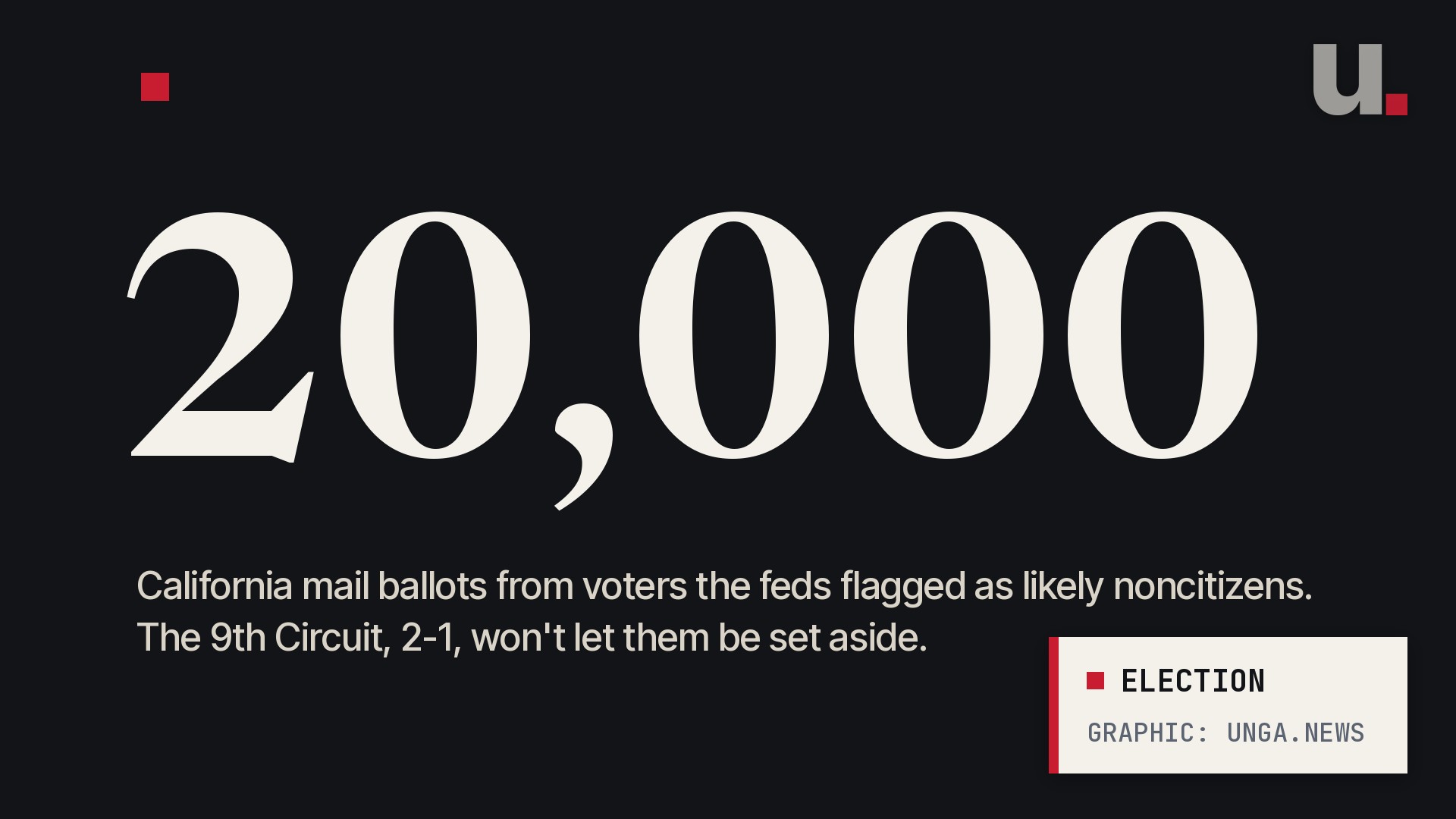
A federal appeals court on Friday turned the Justice Department down for the second time in five days. By a 2-1 vote, a Ninth Circuit panel refused to order California and Los Angeles County to set aside the mail ballots of roughly 20,000 people the federal government flagged as likely noncitizens. Election Day is Tuesday.
This was the round that counted. On Monday, the same panel said the appeal came too early, because the trial judge hadn't ruled yet. He has now: U.S. District Judge David O. Carter refused the request Wednesday and told the government to prosecute illegal voters instead. So on Friday the panel said it did have the power to step in, and chose not to.
What the majority said
Judges Mark Bennett, a Trump appointee, and Gabriel Sanchez, a Biden appointee, signed the unsigned majority order. Their reasons, in plain terms:
The list. The judges leaned on Carter's finding that the government's process for building its October list "was not credible." They quoted his complaints that the government gave "no error rates" or "validation against a reliable benchmark," and that "it remains unknown how Lexis Nexis performed its analysis."
The timing. They said a federal law bars sweeping voter-roll changes in the 90 days before an election, and that Supreme Court precedent warns courts not to change the rules late. "The Purcell principle applies with even greater force" once voting is underway, they wrote.
The machinery. They accepted Los Angeles County's word that its system "ha[s] no function for setting aside the ballots of designated voters," and that building one now risks "the disenfranchisement of eligible voters and putting the entire tabulation process in jeopardy."
Notice what the majority did not say. It never found that the 20,000 people are citizens. It said the risk that noncitizens are voting is "at best, uncertain," and it left the government's answer to the courts after the election, when processed ballots can no longer be pulled back out.
The dissent: one sample, two answers
Judge Patrick Bumatay, also a Trump appointee, dissented again, and his opinion puts the sharpest fact in the case on the record.
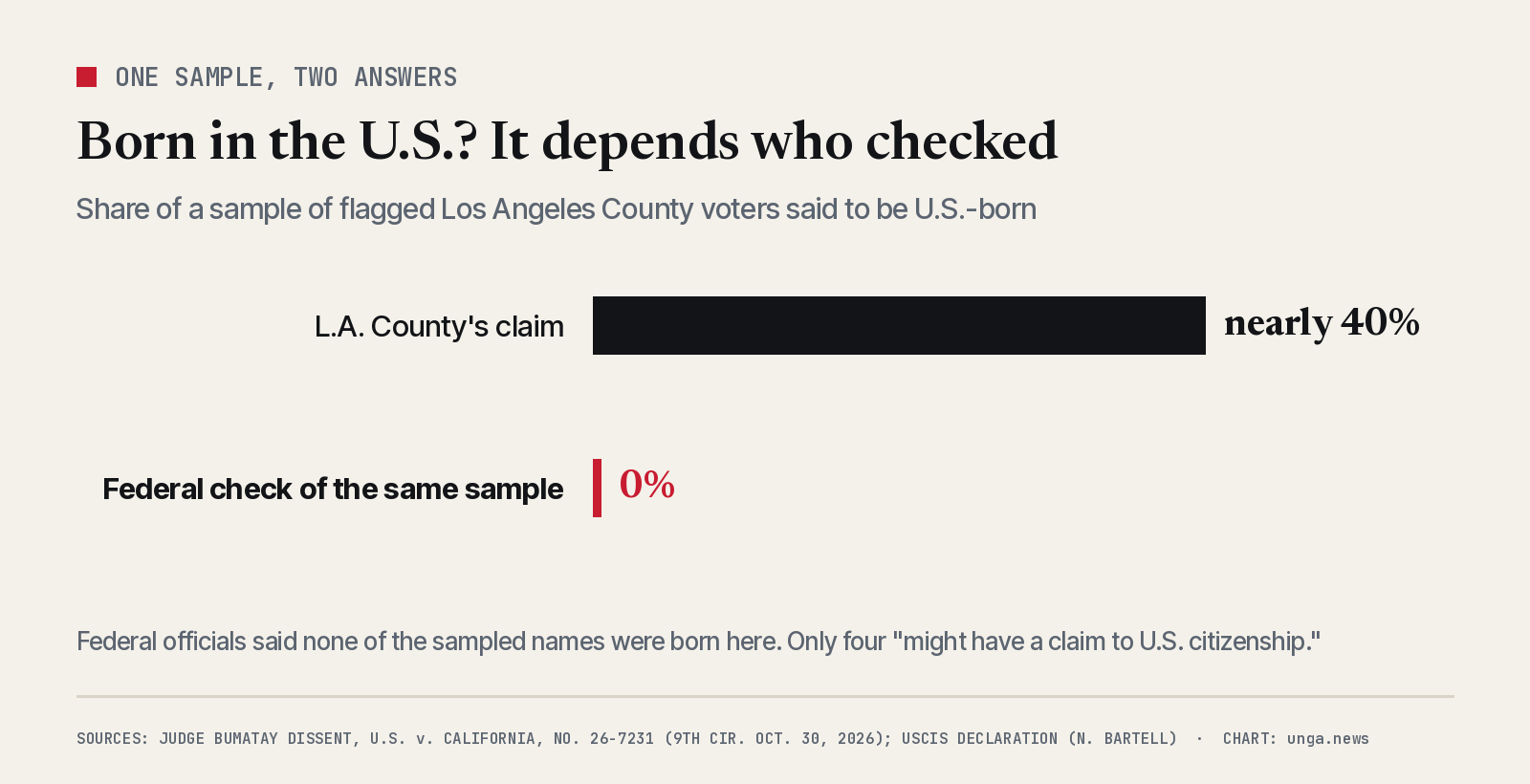
Los Angeles County, he wrote, "claimed that nearly 40% of a sample of suspected noncitizens from the federal government's list had been born in the United States. But when the federal government ran the same sample through its systems, it confirmed that none were born here." A U.S. Citizenship and Immigration Services official had told the trial court the same thing in a sworn declaration, adding that only four people in the sample "might have a claim to U.S. citizenship."
Bumatay also pointed to how California checks citizenship in the first place. At oral argument, he wrote, the county "could give no evidence that it independently verifies the citizenship of its voters. Instead, it apparently relies only on applicants' attestation of their citizenship." In other words, a voter checks a box saying he is a citizen. "Now California says it can do nothing to prevent illegal voting," he added.
And he argued the government was not asking to throw anything out. He called the request "a modest remedy": keep California from mixing the ballots of citizens with those of suspected noncitizens. "This solution would not cancel any vote but would allow time to verify the eligibility of suspected noncitizens," he wrote.
He took aim at Carter, too. The trial judge told the government its remedy was prosecution, then warned it not to "threaten" prosecutions. "Of course, the district court has no authority to order that," Bumatay wrote. The federal government, not a judge, he said, "is tasked with preventing and prosecuting federal crimes."
Why the clock matters
Federal law already makes it a crime for a noncitizen to vote in a federal election. The trouble is that a mail ballot, once it is taken out of its signed envelope and counted, can't be matched to a voter again. That is why the government wanted the flagged ballots held to one side, not tossed. Every day without an order, more of them disappear into the count.
Bill Essayli, the top federal prosecutor in Los Angeles, made the government's case on X on Thursday after California Attorney General Rob Bonta called the list "garbage."
First Assistant U.S. Attorney Bill Essayli on X, Oct. 29, 2026
— @USAttyEssayli View on 𝕏
Bonta, for his part, called the administration's moves "escalating attacks on our hardworking elections officials."
California Attorney General Rob Bonta on X, Oct. 29, 2026
— @AGRobBonta View on 𝕏
What happens next
Friday's denial leaves the Justice Department free to ask the Supreme Court for emergency help before Tuesday, as the Washington Examiner noted. The department had not said publicly by Friday afternoon whether it will. Back in Los Angeles, Carter's special master is reviewing the federal list, and Carter has set an evidentiary hearing for Nov. 13, ten days after the election.
Meanwhile, federal grand jury subpoenas have gone out to California election officials over the flagged ballots. However the ballot fight ends, the criminal investigation goes on.
Sources
- U.S. Court of Appeals for the Ninth Circuit — United States v. California, No. 26-7231, order denying injunction pending appeal, with dissent by Judge Bumatay (Oct. 30, 2026)
- unga.news — Judge Lets 20,000 Flagged Ballots Count, Says Prosecute Instead (Oct. 29, 2026)
- unga.news — Court Lets California Count 20,000 Ballots Flagged as Possible Noncitizen Votes (Oct. 26, 2026)
- Bill Essayli on X — "At least 20,000 suspected noncitizens are registered to vote in California" (Oct. 29, 2026)
- Rob Bonta on X — Statement on the administration and California election officials (Oct. 29, 2026)
- Washington Examiner — Appeals court rejects DOJ effort to set aside 20,000 mail-in ballots, teeing up Supreme Court gambit (Oct. 30, 2026)
- Associated Press — Appeals court rejects Justice Department request for California to set aside disputed ballots (Oct. 30, 2026)