

Hackers Got Inside the Air Force’s Biggest Computer Cloud, Where It Tracks Its Bombs and Missiles
The breach hit the platform that runs pay, personnel records, North American radar feeds and a munitions tracker for more than 200 bases. Cyber Command has been called in, and work on the system is frozen.
While most of the country was sleeping off Thanksgiving dinner, we learned that somebody had gotten inside the computer system the U.S. Air Force uses to run a big chunk of itself.
Hackers breached Cloud One, the Air Force’s flagship cloud computing platform, three people familiar with the matter told Reuters in an exclusive published Friday morning. The break-in was found within roughly the past month, during work to upgrade the system. Reuters could not pin down who did it, how far they got, or whether anything was stolen.
That last part matters, so let’s be plain about it. Nobody has shown that secrets walked out the door. But the list of what lives on this platform explains why the people who know about it are worried.
What sits on the Air Force’s cloud
Cloud One started in late 2017 as a one-stop shop for the Air Force’s computing needs. It runs on four of the biggest names in tech: Microsoft, Amazon, Oracle and Google’s parent, Alphabet. The apps on it handle personnel records and pay, logistics and aircraft maintenance.
Two of them stand out. One is the Air Force’s Cloud-Based Command and Control, which pulls together air defense radar and other data feeds from across North America. The other is the Theater Integrated Combat Munitions System, which keeps track of bombs and missiles at more than 200 Air Force locations around the world. When Cloud One’s own leaders wrote about that munitions tracker in 2023, they put the count at 210 sites.
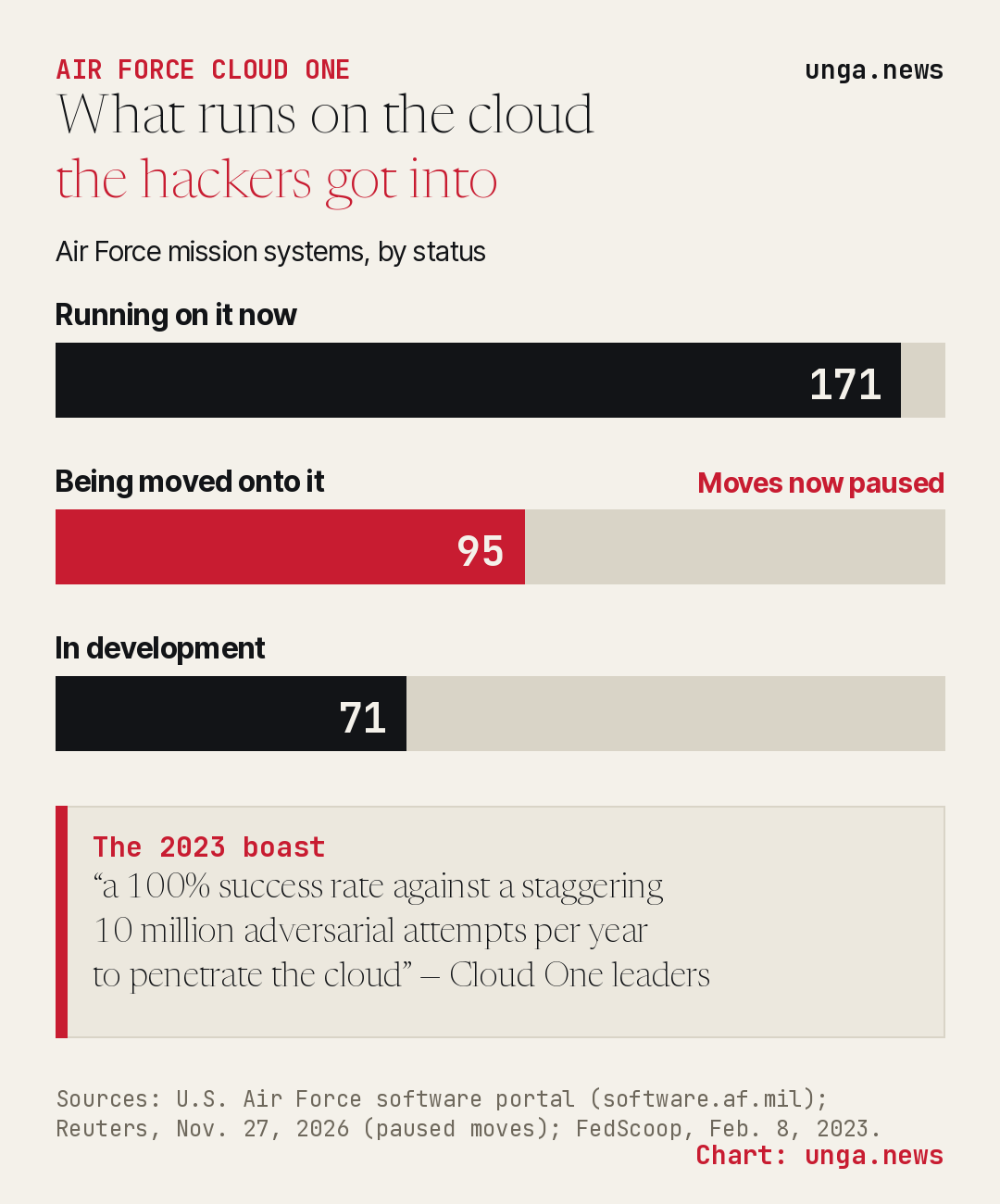
The Air Force’s software portal says Cloud One hosts 171 mission systems, with 71 more in development and 95 in the middle of moving over.
“A breach here is a big deal,” one of the sources told Reuters. Two sources said Cloud One is among the biggest cloud platforms in the whole U.S. military.
The keys to the whole building
The most alarming detail is where the intruders reportedly got in. One source said the hackers used a software flaw to reach what’s called the control plane, the layer that runs everything else. That person compared it to a universal remote.
In theory, the source said, access like that could let someone check whether military aircraft are ready to fly or follow the movement of spare parts. The source was careful to say it’s unclear whether the hackers actually did any of that. Reuters also could not identify the exact flaw they used.
Picture a burglar who didn’t just get into one apartment but got hold of the building manager’s master key ring. Even if he never opened a single door, every lock in the place now needs a hard look.
Frozen in place
The Air Force is acting like it takes this seriously, and that’s the right call. Investigators brought in Cyber Command, the military’s own cyber force, to size up the damage, according to one source.
The cleanup is already costing something. Moving back-office programs onto Cloud One, a long-running military goal, has been paused, according to two sources and a fourth person familiar with the matter. Updates to programs already running there were blocked. A fifth source said some users lost their administrator powers.
Those freezes cut both ways. Blocking updates keeps an intruder from slipping in through a fake fix, but it also leaves airmen unable to patch their programs at the very moment a fresh batch of serious software holes has been announced across the tech industry.
The Air Force, as you would expect, isn’t saying much. In a statement to Reuters, it said it “does not comment on the security posture, vulnerabilities or operational status of specific networks and systems,” and added: “We continuously take prudent measures to protect Department (of the Air Force) information, systems and mission capabilities.” Cyber Command didn’t respond. The longtime prime contractor, SAIC, ran Cloud One until 2025, when Leidos took over. SAIC didn’t answer Reuters, and Leidos sent questions to the Air Force.
A 100% record, until it wasn’t
In February 2023, Cloud One’s leadership wrote a piece for the government tech site FedScoop bragging about the platform’s defenses. “There is no room for error when it comes to security,” they wrote. They claimed “a 100% success rate against a staggering 10 million adversarial attempts per year to penetrate the cloud.”
Nobody gets a perfect record forever. But when the stakes are radar over North America and the location of American bombs, a boast like that should come with a lot of humility and a lot of checking.
This also isn’t a one-off. Reuters counts at least six other recently disclosed hacks the federal government is still cleaning up after. Two hit the FBI. Others reached Pentagon data, Homeland Security personnel files, at least two spy agencies and the Treasury Department. We covered several of them here, including the break-in at the CIA, the Treasury office that collects banks’ reports, and the FBI database police use to check warrants.
Reuters notes growing worry that SI tools can now scan huge cloud networks for weak spots far faster than a human crew ever could. That’s a fair worry, and it points to the real lesson. Handing the military’s digital backbone to a few giant tech companies and a contractor didn’t make the risk go away. It concentrated it.
The Pentagon was right to call in its cyber troops fast. Now Congress and the Air Force owe taxpayers straight answers on three things: who got in, what they touched, and which contractor was minding the gate when it happened. The men and women who fly and fix those jets deserve a system that’s as tough as they are.
Sources
- Reuters (published by CNBC) — Exclusive: Hackers breach US Air Force flagship Cloud One computing platform, by Mike Stone and Raphael Satter (Nov. 27, 2026)
- U.S. Air Force software portal — Cloud One: 171 mission systems hosted, 71 in development, 95 in migration
- FedScoop — Cloud One: Taking aim at the enemy, one application at a time, by Cloud One Leadership (Feb. 8, 2023)
- unga.news — First the FBI, Now the CIA: Hackers Broke Into a Spy Agency Computer System (Nov. 24, 2026)
- unga.news — Hackers Got Inside the Treasury Office That Collects Banks’ Reports on Your Money (Nov. 25, 2026)