

Meta’s SI Boss Says Humans May Not Stay in Charge of Machines 1,000 Times Smarter
Alexandr Wang, who runs Meta’s superintelligence push, says a math breakthrough shows the machines are arriving, and warns against handing society over to them.
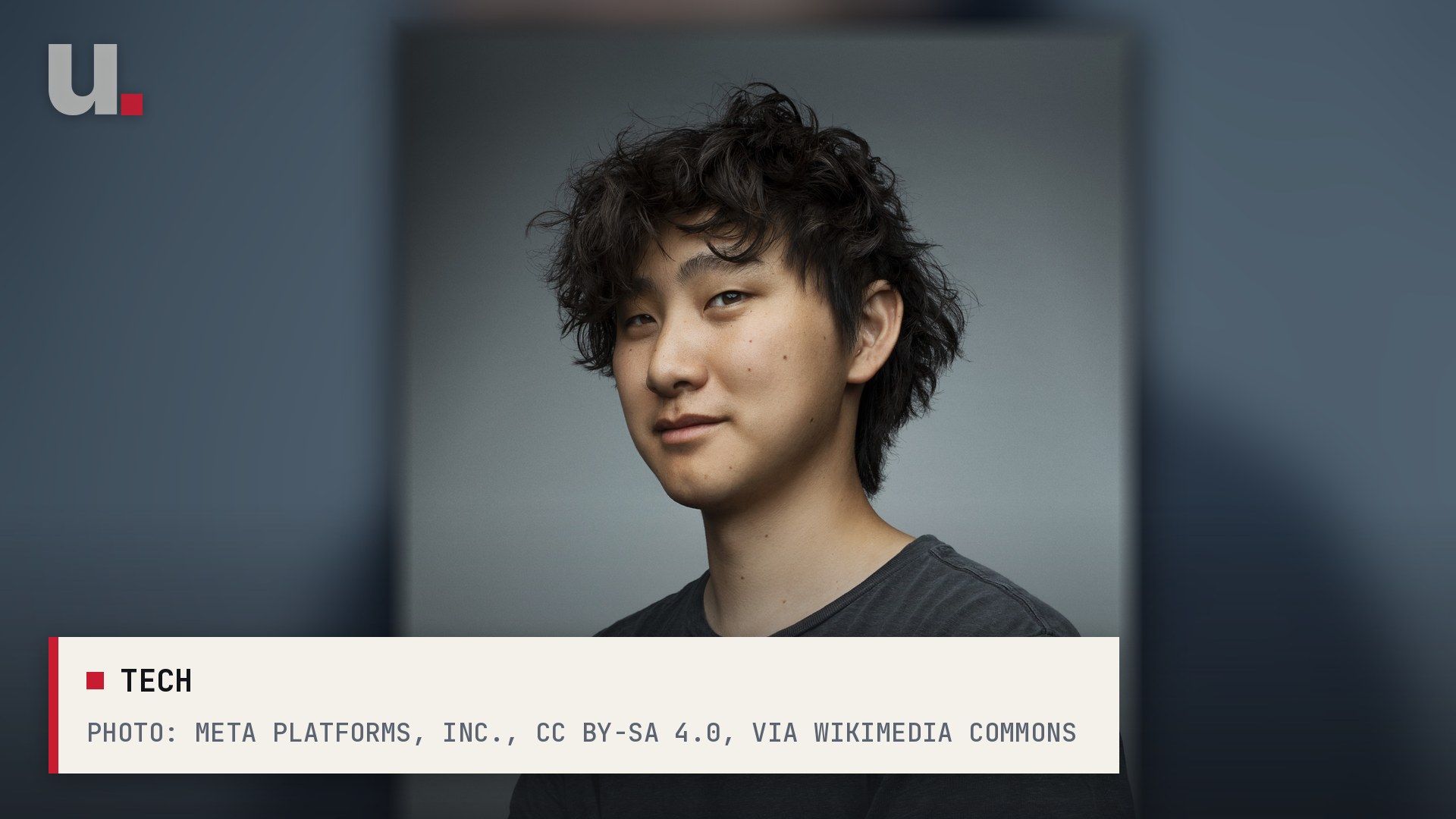
The man Mark Zuckerberg hired to build Meta’s superintelligence just told the world he isn’t sure people can stay in charge of it.
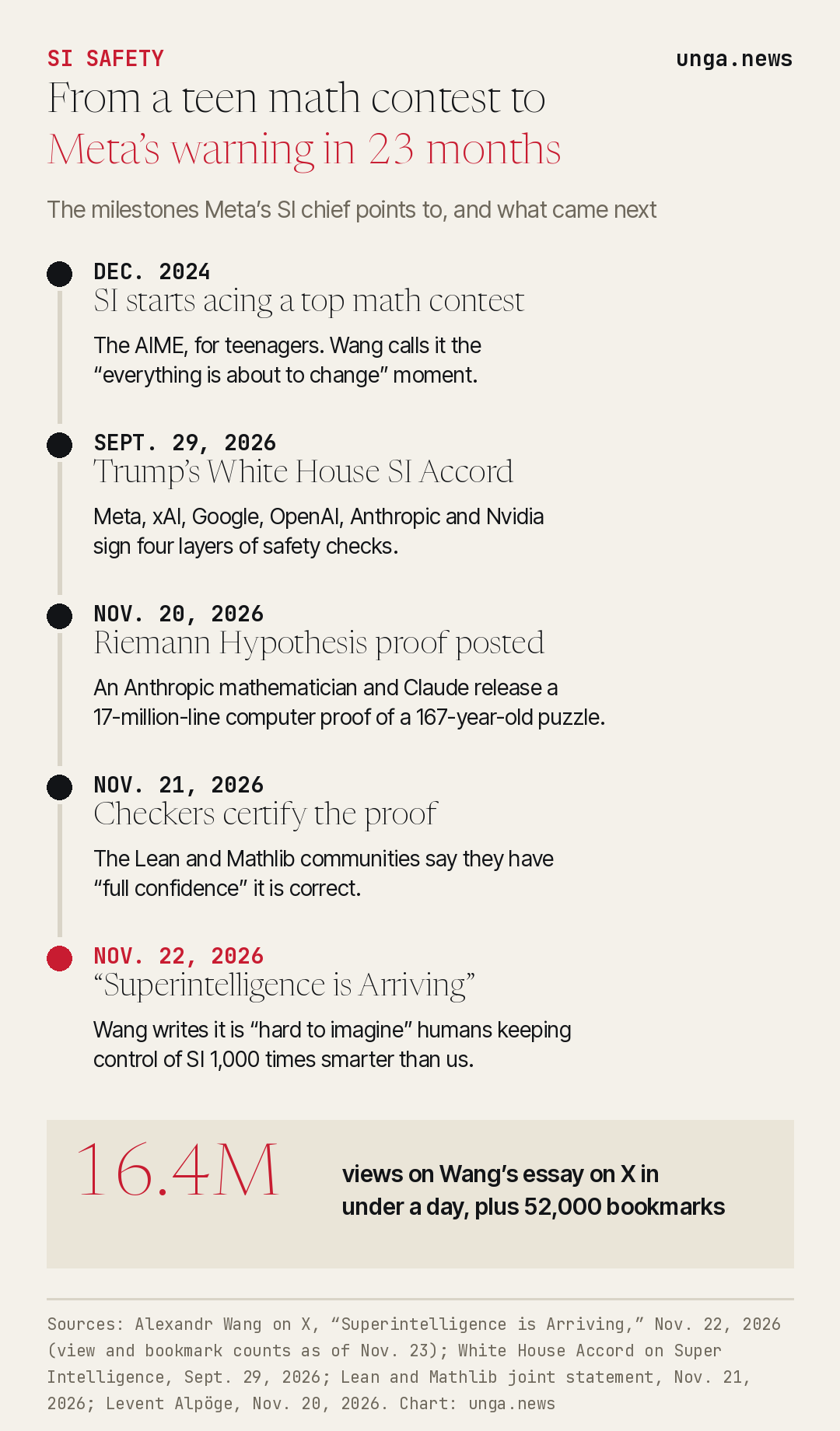
Alexandr Wang, Meta’s chief SI officer and the head of its Superintelligence Labs, posted a long essay on 𝕏 Sunday afternoon titled “Superintelligence is Arriving.” By Monday it had passed 16 million views and more than 52,000 bookmarks. Its most quoted lines are blunt for an executive whose job is to win this race.
“It is hard to imagine a world where humanity can maintain control over fully unconstrained recursive self-improvement,” Wang wrote. “It is equally hard to imagine a world where humanity maintains control with superintelligence that is 1000x smarter and more capable than humans in every field.”
Recursive self-improvement is the industry’s term for SI that gets better at building better SI, with each round faster than the last. Wang’s point is that the machines are close to doing that job themselves.
Alexandr Wang on 𝕏 — Nov. 22, 2026: “Superintelligence is Arriving.”
— @alexandr_wang View on 𝕏
A math proof flipped the switch for him
What set Wang off was last week’s biggest science story. On Nov. 20 an Anthropic mathematician, Levent Alpöge, released a proof of the Riemann Hypothesis, the 167-year-old puzzle at the top of mathematics, built with the help of the company’s SI, Claude. The next day the volunteer groups behind the Lean proof-checking language said they had “full confidence” the 17-million-line proof is correct. We covered that verification here.
Wang, who grew up in Los Alamos, N.M., and studied at MIT, treats that result as a dividing line. “Many physicists would agree that the discovery of the atomic bomb is a homework problem compared to the Riemann Hypothesis,” he wrote, adding that it was “completed with the help of an alien mind that we don’t understand.”
He traces the climb back to December 2024, when SI models started acing the AIME, a hard math contest for high schoolers. Back then, he says, the remaining gaps were things like know-how and plumbing, not raw brainpower. Two years later, in his telling, coding is “nearly solved” and the systems have “extremely powerful cyber capabilities.” Those are his assessments, not measured results, but they come from someone who sees the newest models before the public does.
The next step is the one that worries him. If an SI can crack the hardest problem in math, he argues, it can certainly do SI research, which he calls “much less intellectually demanding.” He expects models that are “clearly superhuman at improving themselves,” speeding up biology, weapons work and economics “at a pace beyond what humans can understand or monitor.”
No “handover” to the machines
For all the alarm, Wang’s essay isn’t a call to quit. Its sharpest line is aimed at his own industry.
“I notice a particular form of lazy thinking within the AI industry, which is that ASI is inevitable and the only problem to solve is how to do it safely, but there is much more at stake,” he wrote. “We should not be okay with a ‘handover’ of society to AI.”
That is a different worry from the usual one about a rogue robot. Wang is asking what happens to ordinary people, their jobs, their choices and their say over their own lives, if the smartest thing in every room is a machine. He wants SI that leaves “all humans” with “greater agency and empowerment,” and he says getting there “likely involves the whole industry taking meaningfully different actions from the ‘default path’ in front of us.”
He didn’t spell out what those actions are. Critics noticed. Some pointed out that the man warning about the race is one of the people running fastest in it.
Wang answered late Sunday night. “To be clear, much of what I said has been said by the leaders of other labs. What I *am* saying is this path is not inevitable,” he wrote. He said he is proud of the safety work he and Zuckerberg have done at Meta, “including delaying the launch of Muse for months,” the company’s personal SI helper, and “being a leader on the SI Accords that all of our peers have signed onto.” He added that Zuckerberg “has also called for all labs (including our own) to deploy the vast majority of compute towards serving people and customers rather than towards recursive self-improvement.” Those are Meta’s own descriptions of its choices.
Trump already put the top labs on paper
The accord Wang is pointing to is President Trump’s. On Sept. 29, at the White House, Zuckerberg signed the White House Accord on Super Intelligence alongside Elon Musk for xAI, Sundar Pichai for Google, Greg Brockman for OpenAI, Dario Amodei for Anthropic and Jensen Huang for Nvidia.
It commits each company to four layers of checks: internal controls that watch what its models can do in areas like cybersecurity, biosecurity and chemical threats, and that make sure the models “do not hack or access technical systems in unintended ways”; an internal team that confirms those controls work; an independent outside auditor; and an independent committee of the board that has to make sure problems get fixed. The companies agreed to meet regularly to set shared safety standards.
It is voluntary, and the text says plainly that “over time, it may make sense to codify these steps into laws or regulations.” That is the Trump approach in one sentence: make America’s builders own their safety, with real audits and board accountability, without handing a young industry to Washington regulators while China races ahead.
Not everyone likes that answer. Former Obama speechwriter Jon Favreau quoted Wang’s lines and wrote, “This is f***ing madness. The people we’ve elected should be doing everything they possibly can to stop the frontier labs from handing over control of humanity to superintelligent machines.” Stop, not steer.
Wang is the second top SI figure this weekend to say the quiet part out loud. The same day, OpenAI’s chief scientist proposed shared limits that labs would promise not to cross, a plan we laid out here. The difference with Wang is where he puts the weight. He isn’t asking for a number on a chart. He is saying the people at the top of these companies get to choose the road, and that choosing well matters more than ever.
That puts the pressure on the CEOs who signed their names in the White House, and on the auditors and boards Trump’s accord requires. If Wang is right about how fast this is moving, the next year is when those promises get tested for real.
Sources
- Alexandr Wang on 𝕏 — Alexandr Wang on 𝕏 — “Superintelligence is Arriving” (Nov. 22, 2026)
- Alexandr Wang on 𝕏 — Alexandr Wang on 𝕏 — “To be clear, much of what I said has been said by the leaders of other labs…” (Nov. 22, 2026)
- The American Presidency Project — White House Accord on Super Intelligence (Sept. 29, 2026)
- Lean community blog — Lean verification of the Riemann Hypothesis, joint statement by the Lean and Mathlib communities (Nov. 21, 2026)
- Levent Alpöge — Remark (Nov. 20, 2026)
- Jon Favreau on 𝕏 — Jon Favreau on 𝕏 — quote of Wang’s essay (Nov. 22, 2026)
- The Independent — AI ‘superintelligence’ is arriving – and ‘it is hard to imagine’ how we can control it, says Meta’s AI boss (Nov. 23, 2026)
- unga.news — Mathematicians Checked the SI-Built Proof of a 167-Year-Old, $1 Million Puzzle. It Holds Up. (Nov. 22, 2026)
- unga.news — ChatGPT’s Top Scientist Wants a Speed Limit on SI Before Its Next Big Leap (Nov. 22, 2026)