

Nvidia’s Best Chips Are Banned From China. Shanghai Bank Records Show They Got There Anyway
Loan papers filed in China list a top-end Nvidia rack by serial number at a Shanghai data center tied to Alice Huang, days after the Trump administration blacklisted the company she founded.
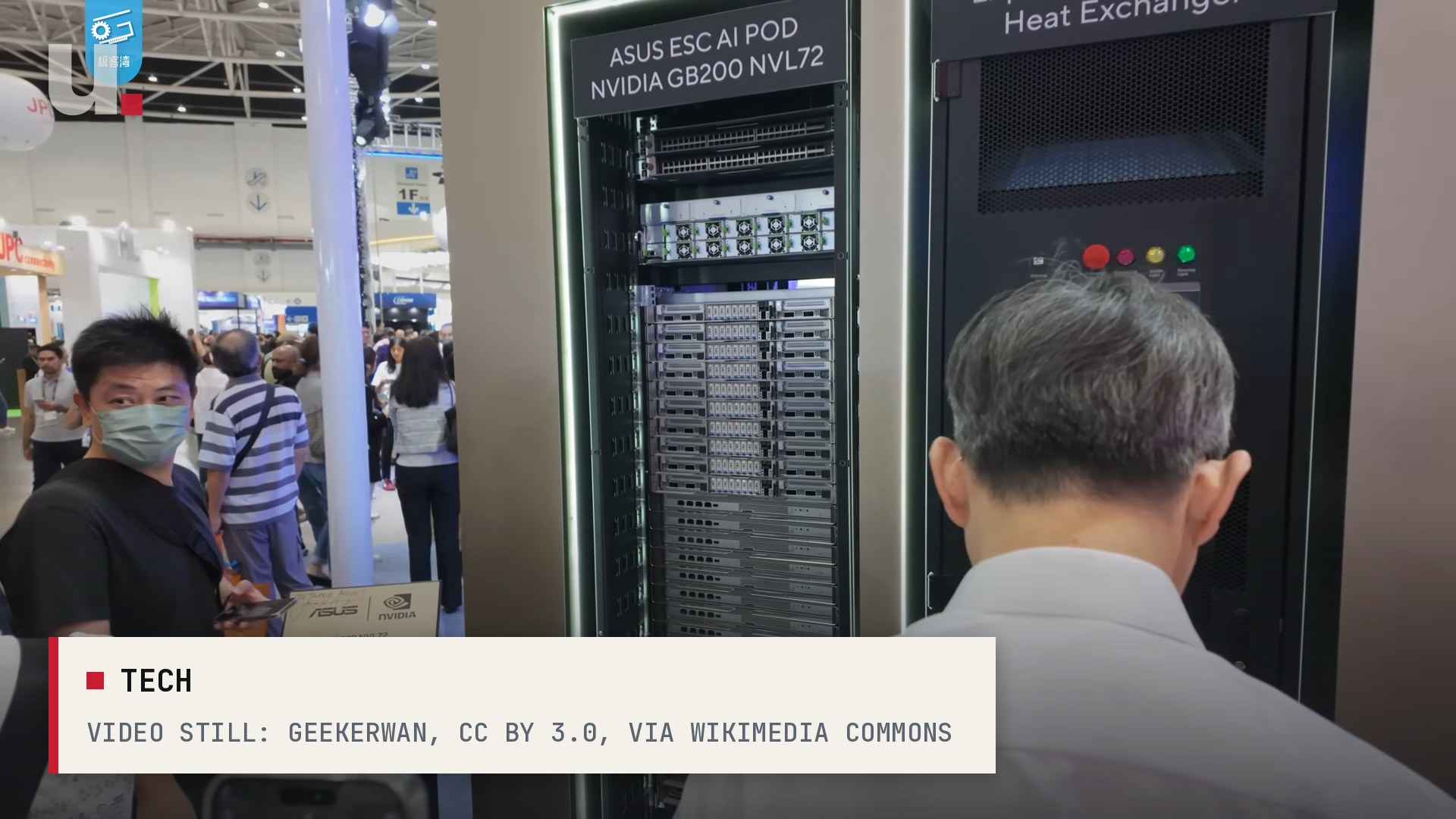
America’s most powerful SI chips were never supposed to set foot in China without Washington’s permission. Now there’s paperwork, filed with Chinese regulators and stamped with a serial number, showing a full rack of them sitting in a Shanghai data center tied to the woman at the center of the Nvidia spy scandal.
Bloomberg News reported Friday that two Chinese companies installed Nvidia’s Blackwell hardware at a giant Shanghai campus called the Yangtze River Delta Project. Local media have described the site as built to hold as many as 800,000 servers, which would put it in the same class as the biggest data centers American SI companies run. Bloomberg says the filings are the first proof that Blackwell chips reached the site.
This is new since our last report, when the Commerce Department put Megaspeed, the Singapore cloud company Alice Huang founded, on the federal trade blacklist. Back then the government cited a “significant risk” of chip diversion. Friday’s records show what that risk looks like on the ground.
A serial number in a loan file
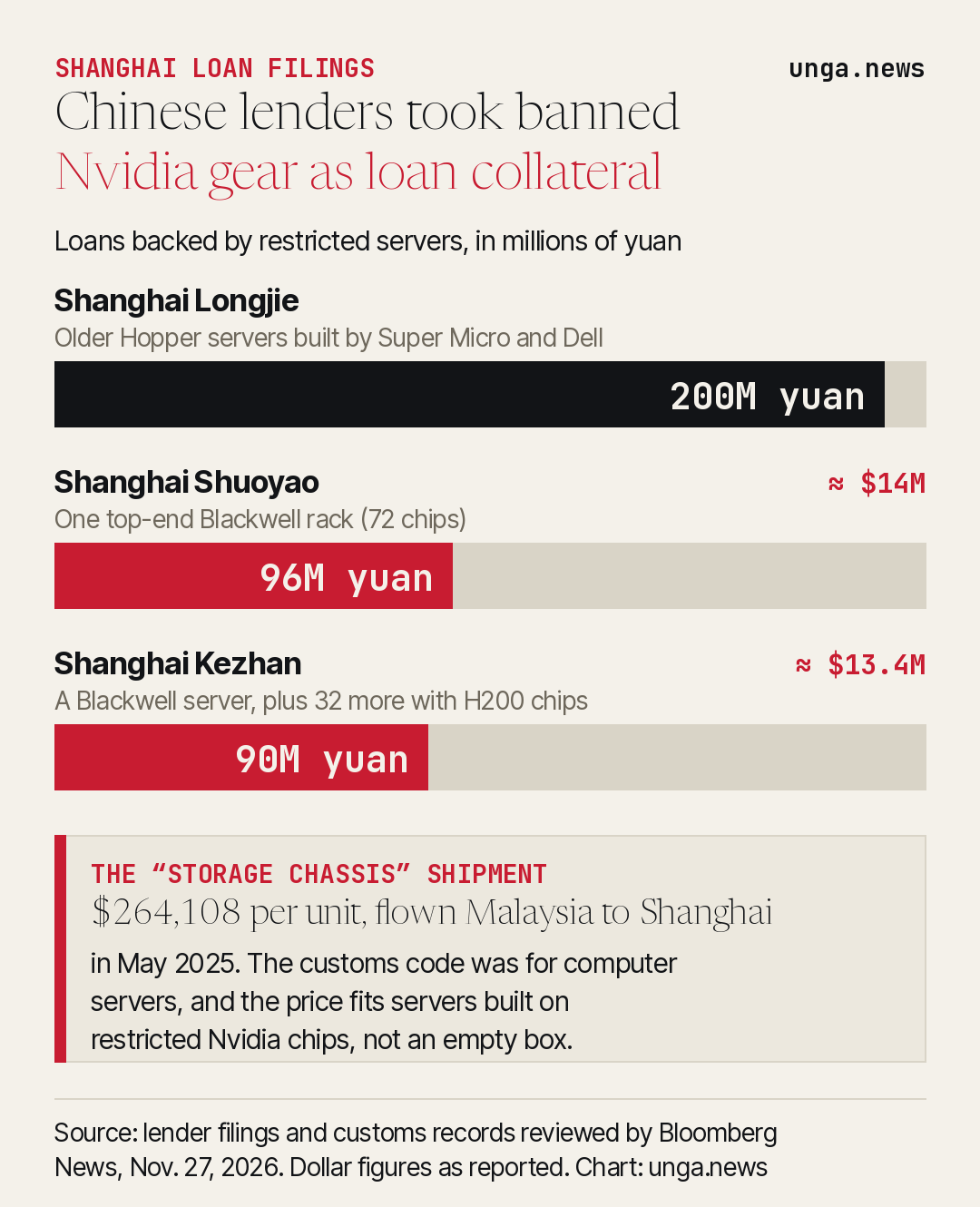
The hardware turned up in an unusual place: loan applications. A company called Shanghai Shuoyao pledged a GB300 NVL72 rack as collateral for a 96 million yuan loan, about $14 million, from Shanghai Innovation Bank. That rack is one of Nvidia’s most powerful products. It holds 72 of the company’s top Blackwell Ultra chips plus 36 of its own processors, stands about six and a half feet tall and can weigh more than 3,300 pounds. Bloomberg describes it as the size of a gigantic fridge.
Bloomberg typed the rack’s serial number into a public warranty database and traced it to Gigabyte, the Taiwanese company that builds servers around Nvidia chips. Gigabyte wouldn’t say who first bought it, citing company policy. “All transactions are subject to our internal compliance requirements and the relevant laws and regulations in effect at the time,” a spokesperson said.
A second company, Shanghai Kezhan, listed a Blackwell-based GB200 server at the same site when it borrowed 90 million yuan in late 2025. Its lender was a leasing firm wholly owned by a Shanghai government agency. Kezhan also disclosed 32 servers built on Nvidia’s H200 chips, an older model that also can’t legally go to China without a U.S. license. A sister company of Shuoyao, Shanghai Longjie, had already used restricted servers made by Super Micro and Dell to back a 200 million yuan loan, Bloomberg reported earlier this month.
Think about what that means. Banks in Communist China, one of them owned by the Shanghai government, looked at American hardware that’s illegal to bring into the country without a license and said, sure, we’ll lend against that. Bloomberg puts it more politely, noting that some Chinese lenders with government ties “were aware that restricted hardware was getting into China and willing to lend capital on those assets.”
Following the boxes back to Malaysia
How the gear got there is still unclear, and Bloomberg is careful about it. It says it has no evidence that Megaspeed itself sent Nvidia hardware to the site, and Megaspeed has denied wrongdoing in the U.S. investigation. But the paper trail keeps circling back to the same names.
Shuoyao admitted this month that it’s one of Megaspeed’s service providers, calling the partnership “limited to ordinary commercial cooperation.” In 2024, Megaspeed showed investors a rendering of the Yangtze River Delta Project and called it its largest data center, a “specific area” facility in a country it didn’t name. A subsidiary of 7Road, the Chinese gaming company that was Megaspeed’s original parent, owns 16.7% of Kezhan. The other 83.3% traces back to a Tokyo company that the Chinese business outlet Caixin says Alice Huang controls.
Then there’s the customs record. In May 2025, Kezhan received an $11 million shipment flown from Malaysia into Shanghai’s main airport. The paperwork called it “storage chassis,” the metal shell that holds a storage server’s parts. But the product code was the one for computer servers, and the declared price was $264,108 per unit. Bloomberg says that’s far too much for a chassis and right in the price range of servers built on Nvidia’s restricted chips.
Malaysia, Singapore and Thailand are exactly where Megaspeed and its affiliates set up shop, and exactly where the administration has been closing doors. Last week Commerce began requiring licenses for top chips sent to data centers in five countries, and Nvidia has since told server makers to pause shipments to four of them, as we reported Thursday.
Republicans want answers next week
President Trump has said plainly that he doesn’t want these chips going to China. His Commerce Department backed that up with the blacklist and the new rule. Friday’s story is a reminder of why both were needed, and why chip makers and server builders can’t just take a reseller’s word for where their gear is headed.
Congress is next. Jensen Huang, who was reinstated as Nvidia’s CEO on Monday, has agreed to sit for a closed-door, transcribed interview with three House committees on Dec. 1. Nvidia’s top lawyer, Tim Teter, follows on Dec. 2. The Republican chairmen running it, John Moolenaar of the China committee, Brian Mast of Foreign Affairs and Rick Crawford of Intelligence, said in a joint statement that “the American people need answers on Mr. Huang and NVIDIA’s role in allowing dangerous PRC actors to access our most advanced chips.”
Rep. Brian Mast on 𝕏 — “As Chairman of the @HouseForeignGOP, export controls on our most advanced AI chips has been a top priority.” (Nov. 23, 2026)
— @RepBrianMast View on 𝕏
Nvidia didn’t answer Bloomberg’s questions. For years the company insisted there was no black market for its chips, and Huang has argued that racks this size are simply too big to smuggle. A serial number in a Shanghai bank file says otherwise. The chairmen now have a very specific question to put to him on Tuesday: how did a machine the size of a refrigerator get past everyone who was supposed to be watching?
Sources
- Bloomberg News — Nvidia Blackwell Tech Used at China Site Tied to Alice Huang (Nov. 27, 2026)
- The Business Times (Bloomberg report, full text) — Nvidia Blackwell chips turn up at China site tied to Alice Huang (Nov. 27, 2026)
- House Select Committee on the CCP — Jensen Huang and NVIDIA Agree to Appear Before Congress (Nov. 17, 2026)
- Rep. Brian Mast on 𝕏 — Rep. Brian Mast on 𝕏 — statement on Nvidia and chip smuggling (Nov. 23, 2026)
- Federal Register (Commerce Department) — Additions to the Entity List, FR Doc. 2026-23999 (filed Nov. 23, 2026)
- Federal Register — Addressing Remote Access to Advanced Semiconductors, interim final rule (Nov. 19, 2026)
- unga.news — Trump’s Team Just Cut Off the Company Suspected of Sneaking Nvidia’s Best Chips Into China (Nov. 23, 2026)
- unga.news — China’s Top SI Labs Are Falling Months Behind After America Shut Its Chip Back Door (Nov. 26, 2026)