

Someone Left 2 Billion Stolen Logins Online With No Password. 61 Million Were Tied to Government Email.
A researcher found a criminal-style warehouse of stolen passwords, cookies and logins sitting wide open. Malware on people’s own computers filled it, and a new password alone won’t fix it.
Somebody spent a long time collecting stolen passwords. Then they left the whole collection sitting on the open internet with no password of its own.
Security researcher Jeremiah Fowler says he found a database holding about 2 billion login records, with email addresses, usernames, passwords, browser cookies and session tokens stored in plain text. It wasn’t locked or encrypted. Anyone who stumbled onto its address could have looked inside. Fowler published his findings Tuesday through ExpressVPN, and he called it “the largest collection of credentials I have discovered in my years as a security researcher.”
He reported the database to the company hosting it. Access was cut off “several days later.” Nobody knows who owned it, how long it sat open or whether criminals got to it before he did.
A pile built from infected computers
The first thing to understand is what this was not. Google wasn’t hacked. Neither were Facebook, Amazon or Roblox. Fowler says the records appear to come from infostealer malware, the kind of program that quietly sneaks onto a laptop or phone through a bad download, a fake browser add-on or a booby-trapped attachment. Once it’s in, it grabs every saved password, every logged-in session and every bit of autofill data it can reach, then ships it off to whoever runs it.
Those stolen logs get bought, sold and traded in criminal channels. This database looks like the warehouse at the end of that supply chain. Fowler counted 8,471 folders. Some were sorted by country, with labels like US, UK, FR, DE, ES and MX. Some files carried Telegram channel branding, and one held an ad from a group selling “geo-targeted” email lists with a price sheet.
He also found about 400,000 documents from more advanced malware that built a separate folder for each victim, with subfolders for cookies, applications and “important files,” plus text files labeled passwords, clipboard and “brute force.” That’s not a list of logins. That’s a profile of a person’s whole digital life.
Fowler says the dataset is more than 13 times the size of a 149 million–record exposure he reported earlier this year, and it goes further. “This one goes further, with session tokens, cookies, and device data that give attackers more ways in than a password alone,” he wrote.
Gmail tops the list, and 61 million records point to government email
Fowler didn’t download the files. While they were still open, he searched them for common domain names to see whose accounts showed up. His tally found about 608 million lines tied to Gmail addresses, 114 million tied to Google services, 88 million to Facebook, 42 million to Yahoo Mail, 41.7 million to Roblox and 36.6 million to Amazon.
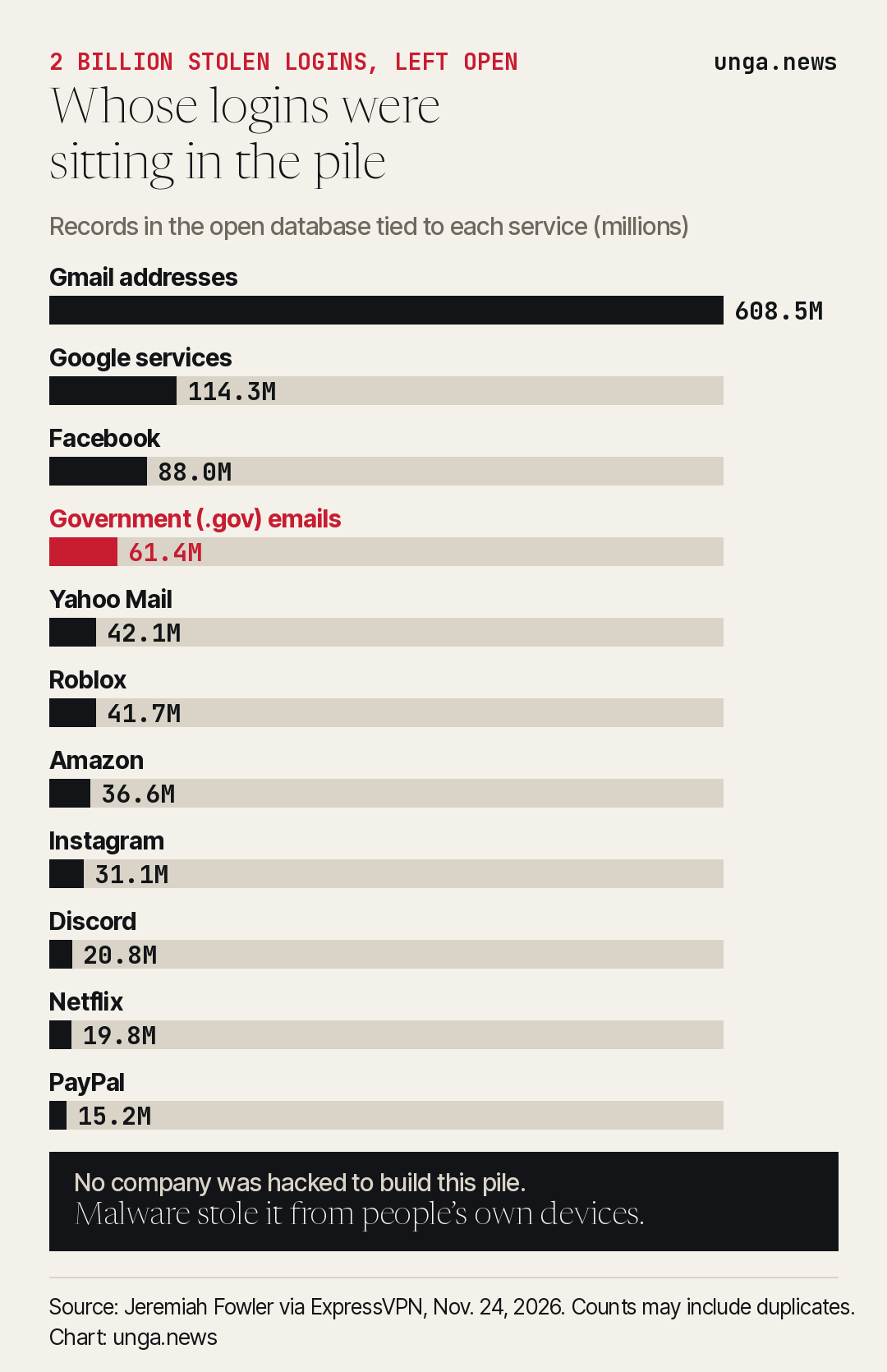
The number that should make Washington sit up is 61.4 million. That’s how many lines Fowler matched to .gov email domains. He also found 46.3 million tied to .edu addresses and 49.9 million to .org. A .gov search can pick up foreign government domains too, and many lines will be repeats. Even so, a stolen work login is a front door. Fowler warns that “compromised business credentials could potentially provide an entry point into a company or organization’s network or cloud environment,” and that “government portals may contain sensitive identity, tax, benefits, or other personal information.”
That lands in a bad month for federal computer security. Hackers have already gotten into a spy agency system, as we reported on the CIA breach, and into the Treasury office that collects banks’ reports on your money. Nobody has tied this database to those attacks. But every stolen government login floating around in a criminal warehouse is one more key someone can try.
Money and kids show up too. The tally includes about 15.2 million PayPal records, 1.7 million Binance records and 1.5 million Coinbase records, plus 41.7 million from Roblox, a game full of children. Fowler also spotted thousands of dark web addresses paired with account names and passwords, which he says is the first time he has seen that many in a credential leak.
Why changing your password isn’t enough
Most people will get this part wrong. The cookies and session tokens in this pile are the reason it’s worse than an old password dump. A session token is what keeps you logged in after you’ve already typed your password and passed the text-message code. Steal the token, and a crook can sometimes walk right past both.
Fowler’s advice is blunt. “Resetting passwords alone will not help if the malware remains active, because it may capture the new ones as soon as they are entered,” he wrote. Clean the device first, with a security scan or even a factory reset if needed. Then, from a clean device, change passwords on the accounts that matter, starting with your main email, since that’s the account that resets everything else. Sign out of every active session, use a different password for every site, and turn on an authenticator app or a security key wherever possible.
He also told people to stay away from browser extensions they don’t recognize, attachments they didn’t expect and links in strange messages. Most infostealer infections start with one careless click.
Big numbers, real caveats
Fowler is careful about his own math. The 2 billion figure “should not be interpreted as representing 2 billion individual victims,” he wrote. One infected computer can hold dozens or hundreds of accounts, and these piles are full of duplicates, expired passwords and records that have been copied and resold. He also allowed that the collection might belong to a legitimate threat-tracking firm or researchers instead of a criminal reseller. There was simply no way to tell.
None of that makes it harmless. Whoever built it went to the trouble of sorting stolen logins by country and by victim, and then left the door wide open. This week, Malwarebytes also reported on a separate unlocked server in China, found by other researchers, holding about 1.64 billion records, including at least 840 million Chinese national ID numbers. The two don’t appear to be connected.
The lesson for regular folks is simple and a little uncomfortable. The biggest risk to your accounts usually isn’t some giant company getting breached. It’s the laptop on your couch, the extension you installed without thinking and the password you’ve used on six sites since 2015. You can fix those today.
Sources
- ExpressVPN (Jeremiah Fowler) — 2 Billion Credentials Exposed in Massive Database Leak (Nov. 24, 2026)
- Malwarebytes — Two exposed databases held over 3.5 billion records
- Hackread — Open database exposed 2 billion credential records, including session tokens
- WIRED — Database Leaks Expose 3.5 Billion Usernames, Passwords, and Documents